Lecture at the 46th Korea Chamber of Commerce Jeju Forum
"Expectations for Growth in the Korean Economy's Middle Stage, Becoming Familiar
Missed the Timing for Restructuring
Now Need Trade Diversification and Restructuring"
Lee Chang-yong, Governor of the Bank of Korea, declared that the era in which the Korean economy enjoyed the ‘China special’ has come to an end. He stated that it is now time to break away from the China-centered, manufacturing-dependent structure and achieve a paradigm shift.
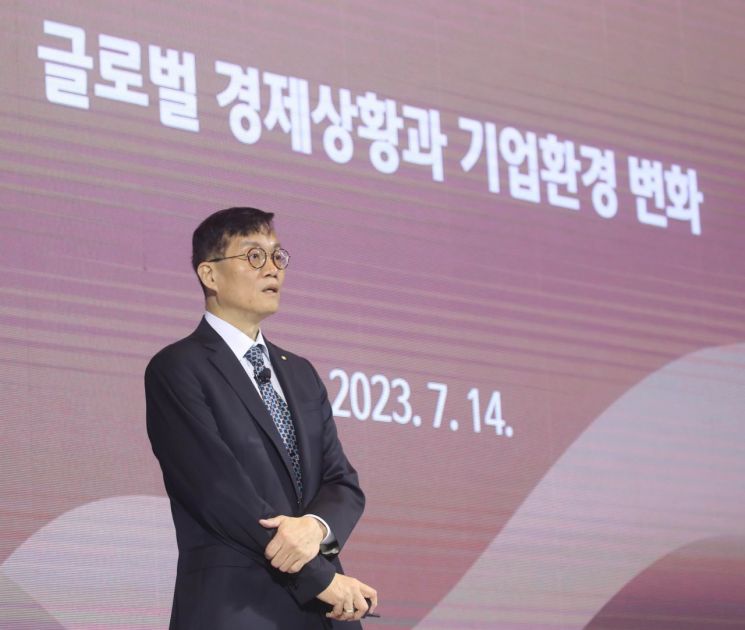 Lee Chang-yong, Governor of the Bank of Korea, is giving a lecture at the '46th Korea Chamber of Commerce and Industry Jeju Forum' held on the 14th at the Haevichi Hotel Resort in Seogwipo, Jeju. Photo by Korea Chamber of Commerce and Industry
Familiarity with the China Special Delayed Industrial Transition... Structural Adjustment Needed Despite Social Resistance
At a lecture held on the 14th at the Haevichi Hotel & Resort in Seogwipo, Jeju, during the ‘46th Korea Chamber of Commerce and Industry Jeju Forum,’ Governor Lee said, "The Korean economy has become too accustomed to the ‘China special,’ which saw significant growth after China joined the WTO (World Trade Organization) in 2001." He added, "When per capita GDP rises above $10,000 to $20,000, the share of manufacturing usually decreases, but Korean companies continued to grow by building factories in China and maintaining manufacturing." He explained that there is a side to this where Korea relied on China and missed the opportunity to foster higher-level industries such as services after manufacturing.
Regarding changes in the trade structure with China, he emphasized the need to respond through diversification. Governor Lee stated, "Our economy earned a large surplus by exporting intermediate goods to China, but now China produces these intermediate goods itself." He stressed, "The decline in exports to China is not only due to the conflict between the U.S. and China. We must now pursue diversification." He also noted that structural adjustments are necessary across industries and all sectors to match the rapidly changing industrial structure.
He further pointed out, "As we move toward climate change and a low-carbon society, we must undergo numerous changes, but our industries are struggling to quickly restructure." Governor Lee added, "In the labor market, temporary unemployment and layoffs may occur during the industrial transition. Social safety nets are needed during unemployment periods, but our society does not seem to have a favorable structure for industrial restructuring. Even if there is social resistance, structural adjustment is necessary, and I believe this will determine our future."
Lee Chang-yong Firmly States, "Do Not Expect Interest Rate Cuts Within This Year"
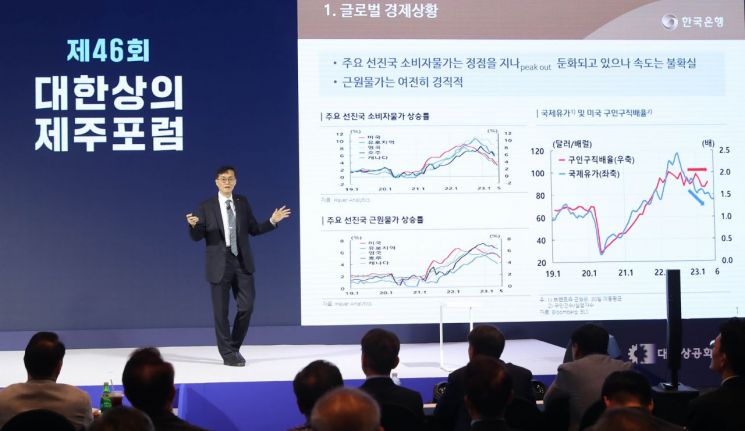 Lee Chang-yong, Governor of the Bank of Korea, is giving a lecture at the "46th Korea Chamber of Commerce and Industry Jeju Forum" held on the 14th at the Haevichi Hotel Resort in Seogwipo, Jeju. Photo by Korea Chamber of Commerce and Industry
Regarding interest rate cuts, he firmly stated, "Do not expect cuts within this year." He explained, "The inflation rate targeted by the Bank of Korea is about 2%, but currently at 2.7%, if we start lowering interest rates, inflation could rise again." He added, "If monetary policy fluctuates, the entire macroeconomic framework will be shaken. That would be dangerous."
He explained the difficulty in lowering interest rates by saying, "Technically, we need to be sure that inflation will sufficiently decrease, so we need to observe." According to Statistics Korea, the consumer price inflation rate for June was 2.7% year-on-year, falling into the 2% range for the first time in 21 months since September 2021. He also said, "The U.S. may raise interest rates twice, so if we lower ours, the gap will widen significantly, raising concerns about what will happen in the foreign exchange market." He cited the ‘household debt issue’ as another reason for the difficulty in lowering rates. Governor Lee said, "Household debt increased over three months. While this is unavoidable in the short term, the large amount of household debt is a significant long-term burden."
Regarding the economic outlook, he said, "The speed is the issue, but I expect a rebound." Earlier, the Bank of Korea lowered its real GDP growth forecast for this year from 1.6% to 1.4% in May. Governor Lee said, "The U.S. and China are the two main pillars of our exports. The U.S. economy seems likely to have a higher growth rate than expected, which is good news for us." He added, "On the other hand, China’s outlook is more uncertain. Growth in the second half of this year or next year could be more uncertain."
He continued, "I think semiconductor prices have nowhere lower to go, and depending on how quickly they rise, growth rates could increase. Although there is uncertainty, I expect about 1.4% growth this year."
After the lecture, in response to an audience question about whether Korea might experience a ‘lost 30 years’ like Japan, Governor Lee said, "Our young people seem more dynamic than those in Japan." He added, "If we can solve the structural adjustment challenges visible to us now, I believe we can escape the low-growth trap without suffering as Japan did."
© The Asia Business Daily(www.asiae.co.kr). All rights reserved.
![Clutching a Stolen Dior Bag, Saying "I Hate Being Poor but Real"... The Grotesque Con of a "Human Knockoff" [Slate]](https://cwcontent.asiae.co.kr/asiaresize/183/2026021902243444107_1771435474.jpg)
















