IBS Reveals Predictive-Sensorimotor Mechanism Through Monkey Experiments
Discovered Principle of 'Smooth Pursuit Eye Movement'
The average pitch speed of Major League Baseball pitchers in the United States easily exceeds 150 km/h. Shohei Ohtani, one of the fastest pitchers, even surpasses 160 km/h. To the human eye, the lightning-fast pitch passes in an instant. Yet, batters manage to hit home runs and singles with remarkable precision. What is the secret behind this? A domestic research team studied the brain mechanisms of monkeys, which are similar to humans, and uncovered the reason. Primates, including humans, can enhance sensorimotor skills through prior prediction. They identified the essence of what athletes refer to as 'dynamic visual acuity.'
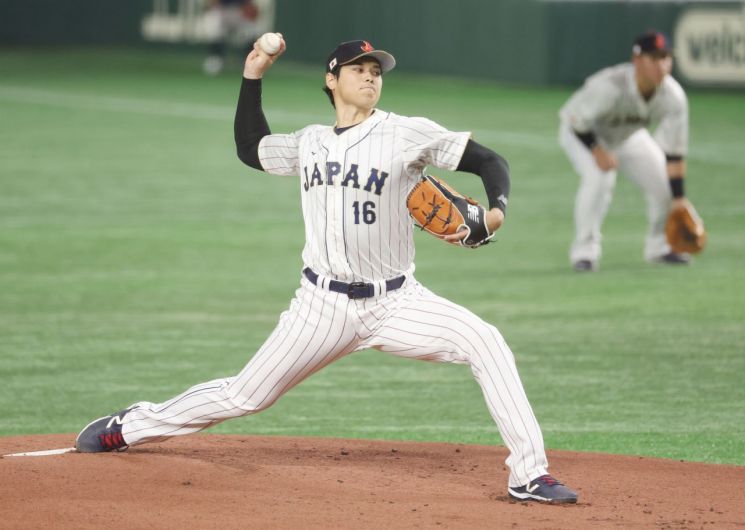 Archive photo. Otani pitching
(Tokyo=Yonhap News) Reporter Shin Junhee = On the 9th, the 2023 WBC Round 1 game between Japan and China was held at Tokyo Dome in Japan.
Japan's Otani is pitching. 2023.3.9
Photo by hama@yna.co.kr
(End)
The Institute for Basic Science (IBS) announced on the 13th that a research team led by Research Fellow Lee Jun-yeol of the Brain Science Imaging Research Group (professor at Sungkyunkwan University) confirmed that prediction based on prior experience knowledge regulates the cerebral cortex sensory areas that process visual information, thereby enhancing sensorimotor abilities. This conclusion was drawn from data obtained through primate behavioral experiments and measurements of neural cell activity.
Animals utilize various sensory information to adapt and survive in their environments. Primates, including humans, primarily rely on visual information obtained through the eyes. Our brain enables appropriate behavior by integrating visual information with predictive information based on past experience, even when visual data is inaccurate or limited. However, it was not yet clear in which brain regions and how this integration and processing occur.
Based on data from primate behavioral experiments and neural activity measurements, the research team revealed that prediction based on prior experience modulates the cerebral cortex sensory areas processing visual information, thereby enhancing sensorimotor abilities. Sensorimotor ability refers to the capacity to respond quickly and accurately to external sensory stimuli. For example, when we track a moving object with our eyes, the brain processes visual information such as the direction and speed of the moving object received by the eyes and controls eye movement accordingly.
During a smooth pursuit eye movement task where rhesus monkeys tracked moving visual stimuli, the researchers measured eye movements and neural activity in the middle temporal visual area (MT) of the cerebral cortex using eye-tracking devices and electrodes. The monkeys were presented with a random dot kinematogram, where dots appeared randomly within a circular area as visual stimuli, and were required to maintain their gaze at the center of the stimulus. The experiments included conditions where high-luminance (easily visible) and low-luminance (less visible) visual stimuli were presented, and where the direction of stimulus movement was either predictable or unpredictable. The research team analyzed the data using computer simulations, machine learning, and neural decoding techniques to mathematically and quantitatively examine how predictive and sensory information are processed in the visual cortex.
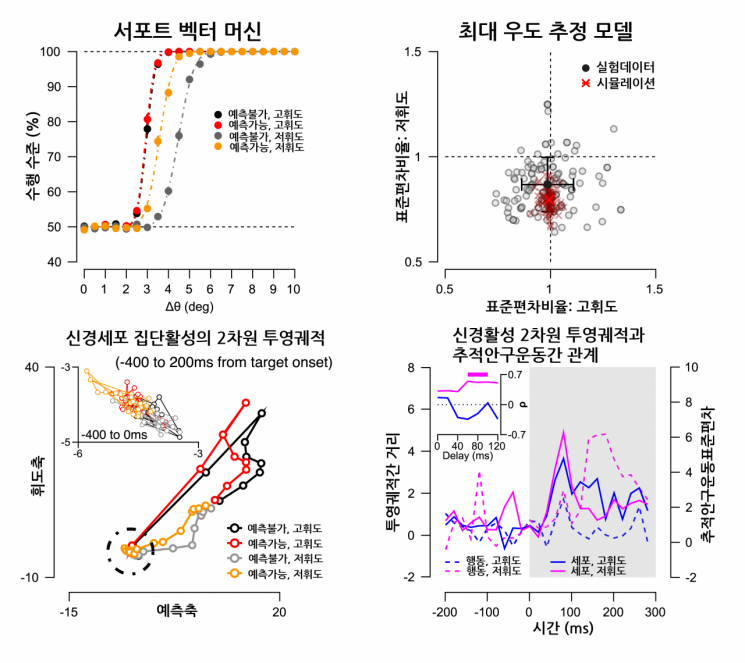 The effect of neural activity modulation in predictive processing on eye-tracking movements. Image source provided by IBS.
Behavioral experiment results showed that when monkeys could predict the movement direction based on prior experience, even if the visual stimulus was not clearly visible, the deviation in smooth pursuit eye movements was small. Conversely, when the movement was unpredictable despite prior experience, the deviation was large. This indicates that when sensory information is uncertain, utilizing prior knowledge improves behavioral precision.
Through data analysis, the research team estimated the stimulus motion direction represented by the neural activity of cells in the middle temporal visual area and compared it with the actual smooth pursuit eye movement direction. They confirmed that the deviation between the estimated direction and the actual eye movement direction was similar. Consistent with the behavioral results, only when the visual stimulus was less visible did prior prediction modulate the direction selectivity of MT cells to better process the pursuit direction of eye movements. This demonstrated that the activation patterns of MT cells can represent predictions about the direction of visual stimuli and that this is related to the precision of eye movements. Previously, it was believed that prediction was performed in the frontal lobe and sensory information was processed in the visual cortex.
Research Fellow Lee stated, “This study revealed that the middle temporal visual cortex is not merely a region that transmits sensory information obtained from the environment as neural signals, but a brain area that can interpret the same sensory information differently based on prior knowledge and prediction to regulate behavior.” He added, “We now understand how the sensory areas of the cerebral cortex can contribute to changes in sensorimotor behavior using prior information. This enhances our understanding of the neural mechanisms of sensorimotor information processing and may aid research on treatments for sensorimotor and cognitive dysfunctions.”
The research findings were published online on the 7th of this month in ‘Science Advances,’ a sister journal of Science.
© The Asia Business Daily(www.asiae.co.kr). All rights reserved.
![Clutching a Stolen Dior Bag, Saying "I Hate Being Poor but Real"... The Grotesque Con of a "Human Knockoff" [Slate]](https://cwcontent.asiae.co.kr/asiaresize/183/2026021902243444107_1771435474.jpg)
















