Online Comments Spread Regardless of Truth
News and SNS·Communities Indiscriminately Spread
Hate and Provocative Expressions for Views
"Malicious Comments Social Cost 35 Trillion Won Annually"
Calls for Introduction of Punitive Damages
The harm caused by malicious comments that slander or belittle others with ill intent is becoming increasingly severe. Some individuals fall into depression or make extreme choices as they are persistently attacked or incited to hatred. Companies have also frequently suffered negative impacts on their external reputation and credibility.
There are studies showing that the socio-economic cost caused by malicious comments exceeds 35 trillion won. This means that society is spending a significant amount equivalent to 1.6% of the Gross Domestic Product (GDP) due to malicious comments. Online comments have long claimed the role of a public forum and emerged as a major channel for shaping public opinion, but as the damage grows, calls for appropriate regulation are emerging.

Comments Target Not Only Celebrities but Also Ordinary People and Companies
Sensational comments spread quickly regardless of their truthfulness. As channels where information circulates have diversified?including online news, community posts, and social networking services (SNS)?there are even more channels through which malicious comments spread as if they were facts. Reckless defamatory comments targeting companies or businesspeople directly lead to social reputation decline, sometimes causing irreparable losses.
In a workplace community, an employee of a company posted a criticism describing their boss as "like patients in the final stage of schizophrenia." The controversial part of the content was a claim that the company's CEO made sexually harassing remarks toward female employees. The company protested, stating that the author posted false information that damaged the company’s image. An investigation revealed that the employee who posted the comment and the CEO worked in completely different buildings and had never met.
There was also a case where a professional agency was caught systematically posting defamatory comments against competitors for payment. In 2019, several comments disparaging a dairy company appeared on an internet parenting information cafe. The comments included claims such as "It tastes like iron powder" and "There is a nuclear power plant near the farm, so there is an impact from radioactive leakage." The victim company requested a police investigation. It was revealed that a competitor created 50 IDs through a promotional agency to post defamatory comments.
 (Photo by Getty Images Bank)
Malicious comments used to target celebrities or sports stars but now even ordinary people cannot avoid them. In December last year, a teenage survivor who lost a friend in the Itaewon tragedy was found dead at a lodging facility in Mapo-gu, Seoul. It is presumed that malicious comments significantly influenced the extreme choice. The bereaved family said the survivor felt sorry for being the only one who survived and seemed to have collapsed after seeing comments that appeared to blame the deceased friend.
A university student who raised issues against the noisy protest organizers at school was also criticized through comments. The student requested the organizers to reduce noise for a month, but there was no change, so they reported it to the police. As the dispute became known as a confrontation between powerless workers and prestigious university students, malicious comments poured in toward the student. During the stalking murder case of a station worker at Sindang Station in September last year, comment controversies also arose. The victim’s family said they were mentally distressed by comments such as "Why would a ‘Hannyeo’ die for any reason?"
Portals Struggle with Comments, Use AI and Operate Only for One Day
Portal companies like Naver and Kakao are deeply concerned about malicious comments. Since they operate news services considered the source of the problem, they cannot simply ignore or completely block comments. This is because the time users spend on the portal while writing or reading comments could decrease. There is also a risk of backlash for blocking or interfering with public opinion.
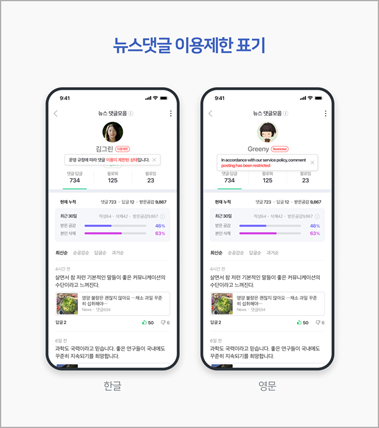
The desperate measure they adopted is artificial intelligence (AI). AI assesses whether comments are appropriate. They also changed how comments are viewed. Since last month, Naver has revised its news comment board operation policy to restrict comment use and display the status on the author’s profile if they post rule-violating comments. Previously, only the user knew about the restriction. This is a kind of "malicious commenter label." The procedure to lift the restriction was also made more stringent. Previously, restrictions were automatically lifted after a set time such as 1 day, 7 days, or 30 days. Under the new policy, additional steps such as solving quizzes related to comment use are required. If these are not completed, the restriction period is extended.
Kakao’s search portal Daum completely changed the comment window to resemble a chat room. They introduced "Time Talk," where comments can be made like chat messages only for a limited time. The comment window operates only for one day after the article is published, and comments disappear after a day. To post or view comments, users must click the Time Talk icon at the top of the article and go through several steps to participate. Previously, some comments could be viewed by recommendation order or latest order, but in Time Talk, comments are viewed sequentially like real-time chat. This prevents the side effect of certain first or malicious comments being excessively prominent in traditional comment sections.
Annual Damage of 35 Trillion Won... "Effectiveness Must Be Increased"
Damage caused by comments also results in economic losses. According to a survey conducted last year by Yonsei University’s Barun ICT Research Center, the socio-economic cost caused by malicious comments reaches 35.348 trillion won annually. Legal fees for hiring lawyers or compensation costs amount to about 3.5 trillion won. Medical expenses for victims’ hospital visits and treatments also reach 55 billion won.
A business official said, "Even if it is an absurd falsehood, once it spreads on the internet, it disrupts normal business activities," adding, "Only 1% of internet news users write comments, but the social cost caused by comments alone reached 1.6% of the GDP last year."

If caught posting malicious comments, one can be punished under criminal law with imprisonment or detention of up to one year or a fine of up to 200,000 won for defamation. If cyber defamation under the Information and Communications Network Act is recognized, imprisonment of up to three years or a fine of up to 30 million won is possible. However, even if charges are acknowledged, most cases result only in fines. There are virtually no punishments for simple one-time malicious comments. Even if false, if there is no intent to defame or if public interest is recognized, a guilty verdict can be avoided.
Since the 21st National Assembly, bills have been proposed to increase the punishment level for malicious comment writers or to create separate laws, but none have passed the plenary session yet. They have repeatedly been blocked due to concerns about weakening freedom of expression. There is growing support for introducing punitive damages as a civil remedy. The logic is that it can simultaneously protect victims and prevent recurrence.
© The Asia Business Daily(www.asiae.co.kr). All rights reserved.
![Clutching a Stolen Dior Bag, Saying "I Hate Being Poor but Real"... The Grotesque Con of a "Human Knockoff" [Slate]](https://cwcontent.asiae.co.kr/asiaresize/183/2026021902243444107_1771435474.jpg)
















