Agricultural and Livestock Product Prices Down 0.8% Last Month
Concerns Over Production Decline Due to Heatwaves and Heavy Rainfall
Last month, the consumer price index for agricultural and livestock products fell by 0.8% compared to the same month last year, showing a downward stabilization trend. However, the government plans to implement supply stabilization measures such as expanding stockpiling and contract farming, as well as imports, while monitoring supply and demand situations by item in preparation for potential price increases due to adverse weather conditions like summer heatwaves and heavy rains.
According to the Ministry of Agriculture, Food and Rural Affairs on the 9th, the consumer price index for agricultural and livestock products in June fell by 0.8% compared to the same month last year.
Kim Jeong-hee, Director of the Food Policy Bureau at the Ministry of Agriculture, Food and Rural Affairs, stated, "Prices of agricultural and livestock products are generally stable, but adverse weather conditions such as summer heatwaves and heavy rains are variables." According to the climate outlook for July to September announced by the Korea Meteorological Administration on the 23rd of last month, the probability that this summer’s temperature will be higher than average is between 56% and 63%, and the probability that precipitation will be higher than average is between 39% and 47%.
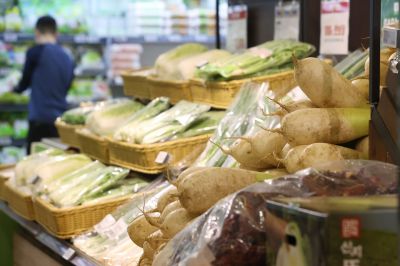
The Ministry of Agriculture, Food and Rural Affairs plans to check supply and demand situations by item daily and implement supply stabilization measures such as expanding stockpiling and contract farming, strengthening growth inspections, and import measures in preparation for adverse summer weather. It will also continue to promote discount support to ease consumer burdens. Along with item-specific supply and demand measures, the government is directly reducing consumers’ price burdens by selecting high-priced items weekly and providing a 20% discount (30% at traditional markets) up to 10,000 KRW per person. The discount items from the 6th to the 12th are onions and cabbage. Discounts are available through various distribution channels including large and small supermarkets, local agricultural cooperatives (Hanaro Mart), local agricultural product direct stores (local food), traditional markets, and online malls.
For agricultural products, some vegetable prices have been strong in late June due to the rainy season, but overall supply has expanded, maintaining stability. The production volume of open-field spring cabbage increased by 20.0% compared to last year, resulting in lower wholesale prices in June than the previous year. Although the shipment area for July and August is expected to be 11% less than average, the demand for summer cabbage from large-scale buyers is expected to decrease due to increased spring cabbage storage, so the price increase is expected to be relatively small. However, if growth disorders occur due to high temperature and humidity, production volume may significantly decrease. In case prices rise due to this, the government plans to actively release 10,000 tons of stockpiled open-field spring cabbage.
In the case of onions, the wholesale price in late June was 1,222 KRW per kilogram, higher than the average. The government is supplying imported onions (6,300 tons) to wholesale markets through auctions and public sales (about 100 tons per day) to expand supply in June. It plans to stockpile 6,000 tons in preparation for demand during holidays and kimchi-making season and will also consider import measures to resolve supply shortages in the second half of the year.
Facility-grown vegetables have been rising since the start of the rainy season in late June. July is a period when production of facility-grown vegetables decreases due to the rainy season and hot weather. With the arrival of full summer, the Ministry of Agriculture, Food and Rural Affairs will closely monitor crop conditions and shipment trends in production areas and, together with the Agricultural Cooperative and Rural Development Administration, plans to expand technical guidance on summer crop management to ensure stable production of facility-grown vegetables.
© The Asia Business Daily(www.asiae.co.kr). All rights reserved.
![Clutching a Stolen Dior Bag, Saying "I Hate Being Poor but Real"... The Grotesque Con of a "Human Knockoff" [Slate]](https://cwcontent.asiae.co.kr/asiaresize/183/2026021902243444107_1771435474.jpg)
















