'Telecommunication Fees and Consumer Welfare Forum' Held
High Device Prices Contribute to Increased Household Communication Costs
Competition Should Be Activated to Induce Fee Reduction
A claim has been made that a plan priced below 20GB should be launched to match the actual usage of 90% of 5G subscribers.
On the 7th, Hwang Unha and Lee Jungmoon, members of the Democratic Party of Korea, co-hosted the 'Telecommunication Fees and Consumer Welfare Forum' at the National Assembly Members' Office Building.
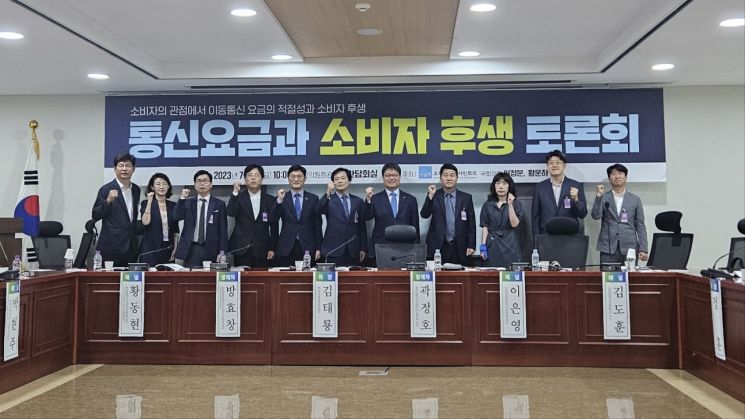 Participants at the "Telecommunication Fees and Consumer Welfare Forum" held on the 7th at the National Assembly Members' Office Building are taking a commemorative photo.
 [Photo by Oh Su-yeon]
To diversify plans and reduce household communication expenses, the government and the three major telecom companies launched a second intermediate 5G plan and introduced youth and senior plans. However, despite these efforts, there are still criticisms that the perceived reduction in communication costs by users is insufficient.
At the forum, Professor Bang Hyochang of Doowon Technical University’s Department of Smart IT (Chairman of the Information and Communication Committee of the Citizens' Coalition for Economic Justice) presented on "Appropriateness of Mobile Communication Fees and Consumer Welfare from the Consumer's Perspective." Professor Bang said, "The top 10% of 5G subscribers use 38.3% of the total traffic. The average 5G subscriber traffic is 28.8GB per month, but 90% of subscribers only use an average of 18.8GB per month," adding, "Various plans are needed in the segment below 20GB." He also pointed out, "The additional intermediate 5G plans are segmented for heavy users, so they are limited in satisfying diverse users."
Regarding LTE plans, he said, "There is an excessively large variance in unit rates, so the monthly fee for subscribers receiving 1.5GB or 2.5GB should be lowered to less than half." He also stated, "Household communication expenses include communication services and device prices, and the recent increase in device prices is a major factor in the rise of household communication costs."
Lee Eunyoung, representative of the Citizens' Coalition for Consumer Rights, said, "Since 90% of 5G subscribers have an average monthly traffic of 20GB or less, the lack of segmentation in this area means that although there are many plans, there are no plans that consumers can actually use," adding, "Plans that consumers can truly benefit from must be created."
Next, Professor Kwak Jungho of Hoseo University’s Department of Big Data AI presented on "Competition in the Telecommunications Market and the Appropriateness of Communication Fees." Professor Kwak also mentioned that while communication service costs within household communication expenses continue to decrease, device purchase costs are rising. In 2011, when LTE was commercialized, 2,613 KRW was spent on communication equipment and 140,444 KRW on communication services, but in 2022, 28,250 KRW was spent on communication equipment and 99,439 KRW on communication services.
Professor Kwak said, "To protect consumer rights related to communication fees, the essential solution is to activate competition," adding, "Rather than direct intervention, efforts should focus on inducing price competition, taking a comprehensive approach from the perspective of household communication expenses, and strengthening support for marginalized groups."
Professor Kim Dohun of Kyung Hee University’s Department of Business Administration said, "To create a healthy virtuous cycle between the market and the supply ecosystem, policy efforts should focus on establishing a foundation for competition," adding, "It is desirable for policy authorities to focus their intervention on vulnerable groups in the blind spots of information and communication services while inducing voluntary price reductions and differentiation among the three major telecom companies through competition activation."
Yoon Sangpil, Director of External Cooperation at the Korea Telecommunications Operators Association, said, "Excessive demands for fee reductions cause investment contraction and weaken the competitiveness of the information and communication technology (ICT) industry," adding, "It is preferable to induce fee reductions through market principles and competition promotion rather than by artificial enforcement."
© The Asia Business Daily(www.asiae.co.kr). All rights reserved.
![Clutching a Stolen Dior Bag, Saying "I Hate Being Poor but Real"... The Grotesque Con of a "Human Knockoff" [Slate]](https://cwcontent.asiae.co.kr/asiaresize/183/2026021902243444107_1771435474.jpg)
















