Disclosure of Inter-Korean Talks Documents Before and After the July 4 Joint Statement
Amid D?tente Atmosphere... South and North Korea Agree on First Unification
Yi Hu-rang, Chief of Central Intelligence Agency, Secretly Travels Between Seoul and Pyongyang
Kim Il-sung: "Apology for Kim Shin-jo Incident, Yi Hu-rang a National Hero"
At 10 a.m. on July 4, 1972, a joint statement was simultaneously announced in Seoul and Pyongyang. This was the '7·4 Joint Statement,' the first agreement between South and North Korea on 'unification' after the Korean Peninsula was divided. Both sides established three major principles: independence, peace, and great national unity, and promised to hold Red Cross talks for the reunion of separated families. The permanent direct telephone line between South and North was also officially installed at this time. The opening line of the news reporting this historic event was: "The path of dialogue between South and North, which had been blocked for half a century, has begun to open."
At the tail end of the Cold War, the 7·4 Joint Statement, buoyed by the international d?tente atmosphere, attracted worldwide attention. For the first time, expectations for 'unification' arose on the Korean Peninsula. It was also a period when the national power of North Korea, which was at its peak in the 1970s, and South Korea, which achieved rapid economic growth under the Park Chung-hee regime, were at their most comparable levels. The fundamental principle of 'renouncing the use of force' was also established at this time. Since it was a declaration from the Park Chung-hee regime, this principle has not been denied by the conservative camp and is recognized even by progressive forces.
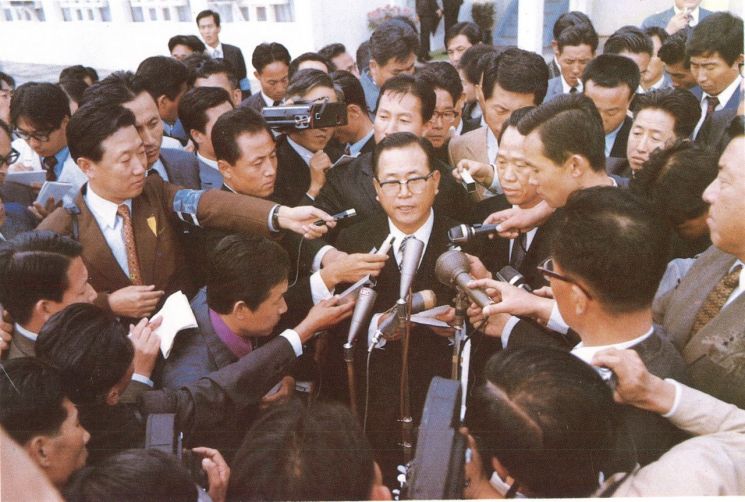 October 12, 1972, Director of the Central Intelligence Agency Lee Hu-rak answering reporters' questions at Panmunjom after the 1st Joint Chairman Meeting of the Inter-Korean Control Committee.
 [Photo by Ministry of Unification]
The Ministry of Unification disclosed on the 6th a political document on inter-Korean talks (1,678 pages) containing this content. Before the South-North Joint Statement on unification was first issued, high-ranking officials from both sides secretly traveled between Seoul and Pyongyang to continue negotiations. Behind the scenes, there was also a meeting between Central Intelligence Agency Director Lee Hu-rak and North Korean Premier Kim Il-sung, but this was not included in the disclosed materials.
Although the content of the meeting itself remains confidential, some of Kim Il-sung's remarks are indirectly confirmed through Lee Hu-rak's words during the inter-Korean talks. It is said that Kim Il-sung met secretly with Lee Hu-rak in May 1972, apologized directly for the January 21 Incident, and promised that there would never again be a fratricidal tragedy like the Korean War. The January 21 Incident, well known as the 'Kim Shin-jo Incident,' involved 31 armed guerrillas from the 124th Army Unit of North Korea's Ministry of National Security's Reconnaissance Bureau infiltrating Seoul on January 21, 1968, with the aim of raiding the Blue House.
After the 7·4 Joint Statement was announced, Lee Hu-rak said at the joint chairman meeting of the South-North Coordination Committee held in Pyongyang in November 1972, "I remember when Premier (Kim Il-sung) scolded the leftist fanatic agitators," and "He mentioned that issue again when we met individually today." Here, the 'leftist fanatic agitators' referred to the January 21 Incident for which Kim Il-sung apologized.
One month before this mention, at a meeting held at the Freedom House in Panmunjom in October 1972, the document records Kim Il-sung's remarks about the Korean War. At that time, Lee Hu-rak said, "When I met Premier Kim Il-sung last time, he clearly said that there would never be another war like the Korean War, so please convey that to President Park."
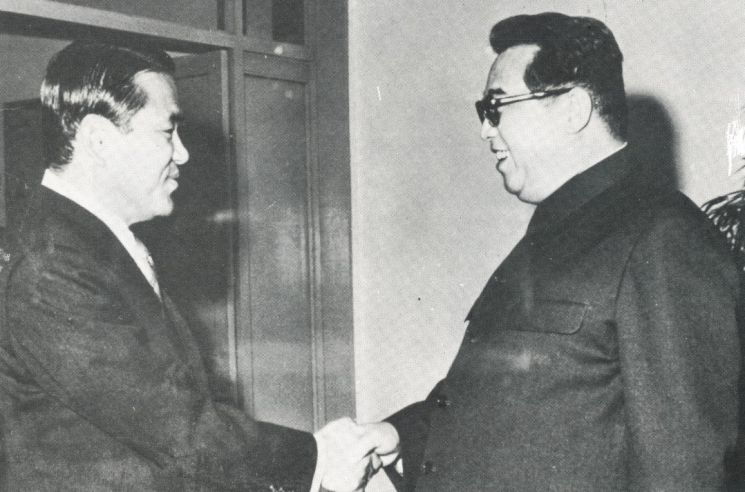 After meeting Kim Il-sung, Premier of North Korea, in Pyongyang in May 1972, Lee Hu-rak, Director of the Central Intelligence Agency. [Photo provided by the Ministry of Unification]
There is also confirmation of an anecdote that Kim Il-sung praised Lee Hu-rak as a 'hero.' After North Korea's unilateral declaration to suspend talks in August 1973, Lee Hu-rak revealed in a press conference, "When I went to Pyongyang, Kim Il-sung told me three or four times, 'Director, you are a hero of the nation, a hero'."
From the documents of the talks, this anecdote can also be glimpsed through the words of Kim Ju-young, the North Korean co-chairman of the South-North Coordination Committee and Kim Il-sung's younger brother, who was head of the Workers' Party Organization and Guidance Department. Kim Ju-young told Lee Hu-rak, who visited Pyongyang in May 1972, "The door that had been closed for 27 years was opened by Director Lee Hu-rak, so Kim Il-sung called you a brave man and a hero."
In addition, various titles for Kim Il-sung appear in the talks documents. In the early stages of South-North contact, North Korean officials such as Kim Young-ju referred to Kim Il-sung simply as 'Comrade General Secretary' several times. However, they generally used the title 'Suryong' (Leader) for North Korean representatives. In North Korea, the position of President was established with the adoption of the Socialist Constitution in 1972, and in the South, Kim Il-sung was mainly called 'Premier' during the talks.
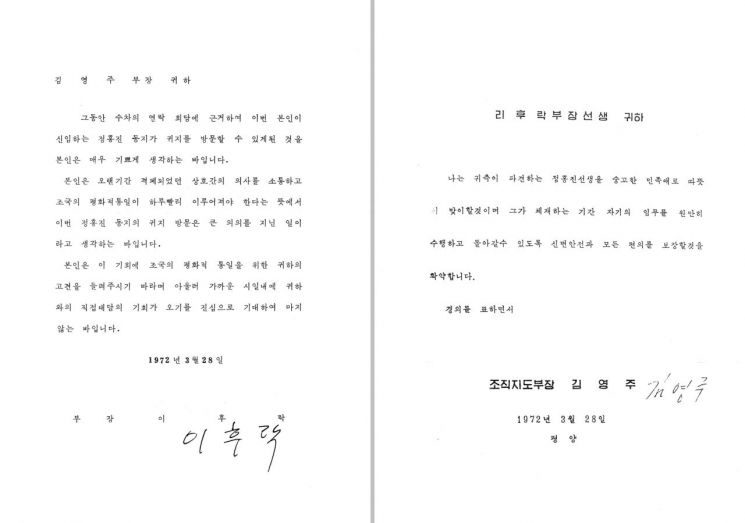 Documents exchanged secretly between Lee Hu-rak, Director of the Central Intelligence Agency, and Kim Young-ju, Director of the Workers' Party Organization and Guidance Department, to travel back and forth between Seoul and Pyongyang.
 [Photo provided by the Ministry of Unification]
Meanwhile, the government had previously disclosed materials twice in May and December of last year. The contents of the meetings between Lee Hu-rak and Kim Il-sung, and the conversations between President Park Chung-hee and North Korean Second Vice Premier Pak Song-chol, which were not disclosed this time, are expected to be reconsidered for release in 2026. The review of inter-Korean talks document disclosure is conducted every three years.
© The Asia Business Daily(www.asiae.co.kr). All rights reserved.
![Clutching a Stolen Dior Bag, Saying "I Hate Being Poor but Real"... The Grotesque Con of a "Human Knockoff" [Slate]](https://cwcontent.asiae.co.kr/asiaresize/183/2026021902243444107_1771435474.jpg)

















