Increased Investment Opportunities in Innovative Companies for Individuals, Expected Revitalization of Venture Market
Related Bills Pending in National Assembly for One Year Due to Opposition Party
"Insufficient Investor Protection" vs "Resolvable with Current System"
The amendment to the Capital Markets Act introducing Business Development Companies (BDC) is on the verge of being stalled at the National Assembly. It has not even been properly discussed as it has failed to be placed on the agenda of the National Assembly's Political Affairs Committee's bill subcommittee, overshadowed by other bills. Moreover, the opposition party strongly opposes the bill, making its passage in this session uncertain. The bill has been pending in the National Assembly for over a year since its proposal in May last year.
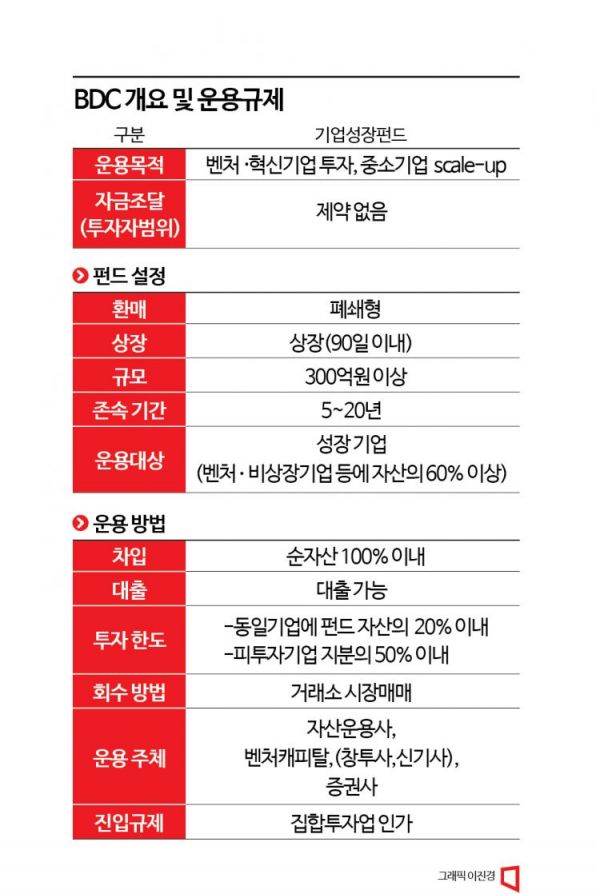
BDC-related Bill Pending in the National Assembly for One Year
According to the financial investment industry, discussions on BDC were still not held at the Political Affairs Committee's bill subcommittee on the 4th. The agenda is set by agreement between the ruling and opposition party floor leaders, but on this day, the bill was pushed aside by other bills and was not even placed on the agenda. On the 27th of last month, there was hope that the bill would be discussed as it was scheduled for the subcommittee, but it was again overshadowed by other bills and no meaningful discussion took place.
BDC is a public offering fund that invests intensively in venture and innovative companies and enhances liquidity through listing. Simply put, it provides a means for individual investors to indirectly invest in venture and innovative companies within the institutional framework. BDCs, formed with private capital, must invest at least 60% of their assets in equity securities (bonds and stocks) of venture and innovative companies, and 10% in safe assets such as government bonds and monetary stabilization bonds. It is a closed-end fund with no early redemption allowed and a duration of at least five years. However, since it is listed on the stock exchange like an Exchange-Traded Fund (ETF), investors needing urgent liquidity can cash out by selling shares. The operators are licensed securities firms, asset management companies, and venture capital (VC) firms.
If more funds are needed, capital can be raised through borrowing within 100% of net assets. Companies concerned about dilution of equity can receive loans (up to 40%) through BDCs. For example, if a fund gathers 10 billion KRW, 6 billion KRW must be invested in venture and innovative companies, of which up to 40%, or 2.5 billion KRW, can be used as corporate loans. While returns on equity securities are calculated based on price fluctuations, interest generated from loans is reflected as income. A Financial Services Commission official explained, “The significance lies in preventing equity dilution through venture debt and protecting management rights,” adding, “It is a system that can invigorate the venture market.”
The Financial Services Commission views BDCs as providing individuals with opportunities to invest in unlisted venture and innovative companies and revitalizing the venture market, which has been frozen by high interest rates. The introduction of the BDC system was included in this year’s major work report, showing the Commission’s dedication to passing the bill. The financial investment industry, centered on securities firms, and the venture industry are urging the National Assembly to promptly pass the BDC introduction bill, arguing that it can activate the venture investment ecosystem by attracting large-scale private capital.
However, the National Assembly’s perspective is quite different. The opposition members of the Political Affairs Committee see the bill as having many areas that need revision. A National Assembly official said, “Usually, unanimous agreement is required in the Political Affairs Committee’s bill subcommittee for a bill to pass, but since there are opposing views, the passage process will not proceed smoothly.” Furthermore, since the opposition unilaterally pushed through the 'Democratic Merit Law' in the last bill subcommittee, escalating conflicts between the ruling and opposition parties, there are opinions that the Political Affairs Committee’s bill subcommittee may not function properly until around July or August.
Office of Representative Lee Yong-woo: “Many Gaps in Operators and Risk Management”
The office of Representative Lee Yong-woo has been a prominent opponent of the BDC-related bill. The ultimate reason is that there are many gaps in investor protection measures such as operators and risk management. The domestic BDC system is largely derived from the U.S. BDC system and the U.K.’s Venture Capital Trust (VCT) system, but the current government bill is criticized for attempting to pass the bill without detailed operational regulations like those in other countries.
First, it is pointed out that there is no system to prevent conflicts of interest among operators. Securities firms that have traditionally invested in unlisted companies through proprietary investment (PI) could form BDCs and incorporate companies they previously invested in at prices higher than their held value. If they raise the company’s value and exit by selling existing shares at a high price, the damage would inevitably fall on individual investors. It is also criticized that although the system allows borrowing for loans to newly established venture and innovative companies, which are difficult to invest in, there is insufficient content on risk management.
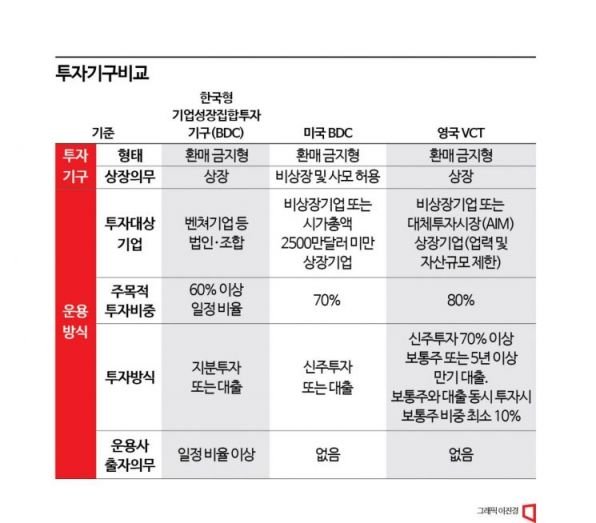
Looking at the U.S. BDCs, a large portion of loans is made to small and medium-sized enterprises through borrowing. After the 2008 Lehman Brothers crisis, small banks stopped lending to smaller companies, and BDCs took over this role. As a result, about 80% of total assets consist of loan bonds. This structure resembles a relatively stable high-yield bond fund rather than stocks. In contrast, the U.K. focuses more on equity investment than loans. Although VCTs are not prohibited from corporate lending, strict operational regulations effectively encourage equity investment over loans.
The office of Representative Lee Yong-woo stated, “If both borrowing and lending are allowed, BDCs will operate with a large proportion of bonds like in the U.S., or strict operational regulations like in the U.K. must be implemented to protect investors, but such aspects are completely absent in the government’s proposal,” adding, “If conflicts of interest arise, a large number of unspecified individual investors who invested in the fund could suffer losses.”
On the other hand, the Financial Services Commission maintains that there is no problem protecting investors under the current system. A triple verification mechanism (Collective Investment Asset Valuation Committee → Trust Company → Audit) is already in place to ensure fair valuation of unlisted assets, and operators (securities firms, asset managers, VCs) are required to invest at least 5% of the total fund shares (150 million KRW out of 30 billion KRW) to align their interests with investors. Additionally, companies receiving more than 10% of total assets must disclose major management matters, and operational regulations applicable to public offering funds also apply.
Some argue that it is unnecessary to view the system rigidly for its establishment. Park Yong-rin, a research fellow at the Korea Capital Market Institute, said, “U.S. BDCs developed their current form by playing the role of bank lending, but some also invest in equity and lend through borrowing,” adding, “While it is important to strengthen investor protection, opening borrowing during the establishment phase is necessary to increase investment incentives.” He further explained, “The venture market is an area that needs nurturing going forward, and since investors can share in the benefits, a flexible approach is required.”
© The Asia Business Daily(www.asiae.co.kr). All rights reserved.
![Clutching a Stolen Dior Bag, Saying "I Hate Being Poor but Real"... The Grotesque Con of a "Human Knockoff" [Slate]](https://cwcontent.asiae.co.kr/asiaresize/183/2026021902243444107_1771435474.jpg)

















