Large Buddhist Offering Items, 54 Pieces, Unearthed in a Large Iron Cauldron
Artifacts from 'Yeongmyosa' Found, Suggesting Heungnyunsa Site May Be Yeongmyosa Site
Near the site of Heungnyunsa, known as the first temple of Silla, a large number of artifacts including roof tile fragments inscribed with ‘Yeongmyosa (靈廟寺)’ and iron cauldrons from the Goryeo period Buddhist offerings have been unearthed.
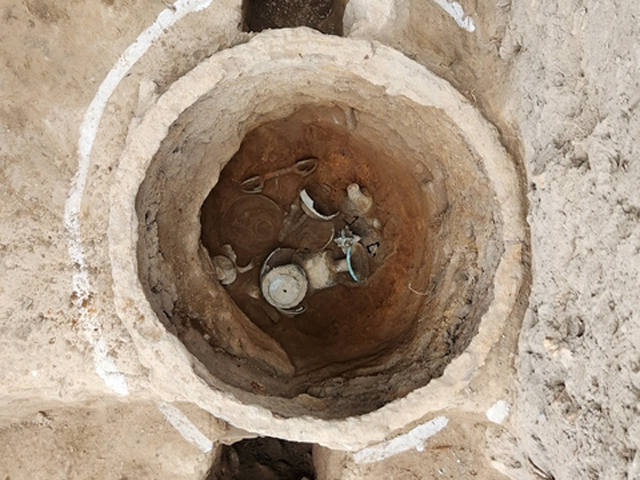
According to the Cultural Heritage Administration on the 5th, remains of buildings, walls, and wells from the Unified Silla to Goryeo periods were confirmed about 22 meters west of Heungnyunsa.
Last month, during excavation work for sewage pipe installation conducted by Gyeongju City and the Chunchoo Cultural Heritage Research Institute, building sites, wall remains, and wells presumed to be related to a temple were discovered. Inside a large iron cauldron measuring approximately 65 cm in diameter and 62 cm in height, 54 bronze Buddhist offering artifacts including incense burners, candlesticks, and vajras (a Buddhist ritual tool shaped like a club) were found together.
Currently, 54 artifacts have been confirmed, and some are still attached to the bottom of the cauldron. With 1 to 2 years of preservation treatment and further investigation, there is a possibility that additional artifacts will be uncovered.
The Cultural Heritage Administration estimates that these artifacts were hurriedly gathered and buried underground as a form of emergency storage (退藏) to protect them from Mongol invasions, fires, or accidents.
Furthermore, although Heungnyunsa is designated as the historic site ‘Gyeongju Heungnyunsa Site (興輪寺址),’ the repeated discovery of roof tiles inscribed with ‘Yeongmyosa’ nearby?found five times previously?supports the opinion that the site designated as Heungnyunsa during the Japanese colonial period may actually be the site of Yeongmyosa.
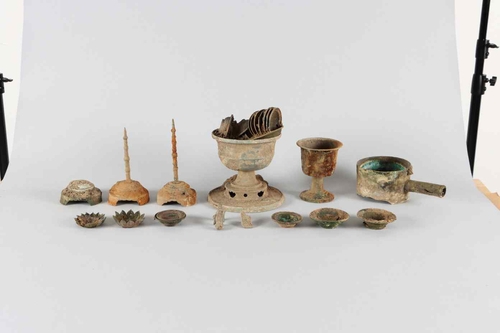
Previously, bronze artifacts have been found at sites such as Malheulli in Changnyeong, Gyeongnam, Ingaksa Temple Site in Gunwi, Gyeongbuk, Dobong Seowon (Yeongguksa Temple Site) in Seoul, Sanoe Temple Site (Musimcheon Riverside) in Cheongju, Chungbuk, and Mangdeoksa and Gulbulsa Temple Sites in Gyeongju.
However, this is the first time such a large-scale collection of artifacts has been excavated. It is expected to become an important resource for future related research.
Meanwhile, the Buddhist offering artifacts from the Dongchong burial mound at the Cheongju Uncheong-dong Temple Site and the Yeongguksa Temple Site in Seoul are currently designated as national treasures.
© The Asia Business Daily(www.asiae.co.kr). All rights reserved.
![Clutching a Stolen Dior Bag, Saying "I Hate Being Poor but Real"... The Grotesque Con of a "Human Knockoff" [Slate]](https://cwcontent.asiae.co.kr/asiaresize/183/2026021902243444107_1771435474.jpg)
















