KT and Bundang Seoul National University Hospital announced that they have completed the establishment of a ‘hospital medical service (5G convergence service)’ based on the ‘Eum 5G (5G specialized network)’ at Bundang Seoul National University Hospital.
The 5G convergence service established at Bundang Seoul National University Hospital was promoted with three goals: improving hospital work efficiency, enhancing medical capabilities, and strengthening patient safety and convenience. The KT and Bundang Seoul National University Hospital consortium was selected last year as the project operator in the ‘public healthcare’ sector of the Ministry of Science and ICT’s 5G convergence service project and has been advancing this project.
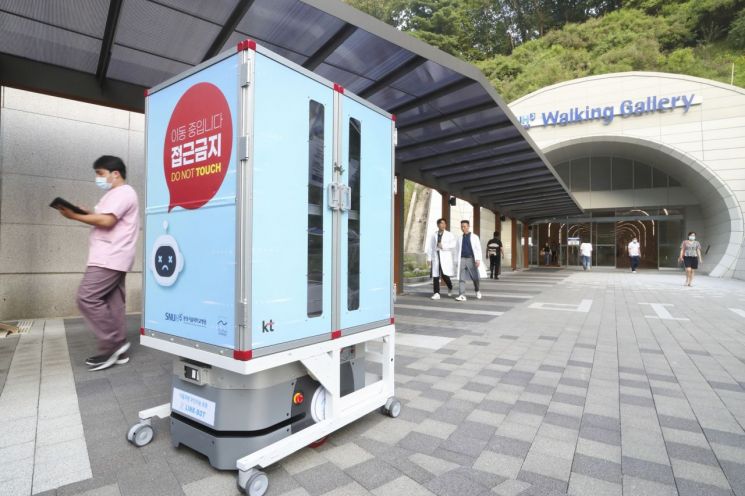 A 'automated transport robot' based on a 5G private network carrying items needed for patient surgery is moving from Bundang Seoul National University Hospital Healthcare Innovation Park to the main building. Photo by KT
After being selected as the project operator, the consortium built a 5G specialized network based on 26 base stations within the hospital over about one year, and is currently applying the convergence service to the medical field to stabilize the service. KT supports the stable operation of the 5G specialized network and the 5G convergence service utilizing it, while Bundang Seoul National University Hospital uses the established 5G convergence service to provide a higher level of medical service.
The 5G specialized network features uninterrupted service through artificial intelligence (AI) fault handling, which analyzes causes and automatically takes action in case of emergency faults. It also automatically detects when new equipment is introduced or expanded, allowing monitoring without additional work. This convenience enables even non-telecommunication experts to easily operate the network.
The 5G convergence service includes ‘autonomous mobile robots,’ ‘remote 3D medical education,’ and ‘autonomous wheelchairs.’ Among these, the ‘autonomous mobile robot (AMR)’ automatically transports medical materials, medicines, linens (patient clothes, bed sheets, blankets, etc.), and other items necessary for surgery and treatment. The items come from the Healthcare Innovation Park, located about 300 meters in a straight line from the main building of Bundang Seoul National University Hospital. The hospital has established an unmanned transport system using six AMRs in the ‘Walking Gallery,’ a tunnel connecting the two buildings.
Previously, outsourced companies transported items between the two buildings, which are 1.5 km apart, by vehicle. Pulling heavy carts from the loading dock to the wards was done manually. Now, once items are loaded onto the carts, the heavy carts are moved by AMRs during early morning hours. This avoids congested daytime hours and minimizes overlapping routes with patients. It improves the accuracy of arrival times for each item and enhances patient safety. It also reduces infection risks.
‘Remote 3D medical education’ is a non-face-to-face medical education service linked with smart operating rooms to strengthen medical staff capabilities. It integrates glasses-free 3D surgical education using 5G specialized network streaming to improve the practical training environment for medical personnel. Bundang Seoul National University Hospital has opened a ‘Smart Simulation Center’ that provides simulation-based training in an environment identical to an actual hospital and offers educational programs to enhance medical staff proficiency.
The remote 3D medical education is characterized by sharing the same time and same three-dimensional video between the surgeon and trainees, enhancing the educational effect. Trainees can vividly observe the surgical site in real time while securing their field of view more easily. In particular, it implements a glasses-free 3D display instead of observation through microscope eyepieces, reducing fatigue and discomfort for trainees.
The ‘autonomous wheelchair’ service was established to enhance the safety and convenience of wheelchair-using patients. The most common safety accident involving hospital wheelchairs is falls caused by the wheelchair sliding backward when getting on or off. The autonomous wheelchair is equipped with an automatic braking function that prevents the wheelchair from sliding backward when patients get on or off. It is expected to reduce management efforts for collection as well. Using the 5G specialized network, the location, status, and battery level of autonomous wheelchairs can be monitored, and a function to automatically retrieve used wheelchairs to storage can be applied. The automatic retrieval function will be implemented after the technology stabilization phase.
Song Jeong-han, director of Bundang Seoul National University Hospital, stated, “Based on the system established through the consortium with KT, we will focus our capabilities to provide patients with a higher level of medical service.”
Jung Jeong-su, Executive Vice President of KT Gangnam Western Metropolitan Headquarters, said, “KT is a leading operator integrating 5G-based services into the medical industry. Going forward, we will support the stable operation of the 5G specialized network and continuously expand services tailored to customer needs in both public and private healthcare sectors.”
© The Asia Business Daily(www.asiae.co.kr). All rights reserved.
![Clutching a Stolen Dior Bag, Saying "I Hate Being Poor but Real"... The Grotesque Con of a "Human Knockoff" [Slate]](https://cwcontent.asiae.co.kr/asiaresize/183/2026021902243444107_1771435474.jpg)















