Domestic Researchers Publish Paper in Nature
Domestic researchers have developed nanotechnology that can fold and unfold genetic material DNA into various shapes like origami.
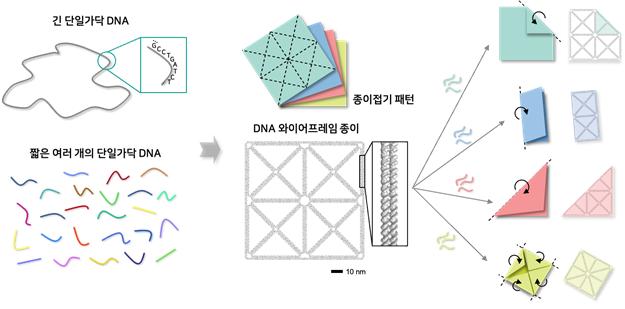
The Ministry of Science and ICT announced on the 6th that Professor Kim Do-nyeon’s research team from the Department of Mechanical Engineering at Seoul National University succeeded in developing DNA nanotechnology that can fold and unfold a single structure into various shapes, inspired by the operating principle of origami. The research results were published as a cover paper in the international journal Nature (IF 69.504) on the same day.
Functional nanostructures that can control the expression of specific functions through shape changes induced by external stimuli can be applied in various fields such as drug delivery and molecular diagnostics. In particular, DNA nanotechnology, which uses self-assembly properties to fabricate structures with desired shapes and physical properties with high precision, is attracting great attention as a next-generation technology for developing functional nanostructures.
Previous studies have developed movable or deformable DNA nanostructures by introducing mechanical elements similar to hinges or joints. However, due to the absence of a multi-deformation operating principle that allows a single nanostructure to change into various shapes at the nanoscale, only simple deformations and limited functional implementations were possible.
The research team proposed a new method that fundamentally overcomes these limitations by drawing inspiration from the origami principle, which allows a single sheet of paper to be folded into various shapes. First, they arranged DNA according to origami patterns to create a two-dimensional lattice structure that can be folded like paper, naming it DNA wireframe paper. The core idea is to selectively control folding and unfolding in desired parts of this structure to realize various shape changes.
At this time, the team’s unique technology is to design DNA wireframe paper by optimizing the mechanical stiffness of the folding parts so that it can be folded and unfolded with structural stability and a high success rate. This is similar to how folding thin paper is easy but structurally weak, while using thick paper makes folding difficult. The optimized structure was experimentally proven to stably sustain repeated folding and unfolding into various forms.
DNA wireframe paper can fold into different shapes depending on the type of stimulus and can be controlled through molecular binding such as DNA or ribonucleic acid (RNA), or environmental changes like pH or light. As a representative example, the research team designed DNA wireframe paper to fold into different shapes depending on the type of disease-related microRNA, demonstrating its potential use as a sensor capable of simultaneously detecting various microRNAs.
The design and fabrication technology developed in this study is expected to have a significant impact in the nanobio field, such as nanosensors for molecular diagnostics and nanorobots for drug delivery.
Professor Kim said, “This research shows the possibility of applying origami technology at the nanoscale,” adding, “If the technology expands and develops through the design of three-dimensional structures, it is expected to be used for developing multifunctional nanostructures that can perform various functions in response to multiple stimuli, overcoming the limitations of existing nanostructures with limited functions for single stimuli.”
© The Asia Business Daily(www.asiae.co.kr). All rights reserved.
![Clutching a Stolen Dior Bag, Saying "I Hate Being Poor but Real"... The Grotesque Con of a "Human Knockoff" [Slate]](https://cwcontent.asiae.co.kr/asiaresize/183/2026021902243444107_1771435474.jpg)















