"Solving the Problem of Making a Living"
1st World Korean Scientists and Engineers Conference on the 5th
4-Person 4-Color Science Talk Concert
Giving 'Advice' to Homeland and Juniors
How do renowned overseas scholars of Korean origin view the phenomenon of young people in their homeland overwhelmingly choosing medical schools? They emphasized that at a time when scientific and technological competitiveness determines the fate of a country, nurturing many young talents is more important than ever, and advised their "juniors" that the issue of "making a living" must be addressed.
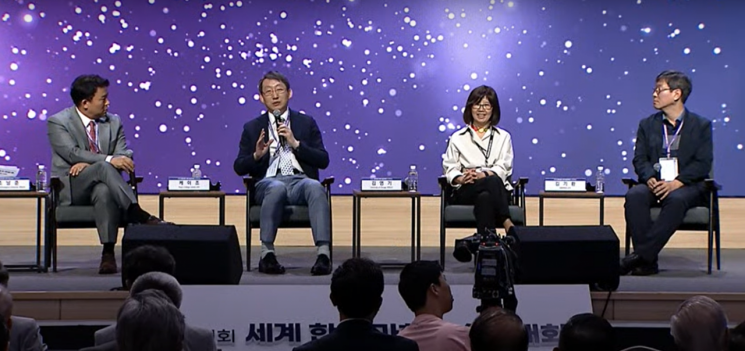 On the 5th, the 1st World Korean Scientists and Engineers Conference 'Science Talk Concert' was held at the Korea Science and Technology Center in Seoul. From the left: Namjun Cho, Professor at Nanyang Technological University, Singapore; K. Jo, Professor at King's College London, UK; Youngki Kim, Professor at the University of Chicago, USA; Kihwan Kim, Professor at Tsinghua University, China.
At the Science Talk Concert held on the 5th at the Korea Science and Technology Center in Yeoksam-dong, Gangnam-gu, Seoul, as part of the 1st World Korean Scientists and Engineers Convention, four global Korean scholars with distinct perspectives who visited their homeland after a long time gave such advice.
At the event, Professor K. Jo of King's College London recalled a time around 2010 when he was offered a position by a global pharmaceutical company and was contemplating leaving academia. Responding to the moderator's question, "The reality is that all students want to go to medical school," he said, "When you worry about making a living, you cannot find 'romance.' It is important to create an environment so that this does not happen." Professor Jo is an authority in neuroscience, the first East Asian to be selected as the Outstanding Neuroscience Researcher of the Year by the Royal Society of London, and a recipient of the Wolfson Research Merit Award. He reflected, "My wife still resents me, asking why I rejected such an offer, and I still feel sorry," but added, "Receiving even a small prize at that time was a decisive help in allowing me to remain in academia."
Professor Young-Ki Kim, Distinguished Professor at the University of Chicago, also emphasized the 'system.' He said, "The reason many students apply to medical schools under difficult circumstances is due to economic and other issues," and added, "Because the environment is not adequate, the system (for applications) must be well established." He pointed out problems such as the concentration in Seoul, difficulties in childcare and education, and the practical attitudes of young people, while particularly stressing the importance of revitalizing local regions. His point was that local areas should develop self-sustainability through global expansion and cooperation, not just simple support. Professor Kim is a particle physicist and the first Korean elected president of the American Physical Society, recognized as a world-class scholar with outstanding research achievements and collaboration skills.
Professor Ki-Hwan Kim of Tsinghua University in China also introduced China's scientific research system. He said, "China's scientific research system is optimized for achieving goals with well-established carrots and sticks at each stage," but added, "It is not yet a system where one can freely pursue research with romance in an open environment." Professor Kim is a core researcher at Tsinghua University's Quantum Information Center and is regarded as the world's leading scholar in the ion trap field, a research method for quantum computers.
These four scholars also advised that the most necessary tasks for the near future development of Korean science are international cooperation, talent cultivation, and the creation of a research ecosystem. Professor K. Jo cited global research collaboration as the background for overcoming the COVID-19 pandemic and said, "To prepare for another possible pandemic that may come in the future, we must continue to devote efforts to international research and development cooperation." Professor Young-Ki Kim also emphasized, "Diversity and international cooperation are essential for rapid progress in science and technology research," adding, "Even if there are 1,000 people like me, there is only one way of thinking, but if there are 1,000 people from diverse backgrounds, many different ideas emerge." Professor Nam-Jun Cho of Nanyang Technological University in Singapore stressed the need for convergent research that removes barriers between research fields. Drawing on his experience of majoring in civil engineering as an undergraduate, materials engineering for his master's and doctorate, and postdoctoral research in bioengineering, he insisted that to cope with future societal crises, multidisciplinary research and a challenging attitude are necessary rather than focusing on a single field.
Professor Ki-Hwan Kim also called for challenging research, free discussion, and creative research. He said, "Scientific research is not predetermined, nor does it only proceed according to goals," and added, "Many people explore diverse and new paths, which leads to development." He continued, "What is important in scientific advancement is that many good talents are nurtured, actively and freely discuss problems, find solutions, and attempt them," emphasizing, "Through such processes, progress is made even if slowly, and that will be the path to sustainable development."
The importance of basic science dealing with fundamental principles was also emphasized. Professor Young-Ki Kim said, "There are hot issues and fields, and it is important to support and create research and development environments for them," but argued, "No one knows which fields will rise in 10 to 20 years. We must look long-term, cultivate each research ecosystem well, see the big picture, and ensure longevity." He added, "Truth comes from very basic and fundamental understanding." Professor K. Jo cited The Beatles' song "In My Life" as an example, saying, "It has the simplest rhythm, so I still listen to it a lot," and added, "Simple is best. The answer lies in the fundamentals. Quantum computers made by quantum scientists who do not understand the brain's structure are becoming similar to the brain. That is proof that science is a universal language."
© The Asia Business Daily(www.asiae.co.kr). All rights reserved.

















