Considering Weather Conditions, Politics, and Diplomacy
Opinions Divided on 'August Discharge' vs. 'September Discharge'
With the International Atomic Energy Agency (IAEA) passing the final verification, the responsibility for the Fukushima contaminated water discharge issue has shifted to the Japanese government, sparking controversy over the timing of the discharge. Even within the Japanese government, various opinions are emerging regarding whether to discharge in August or September, preventing the establishment of a concrete schedule.
The Japanese government had previously set the principle of "discharge within the summer," considering weather variables such as autumn typhoons. However, political issues such as local elections in the Tohoku (東北) region, including Fukushima, next month, as well as opposition from neighboring countries, are raising voices that these factors must be taken into account. It is expected that deliberations over the discharge timing will deepen around three key issues: weather conditions, domestic politics, and diplomatic matters.
On the 5th, Nihon Keizai Shimbun (Nikkei) reported that the Japanese government is considering discharging contaminated water from the Fukushima Daiichi Nuclear Power Plant next month. The plan is to hold briefing sessions for residents of Fukushima and adjacent areas within this month, seek consent from neighboring countries such as South Korea and China, and then proceed with the discharge in August.
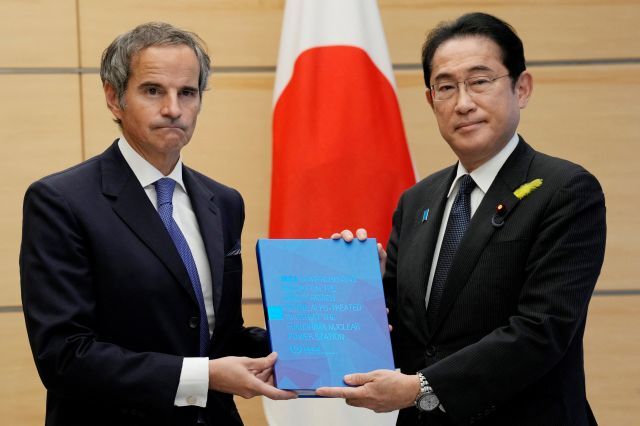 Japanese Prime Minister Fumio Kishida (right in the photo) received a comprehensive report on the plan to discharge contaminated water from the Fukushima Daiichi Nuclear Power Plant into the ocean from Rafael Grossi, Director General of the International Atomic Energy Agency (IAEA) (left in the photo), at the Prime Minister's Official Residence in Tokyo on the 4th. [Image source=Reuters Yonhap News]
The discharge deadline previously announced by the Japanese government is "summer." If the discharge begins in autumn, there is a high risk that high-concentration contaminated water could spread to surrounding waters before being properly treated due to typhoon damage. Previously, in October 2013, Typhoon Wipha swept through Fukushima, resulting in the discharge of 300 tons (t) of contaminated water, and in October 2019, Typhoon Hagibis passed through Fukushima, triggering a contaminated water leakage alarm. Considering this, the Japanese government's basic stance is that the discharge should start by August at the latest.
However, voices within and outside the Kishida Cabinet argue that discharging in August is politically disadvantageous as local elections are approaching in Fukushima and the Tohoku region. A senior official from the Prime Minister's Office told Japan's TBS television, "Realistically, September is the only option. September can also be considered summer," expressing opposition to an August discharge. The local elections in Fukushima and the Tohoku region, originally scheduled for April this year, were postponed to August.
If the start of contaminated water discharge in August negatively affects the Tohoku regional elections, there are concerns that this could deal a significant blow to the Kishida Cabinet's plan, which aims for re-election by dissolving the House of Representatives and preparing for a general election in August.
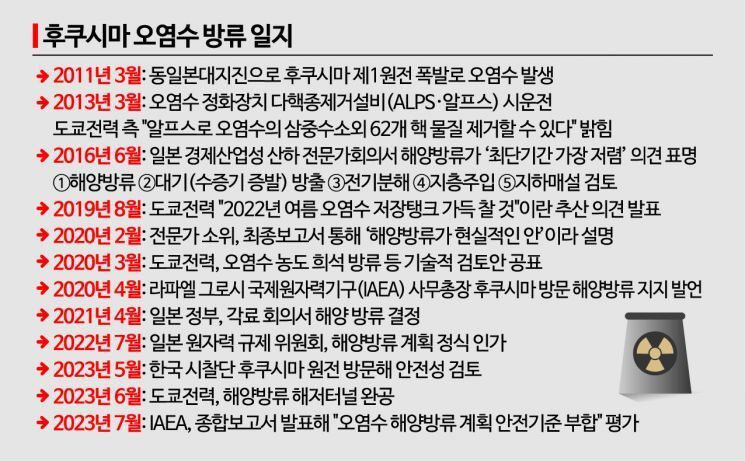
How to resolve opposition and diplomatic friction from neighboring countries regarding the contaminated water discharge is also an important issue. The day before, Wu Jianghao, the Chinese Ambassador to Japan, held a special press conference and strongly opposed the plan, stating, "Regardless of the conclusion reached by the IAEA, the Japanese government has already decided to discharge contaminated water into the ocean," and "We felt no respect for science throughout the process."
Last month, Henry Puna, Secretary-General of the Pacific Islands Forum (PIF), also issued a statement calling for a postponement of the discharge, saying, "More dialogue is needed to reach a common understanding on the discharge issue."
For now, Rafael Grossi, IAEA Director General, is scheduled to begin his visit to South Korea on the 7th, followed by visits to New Zealand and the Cook Islands to explain the verification results. The Japanese government is expected to seek understanding for the discharge together with the IAEA.
© The Asia Business Daily(www.asiae.co.kr). All rights reserved.
![Clutching a Stolen Dior Bag, Saying "I Hate Being Poor but Real"... The Grotesque Con of a "Human Knockoff" [Slate]](https://cwcontent.asiae.co.kr/asiaresize/183/2026021902243444107_1771435474.jpg)
















