Unpredictable Summer Weather Due to El Ni?o
Repeated Heavy Rain and Heatwaves Unlike Traditional Monsoon
"Time to Reconsider the Term 'Monsoon'"
On the 5th, the weather is expected to be unpredictable nationwide, alternating between heatwaves and heavy rain. The weather, which had cooled down due to the rain the previous day, is expected to heat up again immediately. As this unusual climate pattern, different from the typical summer, repeats, there are academic opinions suggesting that the term 'jangma' (monsoon) should be changed.
The Korea Meteorological Administration (KMA) forecasted on the 4th that the monsoon front, which expanded nationwide, will continue until the morning of the 5th. Rain will persist from the night of the 4th until the early morning of the 5th, with rainfall reaching 30 to 60 mm per hour at its peak.
After the rain stops, temperatures will rise sharply, bringing back the heatwave. Usually, temperatures tend to drop somewhat the day after the rain clears. However, this summer is expected to become hotter as it swings between heavy rain and heatwaves. This is because the entire country will soon come under the influence of a high-pressure system.
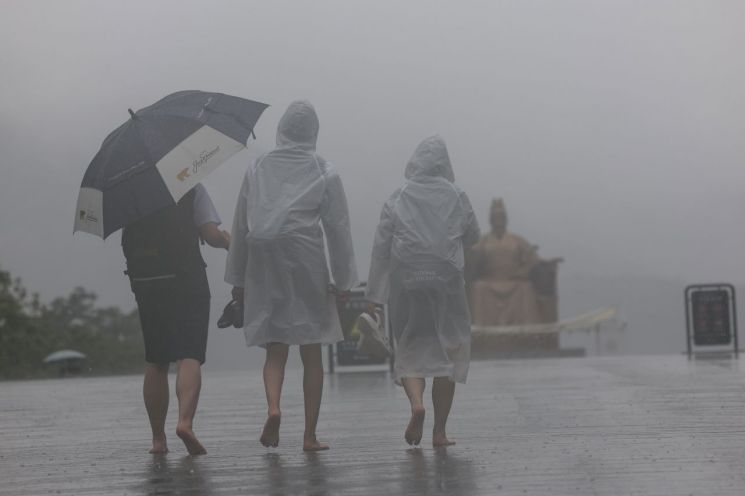 On the afternoon of the 4th, when the monsoon rain fell across the country, high school students visiting Gwanghwamun Square in Seoul were walking barefoot. [Image source=Yonhap News]
According to the KMA, the minimum temperature on the morning of the 5th will be between 22 and 25 degrees Celsius, and the maximum temperature during the day will range from 27 to 33 degrees Celsius. While most regions will record maximum temperatures around 30 degrees, the humidity will rise due to the rain from the previous day, causing the perceived temperature to soar even higher. In particular, the KMA forecasted that on the 6th, the maximum perceived temperature will exceed 33 degrees Celsius mainly in the southern regions, and heatwave warnings may be issued in various areas.
Rain is expected again from the afternoon of the 5th through the 6th. On the 7th and 8th, heavy rain will pour mainly in the southern regions and Jeju Island, with showers spreading to the Chungcheong area on the 8th and to the central regions on the 9th and 10th.
The unpredictable weather alternating between heatwaves and heavy rain appears to be a consequence of climate change. Earlier, in May, the KMA revealed that sea surface temperatures in the Pacific El Ni?o and La Ni?a monitoring zones, which affect domestic climate, had risen sharply.
El Ni?o is a phenomenon where warm seawater causes heavy rainfall and is related to sea surface temperatures. This year, the overall sea surface temperature has risen significantly compared to previous years, so El Ni?o was expected to manifest one month earlier than initially predicted (June to August), occurring between May and July.
When El Ni?o intensifies, global temperatures rise, and as a result, rainfall becomes heavier. The unusual phenomenon of heavy rain following a short heatwave, then immediately followed by another heatwave, is believed to be caused by this.
There are also academic observations that domestic summer weather has moved away from the traditional concept of 'jangma' (monsoon). In October last year, the KMA held an academic conference at the Kim Dae-jung Convention Center in Seo-gu, Gwangju, under the theme "Is the term 'jangma' appropriate in the era of climate crisis?"
At the event, Jeong Yong-seung, director of the Korea University Institute of Atmospheric Environment, pointed out, "The duration of rainfall during the monsoon season has changed significantly, and intermittent showers and localized heavy rain have become more frequent," adding, "A review of the long-used term 'jangma' is necessary." Some academics suggested that instead of 'jangma,' it would be more appropriate to use 'ugi,' which refers to the rainy season in subtropical climate regions where precipitation is concentrated.
© The Asia Business Daily(www.asiae.co.kr). All rights reserved.
![Clutching a Stolen Dior Bag, Saying "I Hate Being Poor but Real"... The Grotesque Con of a "Human Knockoff" [Slate]](https://cwcontent.asiae.co.kr/asiaresize/183/2026021902243444107_1771435474.jpg)















