IAEA Secretary General "Radiation Impact Will Be Minimal"
Kishida Cabinet Reviewing Discharge Date... Also Persuading Neighboring Countries
The International Atomic Energy Agency (IAEA), which has been verifying the discharge of contaminated water from Japan's Fukushima Daiichi Nuclear Power Plant, announced the final verification results stating that the Japanese government's discharge plan complies with international safety standards. With this, the Japanese government's contaminated water discharge plan has gained international credibility, and the Japanese government has begun adjusting the discharge date in earnest. As the Japanese government is expected to announce the discharge schedule within this month and proceed with the discharge immediately, diplomatic tensions with neighboring countries are also expected to intensify.
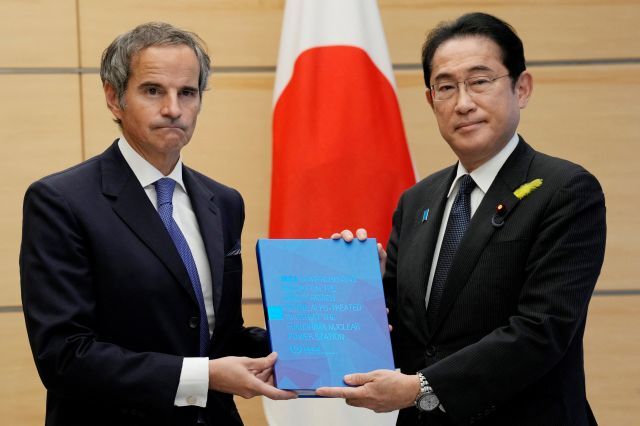 Japanese Prime Minister Fumio Kishida (right in the photo) received a comprehensive report on the Fukushima Daiichi Nuclear Power Plant contaminated water discharge plan from Rafael Grossi, Director General of the International Atomic Energy Agency (IAEA) (left in the photo), at the Prime Minister's Office in Tokyo on the 4th. [Image source=Reuters Yonhap News]
On the 4th, IAEA Director General Rafael Grossi visited Japan and held talks with Prime Minister Kishida, delivering the final verification report, which concluded that Japan's Fukushima Daiichi Nuclear Power Plant contaminated water discharge plan meets international safety standards.
After the meeting with Prime Minister Kishida, Director General Grossi emphasized at a press conference held at the Japan National Press Club that the final verification report was "an evaluation conducted over the past two years" and stated, "The suitability (of the contaminated water) is certain. It is reliable from a technical perspective."
Previously, at the request of the Japanese government, the IAEA had been verifying Japan's contaminated water discharge plan for over two years since 2021. Before releasing the final verification report on this day, the IAEA issued six interim reports, and the final report contains comprehensive judgments and verification details.
In the preface of this report, Director General Grossi stated, "Based on the comprehensive evaluation by the IAEA, we have decided that Japan's approach and activities regarding the contaminated water discharge comply with international safety standards," and added, "The radiological impact of the contaminated water discharge on people and the environment will be minimal."
The IAEA also emphasized the reliability of the report in a separate press release on the same day, stating, "The report was prepared with advice from nuclear safety experts from 11 countries and by a task force (TF) composed of top experts within the IAEA over approximately two years." It further explained, "The TF conducted five verification missions and published six technical reports, during which they met multiple times with officials from the Japanese government and Tokyo Electric Power Company, analyzing hundreds of pages of technical and regulatory documents."
Prime Minister Kishida, who received the report, welcomed the IAEA's verification, stating, "We will explain (the safety issues) in detail both domestically and internationally with scientific evidence and transparency and respond sincerely," and added, "As a responsible leader of the international community, we will not accept any discharge that adversely affects the health of humanity and the environment worldwide."
With the IAEA's official approval of Japan's contaminated water discharge, the Kishida Cabinet can now set a specific schedule for the discharge. NHK reported, "The government has decided to enter the final review phase regarding the planned discharge period scheduled for this summer based on the report."
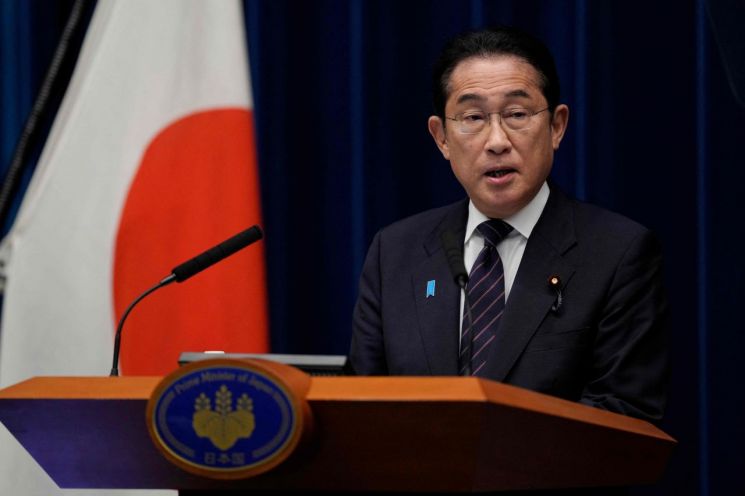
Although the Japanese government maintains its stance to set and implement the discharge schedule within this month, there are counterarguments that it will be difficult to coordinate this in a short period due to strong opposition both inside and outside Japan.
In particular, local governments adjacent to the Fukushima nuclear power plant are strongly protesting. On this day, the Miyagi Prefectural Assembly, neighboring Fukushima Prefecture, held a plenary session and passed a petition urging the government to take measures if fishermen suffer damages. They also demanded that the government provide compensation if fishermen are harmed due to the spread of false information.
How to resolve the opposition from neighboring countries is also a challenge. Chinese Ambassador to Japan Wu Jianghao held a special press conference on this day, stating, "Regardless of the conclusion reached by the IAEA, the Japanese government has already decided to discharge contaminated water into the ocean," and condemned, "We felt no respect for science during this process."
Accordingly, the Japanese government is expected to focus on coordinating domestic opposition and opposition from neighboring countries, including South Korea, for the time being. Director General Grossi also announced that after inspecting the Fukushima Daiichi Nuclear Power Plant on the 5th, he plans to visit South Korea, New Zealand, and the Pacific island nation of the Cook Islands starting from the 7th to explain the verification results of Fukushima's contaminated water.
© The Asia Business Daily(www.asiae.co.kr). All rights reserved.
![Clutching a Stolen Dior Bag, Saying "I Hate Being Poor but Real"... The Grotesque Con of a "Human Knockoff" [Slate]](https://cwcontent.asiae.co.kr/asiaresize/183/2026021902243444107_1771435474.jpg)
















