Start of Constitutional Amendment Discussions After Constitution Day
Legislative Impact Assessment Analysis Promoted to Strengthen Legislative Capacity
Speaker of the National Assembly Kim Jin-pyo proposed to "conclude the election system negotiations by the 15th of this month."
At a press conference marking his first anniversary in office held at the National Assembly that day, Speaker Kim said, "Recently, the floor leaders of both ruling and opposition parties and the Speaker agreed to begin full-scale negotiations on the election law starting from the end of June," adding, "As promised, let us commence full-scale election law negotiations starting today." He continued, "Since a sufficient deliberation process has been undertaken, if the leadership of both ruling and opposition parties responsibly prepare their respective negotiation proposals and declare the start of negotiations, we can reach an agreement by the 15th of this month as promised." He stated, "The Speaker and the leadership of both parties have agreed that once the negotiations conclude, the results will be transferred to the Special Committee on Political Reform on the 17th and then proceed through the plenary session for approval," and added, "Following this, the Central Election Commission will carry out the electoral district demarcation work, and the revision of the election law and the demarcation of electoral districts will be completed by the end of August at the latest." Speaker Kim also expressed his intention to initiate a full-scale constitutional amendment starting from Constitution Day, saying, "Once the election law revision discussions are concluded, we will embark on the constitutional amendment."
Speaker Kim devoted considerable time emphasizing the necessity of revising the election system. He pointed out, "Recently, the opposition party has been passing bills unilaterally, and the government has been rejecting them, creating a vicious cycle," and added, "The core reason for the repeated extreme confrontation and political conflict lies in the current election system. Our election system now operates under an extreme winner-takes-all system where winning just one more vote means taking everything."
He explained, "In fact, in the last general election, the difference in vote share between the first and second parties was only 8%, but the difference in constituency seats nearly doubled," and introduced, "Because of this extreme winner-takes-all election system, our politics is becoming increasingly polarized."
He said, "The essence of politics is to promote universal policies that at least 60-80% of the people agree on through dialogue and compromise, but currently, whenever issues arise, both ruling and opposition parties avoid dialogue and compromise and insist only on extreme self-assertions," and criticized, "Through this, they consolidate their core support bases and engage in politics that aim to win even a single vote in the upcoming election."
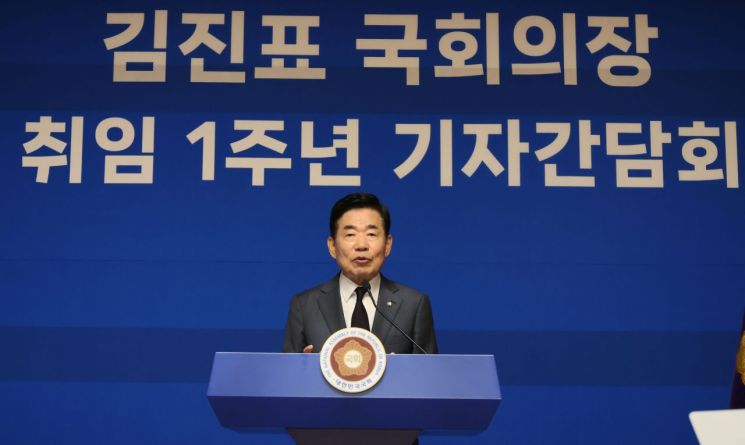
Speaker Kim cited the classical idiom ‘Pabu Chinjoo (破釜沈舟)’ and urged both ruling and opposition parties to approach the election system negotiations with extraordinary determination. He said, "When undertaking a great task, one must break the cooking pots and sink the boats in the river, cutting off all routes of retreat and resolutely pushing forward," adding, "Reforming the election system is exactly such a task." He continued, "Over the past year, we have mobilized all available means to unite the will of the people, including members of the National Assembly, citizens, journalists, and experts. The conclusion was clear," and said, "The people are now watching closely whether the leadership of both parties will keep their promise of political reform. A resolute decision akin to breaking the cooking pots and sinking the boats, a point of no return, is necessary."
Meanwhile, Speaker Kim promised to strengthen the legislative capacity of the National Assembly. Introducing the current situation where government legislation is decreasing and member-initiated legislation is increasing, he said, "In the past, the government mainly managed the legislative process, but now the National Assembly must handle it on its own." He pledged, "We will dramatically enhance the National Assembly’s legislative capabilities to reduce excessive conflicts arising during the legislative process," and added, "We will prepare so that excellent professionals assigned to each standing committee, the Legislative Research Office, and the Budget Office can thoroughly assess the impacts of legislation in advance and provide sound advice." Regarding this, he said, "We will actively promote the introduction of a ‘Legislative Impact Analysis System’ within the National Assembly," and promised, "Through this, we will reduce the proposal of bills that create unnecessary regulations and instead lay the foundation for promoting ‘good legislation.’"
© The Asia Business Daily(www.asiae.co.kr). All rights reserved.
![Clutching a Stolen Dior Bag, Saying "I Hate Being Poor but Real"... The Grotesque Con of a "Human Knockoff" [Slate]](https://cwcontent.asiae.co.kr/asiaresize/183/2026021902243444107_1771435474.jpg)















