Analysis Results of Gold-Gilded Ornaments from Jjoksaem Tomb No. 44 Revealed
"Four Leaf Decorations Combined with Metal Ornaments"
Fabric Form Wrapping Hair Also Confirmed
The jewel beetle's forewings are yellowish or pale green. Due to their luster, they have been used in various decorations since ancient times. Traces are only confirmed in the highest-grade tombs of Silla. A representative example is the hundreds of jewel beetle gilt-bronze ornaments found in the Jjoksaem No. 44 stone-cist tomb in Gyeongju in November 2020. After extensive analysis and research, they were identified as part of a bamboo textile maldarae. Maldarae is a panel hung under the saddle to prevent dirt from splashing onto the rider's legs.
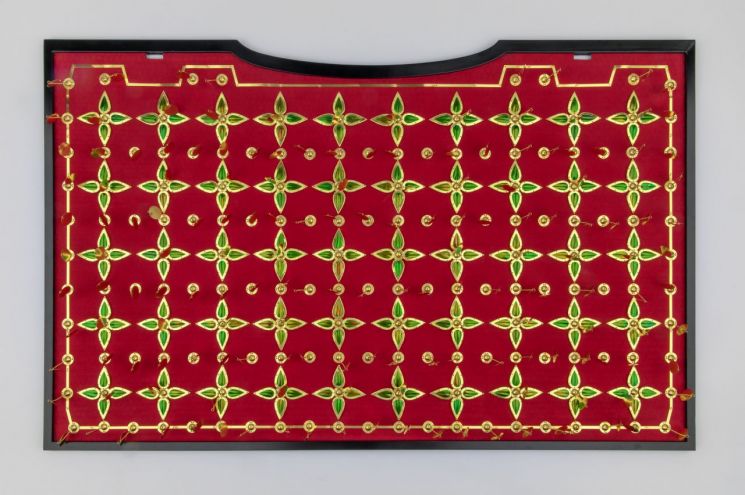 Reproduction of a Horse Bit Ornament with a Buprestid Beetle Decoration from Gyeongju Jjoksaem Tomb No. 44
The National Gyeongju Cultural Heritage Research Institute disclosed the analysis and research results of the jewel beetle gilt-bronze ornaments found in the Jjoksaem No. 44 tomb on the 4th. The bamboo textile maldarae was made by weaving bamboo slats to create a base frame measuring 80 cm wide and 50 cm long, then layering multiple fabrics on top. On top, decorations shaped like flower petals made from jewel beetle wings were placed.
An institute official explained, “Two jewel beetle wings were overlapped on a gilt-bronze plate, and a gilt-bronze plate decorating the perimeter was placed on top and fixed with thread to create a leaf-shaped ornament. Four leaf-shaped ornaments were combined on a thin metal decoration to complete the flower petal shape.” He added, “Fifty flower petal shapes are attached to the maldarae,” emphasizing, “This offers a glimpse into the brilliant craftsmanship of Silla.”
The analysis results of various organic materials found in the Jjoksaem No. 44 tomb are also noteworthy. In 2020, a 5 cm wide bundle of organic material found near the gilt-bronze crown was examined under a microscope and identified as human hair. An institute official said, “From the form of the fabric wrapping the hair, we could estimate the hairstyle that tied the hair together.”
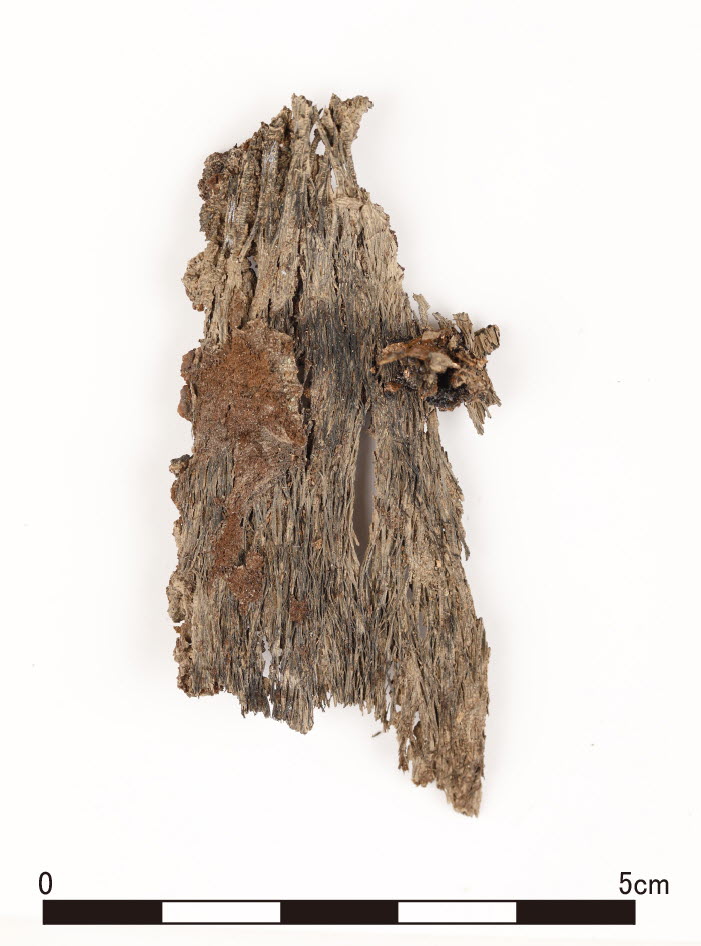
In the gilt-bronze crown, a textile called Samsek Gyeonggeum (三色經錦), made with threads of three colors, was also confirmed. This is the first physical confirmation of a textile from the Three Kingdoms period, and it is expected to be an important research material going forward.
Meanwhile, the Cultural Heritage Administration and the institute held an event at the Seorabeol Cultural Center on the same day to summarize the research and investigation results. Additionally, until the 12th, artifacts that have undergone preservation treatment will be exhibited at the Jjoksaem Site Excavation Hall, recreated to their original appearance at the time of excavation.
© The Asia Business Daily(www.asiae.co.kr). All rights reserved.
![Clutching a Stolen Dior Bag, Saying "I Hate Being Poor but Real"... The Grotesque Con of a "Human Knockoff" [Slate]](https://cwcontent.asiae.co.kr/asiaresize/183/2026021902243444107_1771435474.jpg)

















