Stiff Trend Seen in Core Inflation
Outpaced Forecast but Slowing
If US Raises by 0.25%p This Month
2%p Gap with Korea Would Be Record High
Concerns Over Increased Volatility in Forex Market
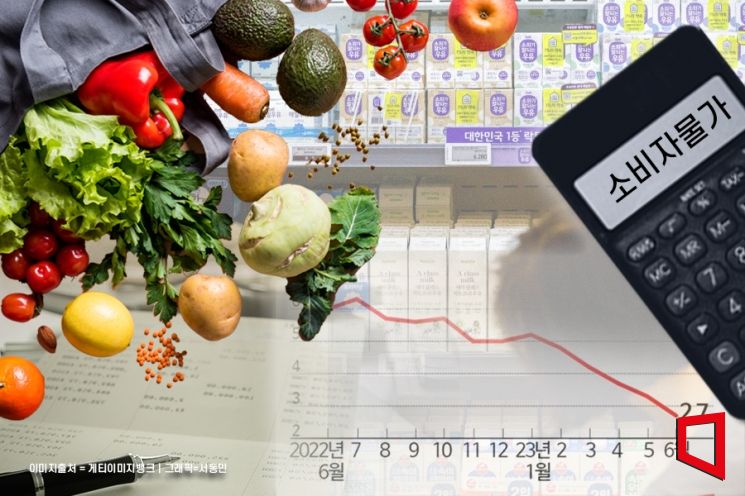
The consumer price inflation rate in June recorded a 2% range for the first time in 21 months, significantly easing inflationary pressures, leading to increased expectations that the Bank of Korea will keep the base interest rate unchanged for the fourth consecutive time at the Monetary Policy Committee meeting scheduled for the 13th. This judgment is based on the fact that petroleum prices, which had been fueling inflation, fell by the largest margin ever, and the core inflation rate, which had shown a rigid trend, has slowed down, gradually extinguishing inflationary flames. However, if Korea freezes the base rate this month while the U.S. Federal Reserve (Fed) raises its base rate by 0.25 percentage points in the second half of this year, the Korea-U.S. interest rate differential will reach a record high of 2 percentage points, emerging as a major variable in future monetary policy.
On the morning of the 4th, at a 'Price Situation Review Meeting' held in the 16th-floor conference room of the main building chaired by Deputy Governor Kim Woong, the Bank of Korea stated, "The consumer price inflation rate in July is expected to continue the slowing trend following June, but then rise again, fluctuating around 3% until the end of the year." The June consumer price inflation rate slowed to the 2% range as expected due to the base effect of a sharp decline in petroleum prices, and although the slowing trend will continue next month, it is forecasted to rise back to the 3% range from August.
Clear slowdown in inflation... Core inflation poses upside risks
The Bank of Korea judged that the consumer price inflation rate slowed to the 2% range in June and that the inflationary flames are gradually being extinguished as the inflation rate in the service sector also slowed. However, it noted the need to pay attention to future trends as the core inflation rate (excluding food and energy), which shows the underlying trend of prices, continues a slower-than-expected pace, exceeding forecasts. Deputy Governor Kim Woong said, "The core inflation rate in June also saw an expected widening of the slowdown due to a mild deceleration in rent and a reduced increase in personal service prices," adding, "However, while core inflation shows a mild slowing trend, it may somewhat exceed the previous forecast path."
This month, the core inflation rate recorded 3.5% year-on-year, the lowest in 13 months since May last year (3.4%). Considering that the core inflation rate was 3.9% in May, it can be seen as a sign that the previously concerning core inflation has also turned to a slowing trend. However, compared to the first half forecast, it still remains at a high level, exceeding the Bank of Korea’s forecast. In the revised economic outlook released last May, the Bank of Korea expected the core inflation rate to be 3.8% in the first half and 2.9% in the second half, resulting in an annual rate of 3.3%. Since the core inflation rate for the first half announced this day was 3.9%, there is a possibility that the annual core inflation forecast will be revised upward.
Choi Chang-ho, director of the Bank of Korea’s Research Department, explained, "The consumer price inflation rate soared to a peak of 6.3% in July last year but dropped by 3.6 percentage points to 2.7% last month. However, the core inflation rate peaked at 4.3% in November last year and only slowed by 0.8 percentage points to 3.5% last month," adding, "Compared to past inflation slowdown periods, the recent decline in core inflation has been very slow."
Record-high Korea-U.S. interest rate gap... Caution over foreign exchange market volatility
Experts predict that as the consumer price inflation rate falls to the 2% range, easing the inflation burden, the base interest rate will be kept unchanged at the Monetary Policy Committee meeting on the 13th of this month. Professor Ha Jun-kyung of Hanyang University’s Department of Economics said, "Although the prevailing forecast is that the U.S. will raise its base rate by 0.25 percentage points this month, the Bank of Korea will not raise its base rate ahead of the U.S.," adding, "With the U.S. raising rates and the Korea-U.S. interest rate gap widening to a record 2 percentage points, the Bank of Korea will monitor foreign exchange market volatility and conduct monetary policy while checking future U.S. inflation trends."
Key variables for future monetary policy are expected to be the pace of U.S. inflation slowdown and whether the trade balance improves. Other uncertainties include international oil price trends, China’s economic recovery, domestic and foreign economic conditions, and the degree of public utility fee adjustments. Professor Ha said, "As the semiconductor industry recovers, improvements in the trade balance and current account balance are necessary to ease the burden on the foreign exchange market caused by dollar inflows," adding, "If the U.S. inflation slowdown is slower than expected and the tightening period is longer than anticipated, changing market expectations about the timing of rate cuts, Korea’s monetary policy will inevitably have to be adjusted."
© The Asia Business Daily(www.asiae.co.kr). All rights reserved.

















