Unauthorized Road Occupation Memorials Remain Across Seoul for Years
"Agreed Removal Is Best, but Law Enforcement Needed If Public Consensus Lacks"
Several memorial facilities across Seoul remain in place despite their installation permits having expired. Legally, these facilities constitute unauthorized use of public roads, but the Seoul Metropolitan Government prefers to resolve the issue through consultations with the organizations that installed the memorials rather than resorting to forced removal using physical measures.
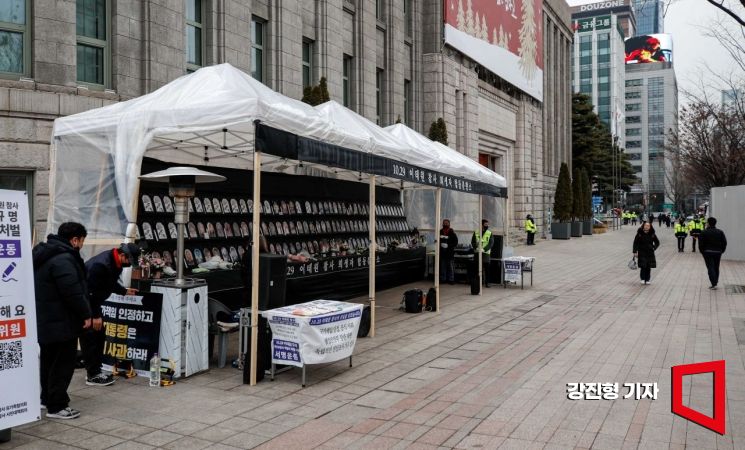 Joint memorial altar for the Itaewon disaster set up at Seoul Plaza, Jung-gu, Seoul. Photo by Jinhyung Kang aymsdream@
A representative example is the Itaewon disaster memorial altar installed in Seoul Plaza. On February 4, marking 100 days since the Itaewon tragedy, the bereaved families staged a street march and suddenly set up the altar in Seoul Plaza. The Seoul city government classified the altar as an illegal structure, imposed a fine of 30 million KRW for unauthorized occupation of Seoul Plaza, and issued several administrative enforcement notices, but whether the altar will be voluntarily removed remains uncertain.
In front of the Seoul Metropolitan Council, there is the 'Sewol Ferry Memory Space' commemorating the victims of the Sewol Ferry disaster that occurred in April 2014. This facility was originally installed in Gwanghwamun Plaza but was relocated to the front of the Seoul Metropolitan Council main building last June due to plaza restructuring work. However, more than a year past the deadline, the facility continues to operate while illegally occupying the sidewalk. A Seoul Metropolitan Council official said in response to questions about the possibility of forced removal, "We have notified the bereaved families of the fine for unauthorized occupation and are discussing alternatives with them. The decision will depend on the outcome of these talks, but we are trying to avoid physical measures such as forced removal."
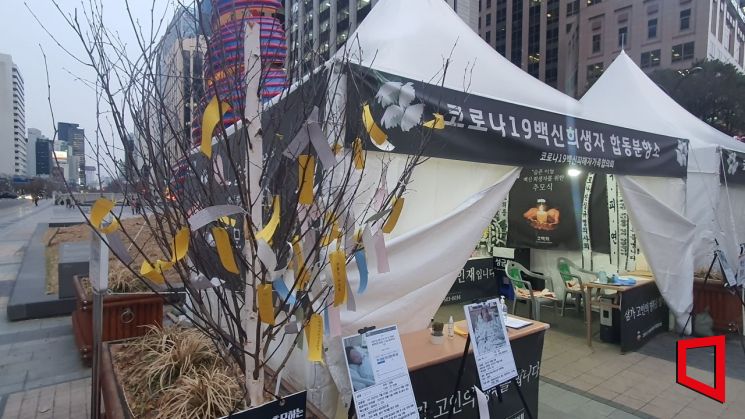
At the entrance of Cheonggye Plaza, the starting point of Cheonggyecheon Stream, and in front of the Seoul Metropolitan Council, the 'Joint Memorial Altar for COVID-19 Vaccine Victims' has been installed. This was also set up suddenly without local government permission on January 11 last year. Since then, Jung-gu District Office has sent several notices urging voluntary removal, but the bereaved families continue to maintain the altar. A Jung-gu District official said, "While removal is necessary for public safety, there are concerns about safety issues arising from conflicts during enforcement. Pedestrians, especially people with disabilities, have continuously filed complaints about difficulties passing due to the joint memorial altar."
There are also cases where removal is difficult due to connections with assembly reports. The memorial space for the late Son Jeong-min near the Banpo Hangang Park water taxi dock is one such case. Son was found dead in the Han River in April 2021. Since November of the same year, Seoul city has requested managers to voluntarily remove the memorial. A Seoul Hangang Project Headquarters official explained, "Complaints from nearby residents and park visitors have been ongoing. After consulting with lawyers and other experts, although it is confirmed to be unauthorized occupation, intermittent assembly reports have been filed, making forced removal practically impossible."
The reason why memorial facilities with expired permits are not removed is due to differences in positions between the parties. Bereaved families generally prefer locations with high foot traffic because the incident is less likely to be forgotten and can receive more memorial attention.
Kim Doo-kyung, chairman of the COVID-19 Vaccine Victims' Families Association, said, "Nothing has been practically resolved, but as the COVID-19 situation eases, vaccine victims are fading from public attention. In this situation, they endure by placing the altar in a symbolic place like Gwanghwamun to avoid being forgotten."
The case of the Itaewon disaster altar is similar. Seoul city initially proposed a space inside Noksapyeong Station near the disaster site, but the bereaved families insisted on Seoul Plaza and rejected the offer.
Experts explain that this situation has arisen because, as large-scale disasters continue to occur in Korea, a culture of accommodating victims and their families beyond legal boundaries has formed.
Professor Jang Young-soo of Korea University Law School said, "It has become customary to tolerate some legal violations for the purpose of consoling those affected by large-scale accidents or social disasters." He added, "However, occupying land long-term or installing auxiliary facilities beyond the permitted assembly period requires local government approval. It is not right to think that social consolation justifies ignoring statutory laws."
Currently, Seoul city does not plan to carry out immediate forced enforcement but maintains that it cannot abandon the principles of managing public facilities.
Experts suggest that social consensus through public discussion is the most desirable solution. Professor Jang said, "If illegal acts are tolerated, they become customary. When laws become ineffective, the public suffers. However, enforcing removal without a public discussion process leads to a false equivalence. It is necessary to persuade the memorial installation organizations to understand and accept the public inconvenience such as pedestrian disruption and infringement of the right to rest."
Professor Koo Jung-woo of Sungkyunkwan University’s Department of Sociology said, "Memorial spaces are indeed necessary for large-scale disasters. The best approach is for Seoul city and memorial groups to negotiate and find alternatives through dialogue. However, if the majority of citizens cannot sympathize, enforcement of public authority should also be considered."
© The Asia Business Daily(www.asiae.co.kr). All rights reserved.
![Clutching a Stolen Dior Bag, Saying "I Hate Being Poor but Real"... The Grotesque Con of a "Human Knockoff" [Slate]](https://cwcontent.asiae.co.kr/asiaresize/183/2026021902243444107_1771435474.jpg)
















