Ultra-Compact 'Personal Size' Released One After Another
Customized Production Considering Customer Health and Preferences
There is a growing expectation that it will become difficult to find 'Large' size pizzas in Japan in the future. This is due to the declining birthrate and aging population, which are reducing both the number of people eating and the amount they consume. As the food market size is expected to shrink rapidly, companies have begun shifting their strategies from 'mass production of many varieties' to 'customized production' based on individual consumers' health conditions and preferences. With advancements in related technologies, it is also anticipated that in the future, food size distinctions will become unnecessary due to fully personalized customer customization.
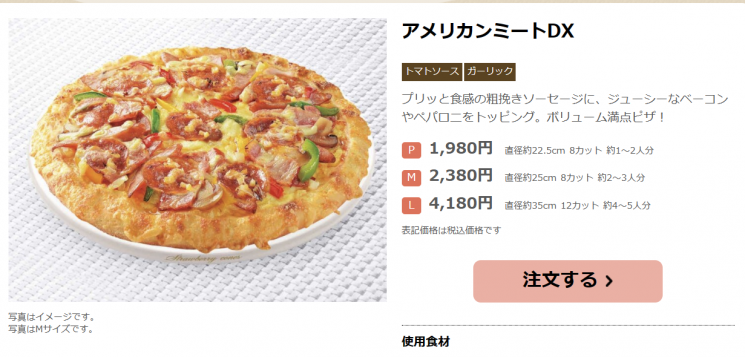 Menu board of Japan Strawberry Cones. You can order a 22.5cm 'P Size' pizza. (Photo by Strawberry Cones official website)
On the 3rd, Nihon Keizai Shimbun (Nikkei) reported that the Japanese food industry is recently redefining 'single servings' in line with the aging trend. Taking pizza as an example, it is expected that single-serving products much smaller than the existing Large (L) and Regular (R) sizes will become the mainstream.
Strawberry Cones, a Japanese delivery pizza specialty store, recently launched a 'P size' pizza. The P size, meaning 'Personal Size,' is smaller than the existing Large (L) and Regular (R) sizes and is made to be consumed entirely by one person. This decision was made considering the shrinking population, but it is also popular among single-person households. Masamichi Miyashita, president of Strawberry Cones, stated, "In the future, a world will come where sizes are individually tailored to each customer."
Mos Burger is also considering launching smaller-sized hamburgers than before. Eisuke Nakamura, president of Mos Burger, said, "We need to consider sizes that are easy for elderly people to eat," adding, "Along with this, we will respond to aging by offering burgers made with plant-based meat that is easy to digest."
Alongside this, 'customizing' that reflects individual consumer preferences is also gaining popularity. Calbee, a snack manufacturer known as 'Garubi' in Korea, has been operating a service since April that customizes granola based on customers' gut conditions and delivers it regularly.
The background to these changes lies in concerns that it is no longer possible to survive in the market with the existing 'mass production of many varieties' system. With the population expected to fall below 100 million by 2056 and 40% of the population projected to be elderly aged 65 or older, the food market size faces a significant contraction risk.
According to the polling agency Insight, the combined market size of food, beverages, and alcoholic drinks is expected to decrease by more than 8%, from 18.1 trillion yen last year to 16.6 trillion yen in 2030. Nikkei noted, "There is a sense of crisis that without responding to customer needs, it will be impossible to survive in the shrinking domestic market," and predicted, "As competition over the limited market intensifies, corporate elimination and industry restructuring will inevitably proceed."
 Customized granola service presented by Japan's Calbee. The individual's gut condition is diagnosed using a kit, and granola is produced and delivered based on the results. (Photo by Calbee website)
It is analyzed that companies that first establish a customized small-batch production system considering individual health conditions and preferences will survive. Related technologies are also evolving to support this direction.
Last year, at the 'World Robot Summit' hosted by the Ministry of Economy, Trade and Industry, a contest was held on the theme of future convenience stores. The winning idea was to place a '3D food printer' in stores that produces food tailored to individual consumer convenience.
The idea is to process ingredients that do not meet standards and have reduced marketability into powder, then blend them according to individual tastes and constitutions, and finally use the food printer to recreate and sell the food.
Yusuke Nakahashi, general manager of sales at Seven-Eleven Japan, who participated in the judging, said, "The idea resonated because it aims to reduce food waste and promote a healthy society (for the elderly)."
Nikkei reported, "If companies develop food tech to customize all foods according to customer preferences and biometric data, the need for size distinctions like Large and Regular will disappear."
© The Asia Business Daily(www.asiae.co.kr). All rights reserved.
![Clutching a Stolen Dior Bag, Saying "I Hate Being Poor but Real"... The Grotesque Con of a "Human Knockoff" [Slate]](https://cwcontent.asiae.co.kr/asiaresize/183/2026021902243444107_1771435474.jpg)
















