EBS CSAT Textbook Linkage Rate Maintained at 50% Level
Significant Score Differences Among Science Subjects Make Adjustment Inevitable
The 2024 College Scholastic Ability Test (CSAT), which has become even more difficult to predict in terms of question trends and difficulty due to the controversy over ‘killer questions,’ will be held on November 16. Experts advise test-takers to maintain their original study pace rather than drastically changing their existing study methods.

The Korea Institute for Curriculum and Evaluation (KICE) announced the detailed plan for the 2024 CSAT on the 2nd. The institute stated that this year’s CSAT will feature questions of appropriate difficulty that students can solve by faithfully attending school education and supplementing it with EBS-linked textbooks and lectures.
Additionally, since the 2015 revised curriculum will be applied to all subjects and areas, questions will be created according to the content and level of the curriculum, and after the CSAT, the achievement standards for each question and other curriculum bases will be disclosed.
◆Difficulty: Korean will be increased, Math will be lowered= The linkage rate with EBS CSAT textbooks will be maintained at about 50% based on the number of questions per subject and area. The connection between EBS CSAT textbooks and lectures and the CSAT questions will be indirect, and the plan is to increase the sense of linkage by utilizing materials such as charts, pictures, and passages included in the linked textbooks.
Accordingly, citations of passages such as EBS pictures and charts are expected to increase. In the Korean section, where the standard scores were low in the June mock exam, there is a high possibility that more difficult passages and questions from EBS textbooks will be used to raise the difficulty. In particular, non-literary passages, which were representative ‘killer questions,’ are likely to be included within the curriculum.
To avoid criticism that the CSAT favors science students, the math section is expected to be somewhat easier. In the June mock exam, the highest standard score in math reached 151 points, creating a 15-point gap with the highest score in Korean. The difficulty of the common math subjects is expected to be lower than in the June mock exam. Lim Seong-ho, CEO of Jongro Academy, analyzed, “It is highly likely that killer questions in the common subjects, especially subjective questions, will be created by excluding complex variables.”
The science inquiry section is also expected to see changes in question trends. In the June mock exam, the highest standard scores for Science Inquiry II subjects ranged from 86 to 98 points, showing an excessively large score gap compared to Science Inquiry I subjects (66 to 71 points). This was because Seoul National University abolished the designation of Science Inquiry II subjects starting this year, leading top students to all take Science Inquiry I subjects, which caused a sharp rise in standard scores even with slightly higher scores in Science Inquiry II. Attention is focused on the evaluation institute’s countermeasures regarding this issue.
Lim said, “It is important for test-takers to maintain their originally planned study pace from right after their final exams rather than making major changes to their existing study methods,” adding, “They should also note that EBS linkage may be more prominent in Korean compared to math and English.”
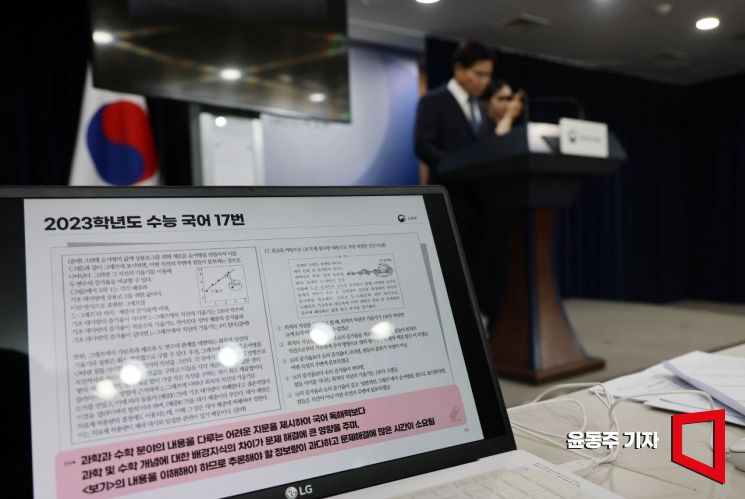 On the 26th, Oh Seung-geol, Director of the Responsible Education Policy Office at the Ministry of Education, is presenting examples of killer questions from the College Scholastic Ability Test at the Government Seoul Office in Jongno-gu, Seoul. Photo by Dongju Yoon doso7@
◆Integrated CSAT system for humanities and sciences again this year= As in the previous year, the Korean and math sections will be conducted under a ‘common subject + elective subject’ system without distinction between humanities and sciences. Test-takers will take the common subjects and choose one subject from Korean: Speech and Writing, Language and Media; and one from Math: Probability and Statistics, Calculus, Geometry.
English, Korean History, and the second foreign language/Chinese characters sections will be graded on an absolute scale, and in the social and science inquiry sections, test-takers can choose up to two subjects from 17 elective subjects without distinction between social and science. In the vocational inquiry section, up to two subjects can be selected from six subjects.
Korean History is mandatory, and failure to take it will invalidate the entire CSAT application and no scores will be provided.
The application period for the CSAT is 12 days from August 24 to September 8, and score reports will be distributed to test-takers on December 8.
Current students can receive their score reports from their schools, while graduates and those who took the qualification exam can receive them from the institution where they applied. Score reports can also be issued online through the score certificate issuance site using the test-taker’s own digital certificate. The score report shows standard scores, percentiles, and grades for each subject and area, while only grades are shown for absolute evaluation subjects such as English, Korean History, second foreign language, and Chinese characters.
The number of test-takers per exam room is limited to 24. However, quarantine guidelines due to COVID-19 and other factors have not yet been finalized. The Ministry of Education and KICE plan to prepare and implement CSAT quarantine measures in cooperation with health authorities and will separately inform test-takers before the exam.
Test-takers who do not take the CSAT due to natural disasters, illness, final acceptance in early admissions, military enlistment, or other reasons can apply for a refund between November 20 and 24 and receive 60% of the CSAT application fee back.
© The Asia Business Daily(www.asiae.co.kr). All rights reserved.
![Clutching a Stolen Dior Bag, Saying "I Hate Being Poor but Real"... The Grotesque Con of a "Human Knockoff" [Slate]](https://cwcontent.asiae.co.kr/asiaresize/183/2026021902243444107_1771435474.jpg)
















