43.2% Surge... Implementation of Global Hub Nation Strategy
Top-Down Package Projects to Prevent Aid Fragmentation
Linked with Diplomatic Strategies Including Indo-Pacific Strategy
The government has approved a public development assistance (ODA) budget plan of 6.8432 trillion won for next year. This is the largest annual increase since joining the Development Assistance Committee (DAC) in 2010, and the budget size is also the highest ever. It follows the Yoon Seok-yeol administration's 'Global Hub Nation Strategy,' significantly expanding the budget to fulfill the pledge to promote advanced country-type ODA. The government plans to leverage Korea's unique experience as the only country that has transitioned from an aid recipient to a donor to advance national interests through ODA projects.
Increased by 43.2%, the highest growth rate... Significant expansion of ODA budget
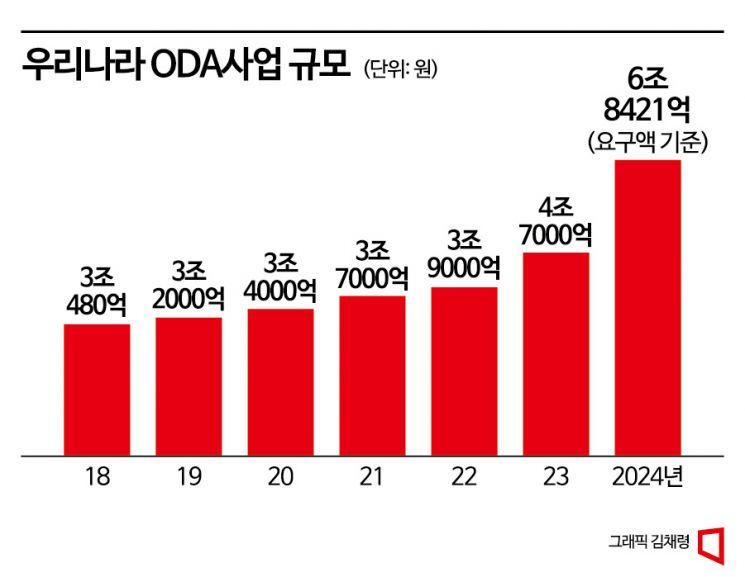
On the 30th, Prime Minister Han Duck-soo held the International Development Cooperation Committee meeting at the Seoul Government Complex in Gwanghwamun and approved a budget plan of 6.8421 trillion won for 1,978 ODA projects. This represents an increase of 2.065 trillion won (43.2%) compared to the previous year, marking the highest growth rate. The expanded budget will be focused on responding to global issues such as disasters and conflicts. Humanitarian aid will increase by 758.1 billion won, and an additional 569.1 billion won will be invested in large-scale concessional infrastructure projects. Furthermore, 119.7 billion won will be allocated to contributions to international organizations (UN) to strengthen international cooperation.
In particular, the humanitarian aid sector will see a 188% increase from 403.6 billion won this year to a requested 1.1617 trillion won next year. This is to ensure timely responses to urgent crisis situations such as the T?rkiye earthquake, Ukraine reconstruction, food security, health, disasters, and calamities.
Top-down package projects also being developed to prevent aid fragmentation and fragmentation
Additionally, large-scale projects will be actively developed focusing on cooperation projects requested by aid recipient countries. For example, the Indonesian Integrated Data Center construction project currently planned by the government is a cross-ministerial effort involving the Economic Development Cooperation Fund (EDCF), KOICA, and the Ministry of the Interior and Safety to establish integrated management of information resources and export infrastructure for e-government systems. Also, the Egypt railway modernization project is being carried out in coordination between EDCF and KOICA to modernize the railway system in the country while promoting the entry of domestic railway-related companies.
Large-scale package projects are top-down initiatives led by the Prime Minister's Office to address the issues of aid fragmentation and segmentation that can arise when ministries discover projects through a bottom-up approach (collecting from the bottom up). As the ODA scale expands significantly, the government plans to establish an ODA execution management task force within the Office for Government Policy Coordination to closely monitor project implementation.
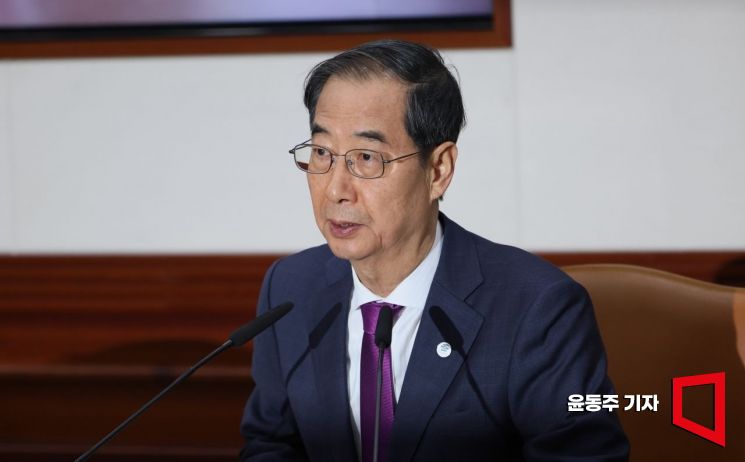 Prime Minister Han Duck-soo is attending the Ministerial Meeting on State Affairs held at the Government Seoul Office in Jongno-gu, Seoul on the 6th, delivering opening remarks. Photo by Dongju Yoon doso7@
Strengthening linkage with diplomatic strategies such as Indo-Pacific strategy to promote national interests
Connections with Korea's diplomatic strategies such as the Indo-Pacific Strategy and the Busan Initiative will also be strengthened. This is to strategically engage in development in Latin America and climate change response in Pacific island countries to promote national interests. At the meeting, Prime Minister Han Duck-soo stated, “Despite maintaining a sound fiscal stance, we have dramatically increased the ODA scale, so we will thoroughly manage ODA projects to ensure that taxpayers' money is not wasted.”
Since joining the DAC in 2010, Korea has steadily expanded its ODA level, but as of last year, its absolute budget size ranked mid-level (16th) among about 30 countries. The international community has continuously called for Korea to expand ODA in line with its economic scale. The average ODA budget of DAC member countries relative to GNI is 0.36%, while Korea's is only 0.17% (based on provisional 2022 data). In terms of ODA budget relative to GNI, Korea ranks 28th out of 30 countries.
In contrast, Japan's ODA is 6.3 times that of Korea, Canada?whose economic scale is similar to Korea's?is three times larger, and Italy's ODA is twice as large. Han Kyung-pil, head of the International Development Cooperation Headquarters at the Office for Government Policy Coordination, said in a background briefing, “To become an export-oriented country, we need to make global contributions and humanitarian aid commensurate with our economic scale to enhance our national prestige,” adding, “We will systematically support ODA projects to assist developing countries and contribute to long-term national interests.”
© The Asia Business Daily(www.asiae.co.kr). All rights reserved.
![Clutching a Stolen Dior Bag, Saying "I Hate Being Poor but Real"... The Grotesque Con of a "Human Knockoff" [Slate]](https://cwcontent.asiae.co.kr/asiaresize/183/2026021902243444107_1771435474.jpg)

















