Government Ruling Party and Opposition Clash Over Public Broadcasting
Criticism of 'Ruling Bias' if Power Changes Hands
"Broadcasting Act Used as a Tool for Power Struggle"
The amendment to the Broadcasting Act is currently stalled. The Broadcasting Act, which aims to increase the number of public broadcasting directors to minimize government bias, was strongly pushed by the Democratic Party of Korea at the end of last year during the National Assembly budget negotiations by attempting to bring it directly to the plenary session. However, it has not passed the National Assembly threshold for over 200 days since then.
According to the National Assembly Legislative Information System on the 30th, the so-called 'Broadcasting 3 Acts,' including the Broadcasting Act, the Broadcasting Culture Promotion Act, and the Korea Educational Broadcasting System Act, were included in the agenda for the plenary session that day. The Broadcasting Act has been pending for 102 days since it was directly referred to the plenary session at the March meeting of the National Assembly's Science, Technology, Information and Broadcasting Committee. Including the committee's approval on December 2 last year, it has been held up for over 200 days after passing the committee stage.
The Democratic Party plans to handle the Yellow Envelope Act (an amendment to the Labor Union and Labor Relations Adjustment Act) guaranteeing labor unions' right to strike and the Itaewon Special Act fast-track (rapid processing agenda) at the plenary session that day, but the Broadcasting Act amendment will be re-discussed after a public opinion process.
Opposition Party, Why Reintroduced the Broadcasting Act That Failed Under the Moon Administration?
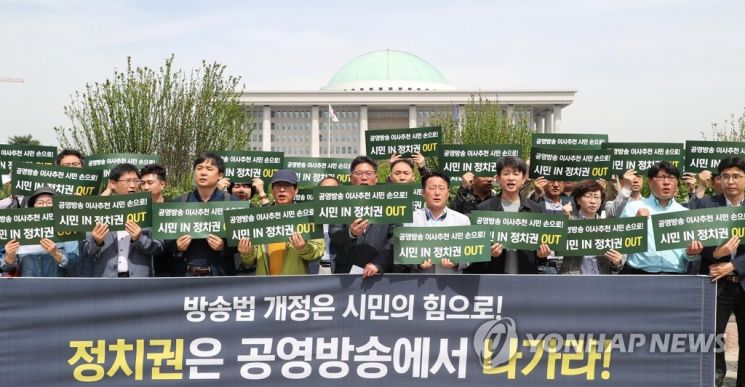
The Broadcasting 3 Acts, known as the public broadcasting governance improvement law, include provisions to increase the number of public broadcasting directors from the current 9 or 11 to 21 and diversify the director nomination bodies to the National Assembly (5 members), media-related academic societies (6 members), viewer committees (4 members), and the Broadcast Journalists Association, Korea PD Association, and Broadcast Technicians Association (2 members each). This aims to supplement the government bias that may occur in the process of appointing public broadcasting directors and presidents, thereby weakening the ruling party's influence.
Currently, the board of directors of public broadcasting is composed by the Korea Communications Commission recommending members and the president appointing them. Since the KCC consists of 3 members appointed by the president and ruling party and 2 members appointed by the opposition party, the ruling party's influence inevitably strongly operates in this structure.
For this reason, in July 2016, then-opposition Democratic Party lawmaker Park Hong-geun proposed an amendment to the Broadcasting Act to form the public broadcasting board with 13 members including the chairman (7 recommended by the ruling party, 6 by the opposition), and to appoint the public broadcasting president with two-thirds approval. However, after the impeachment of former President Park Geun-hye and the successful regime change in 2018, the Democratic Party, now the ruling party, delayed processing this amendment and was criticized for it.
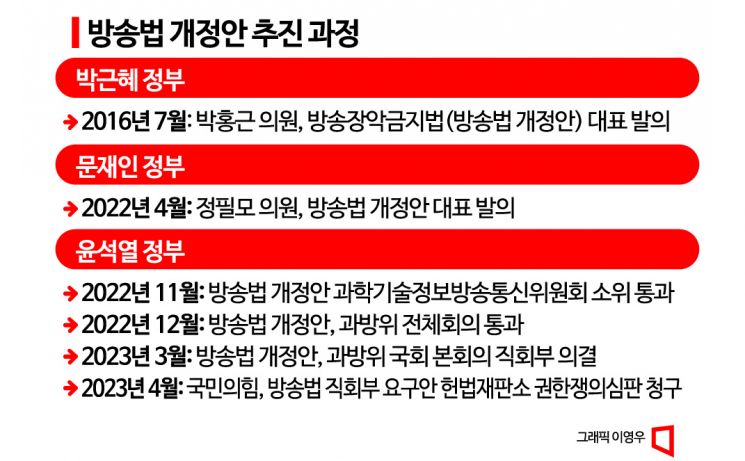
The Democratic Party became active in re-pushing the Broadcasting Act in December last year, claiming that the Yoon Seok-yeol administration was increasingly intensifying broadcasting suppression and pushing for the forced passage of the Broadcasting Act pending in the standing committee. At that time, the People Power Party's Science, Technology, Information and Broadcasting Committee members countered, saying, "Most of the members of the viewer committee and broadcasting/media-related academic societies are supporters of the opposition party," and "The Democratic Party claims to pursue political independence of public broadcasting, i.e., to break away from 'political patronage,' but in reality, the content has been distorted into a bill for 'Minnocho Media Union patronage.'"
Will the Broadcasting Act Pass This Time?
According to the March decision to directly refer the Broadcasting Act to the plenary session, the ruling and opposition parties must agree and submit it to the plenary session within 30 days. However, both sides are withholding the bill's submission. Democratic Party floor spokesperson Lee So-young explained, "There are overlapping issues related to the media situation, including the Korea Communications Commission (such as the dismissal of Chairman Han Sang-hyuk) and other problems," adding, "We need to comprehensively resolve these issues, so we are considering the timing of the bill's processing."
The People Power Party's constitutional complaint filed in April with the Constitutional Court requesting suspension of the effect of the direct referral demand for the Broadcasting Act amendment is also acting as a legislative variable. Since the chairperson of the Science, Technology, Information and Broadcasting Committee, the respondent in the constitutional lawsuit, was recently replaced by People Power Party lawmaker Jang Je-won, and the legal counsel was changed, it is interpreted that the ruling party has gained a favorable position. This means that even if the opposition party-led amendment to the Broadcasting Act is processed, if the Constitutional Court accepts the constitutional complaint, the resolution could be invalidated.
For this reason, the People Power Party predicts that the Democratic Party will find it difficult to forcibly pass the Broadcasting Act. Jang Dong-hyuk, the People Power Party floor spokesperson, told this publication, "We expect that only the Itaewon Special Act fast-track and the Yellow Envelope Act direct referral will be possible at this plenary session," adding, "(The Democratic Party) will not try to push all issues at once. There is no movement at all to request consultation on the Broadcasting Act."
"Political Circles Lack Sincerity on Broadcasting Neutrality"
Experts say that while social discussion on the independence of public broadcasting is necessary, the way it is currently discussed in the political circles is inappropriate. Lee Kwang-jae, Secretary-General of the Korea Manifesto Practice Headquarters, said, "The Democratic Party can be seen as more progressive than the People Power Party, but it is hard to say they sincerely tried to ensure broadcasting neutrality," and questioned, "If the ruling and opposition parties switch roles in four years, will they maintain the same attitude?" He added, "Before discussing whether we need public broadcasting, why political neutrality should be guaranteed, and what reforms are necessary, it seems the focus was only on who would secure left- or right-leaning policies or politics."
Park Sang-byeong, a professor at Inha University Graduate School of Policy, also stated, "Both ruling and opposition parties are using the Broadcasting Act as a tool for power struggles, and as soon as the regime changes, they try to innovate and reset broadcasting to be pro-government, which is almost the same for both parties." He added, "Political involvement in appointing broadcasting directors or presidents should be institutionally blocked," and explained, "It is best to leave it to the autonomy of broadcasting companies, but considering the vulnerable reality, having a board of directors nominated in various ways is the second-best option for now."
© The Asia Business Daily(www.asiae.co.kr). All rights reserved.
![Clutching a Stolen Dior Bag, Saying "I Hate Being Poor but Real"... The Grotesque Con of a "Human Knockoff" [Slate]](https://cwcontent.asiae.co.kr/asiaresize/183/2026021902243444107_1771435474.jpg)

















