Attention on Whether the Key to Solving Global Climate Change Will Be Obtained
An international joint research project to observe the atmosphere of Venus, Earth's "twin planet," will be led by Korean scientists. Venus is undergoing severe climate change, drawing attention to whether the secrets of Earth's climate change can also be uncovered.
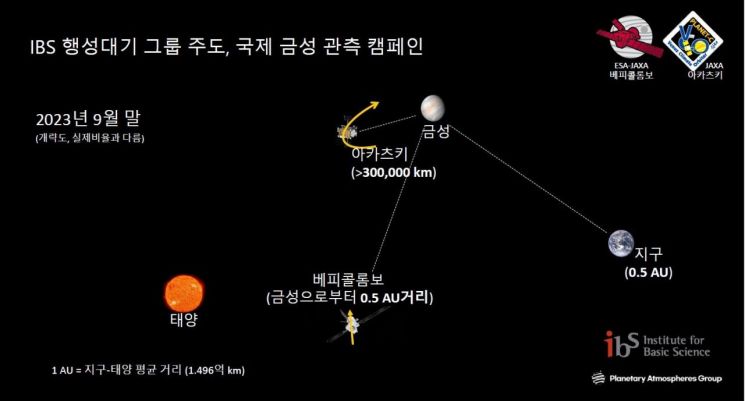
The Institute for Basic Science (IBS) announced on the 29th that the research team led by Yeonju Lee, Chief Investigator (CI) of the Planetary Atmosphere Group at the Climate and Earth Science Research Division, is planning an international Venus observation campaign and recruiting international research teams to participate in ground-based observations.
Venus, the "twin planet" similar in size and mass to Earth, is experiencing climate change. The amount of sulfur dioxide (SO2) gas, the main component of Venus's clouds, sharply decreased after 2008 and then sharply increased after 2016, showing fluctuations. The cause of Venus's climate change is still unknown. Various causes such as volcanic eruptions and "unidentified absorbers" have been suggested in the academic community.
The international Venus observation campaign led by IBS aims to acquire scientific data to measure the amount of unidentified absorbers and sulfur dioxide gas present in Venus's clouds. To this end, Venus will be observed from three locations within the solar system, including Earth. In space, the Mercury probe BepiColombo, jointly launched by the European Space Agency (ESA) and the Japan Aerospace Exploration Agency (JAXA), and the Venus probe Akatsuki, launched by JAXA, will conduct observations. Observations will be carried out at the end of September when BepiColombo, en route to Mercury, faces Venus. BepiColombo will observe Venus from a distant location about 0.5 AU (astronomical units; 1 AU is approximately 150 million km) away. Meanwhile, Akatsuki, which has been continuously observing Venus since entering orbit in December 2015, will conduct observations at a distance of less than 300,000 km.
Simultaneously, ground-based observations of Venus will be conducted using telescopes on Earth. In Korea, Professor Masateru Ishiguro's team at Seoul National University will participate using the Seoul National University telescope, and the use of the Bohyunsan Optical Astronomy Observatory telescope of the Korea Astronomy and Space Science Institute is also under consideration. Additionally, research teams from Japan, Spain, Germany, Switzerland, and Russia have already confirmed participation, and more teams are being encouraged to join.
The reason for conducting simultaneous observations from Earth and space is to observe all wavelength ranges absorbed by the unidentified absorbers. These absorbers absorb from near-ultraviolet to part of the visible light (blue). BepiColombo and Akatsuki plan to observe sunlight reflected from Venus's corona in the ultraviolet range. Ground-based telescopes will observe longer visible and near-infrared wavelengths. All data obtained through the campaign will be centrally analyzed by the IBS Planetary Atmosphere Group.
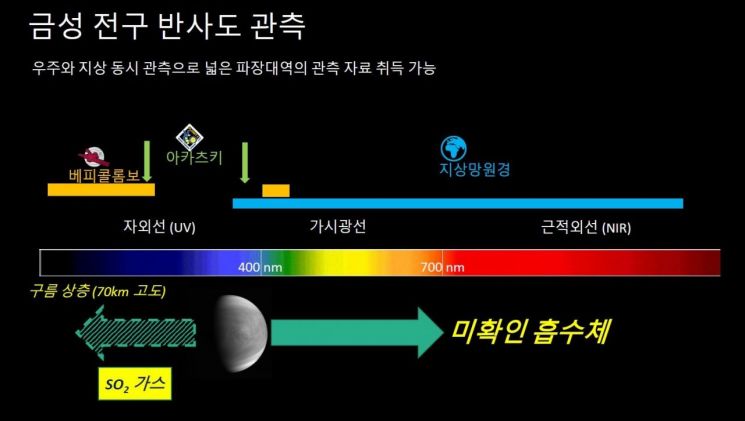
The reason IBS's Planetary Atmosphere Group is overseeing the observation of Venus's atmosphere is thanks to the presence of CI Yeonju Lee. In August-September 2020, while working at the German Aerospace Center, his previous affiliation, he led the first Venus observation campaign. At that time, three space probes and six ground-based telescopes participated in the campaign, investigating wavelengths ranging from 52 to 1700 nm. The results of the data analysis were published last September in the international journal Planetary Science Journal. It was concluded that the absorption spectrum shape of the unidentified absorbers was similar to that captured by NASA's Mercury probe MESSENGER during its Venus flyby in 2007. However, the first campaign left some regret as BepiColombo data contained errors and could not be utilized.
CI Yeonju Lee said, "Although new Venus probe launch plans such as ESA's 'EnVision' and NASA's 'VERITAS' are being announced one after another, it is impossible for a single mission to observe Venus's atmosphere across a wide wavelength range at once. Based on past experience, by supplementing the shortcomings, we will be able to acquire important scientific data that can help us better understand Venus."
© The Asia Business Daily(www.asiae.co.kr). All rights reserved.
![Clutching a Stolen Dior Bag, Saying "I Hate Being Poor but Real"... The Grotesque Con of a "Human Knockoff" [Slate]](https://cwcontent.asiae.co.kr/asiaresize/183/2026021902243444107_1771435474.jpg)
















