Expansion of Electric Vehicle Charging Infrastructure and Safety Enhancement Measures
Payment Possible with One Membership Card...Safety Also Strengthened
The government plans to significantly expand charging facilities to over 1.23 million units to support the distribution of 4.2 million electric vehicles (EVs) by 2030, and improve payment methods so that all chargers can be used with a single membership card. Additionally, it is considering providing extra subsidies for purchasing EVs with superior battery safety.
On the 29th, the Ministry of Environment announced at the National Policy-Related Ministers' Meeting that it had finalized the "Plan to Expand Electric Vehicle Charging Infrastructure and Strengthen Safety," which includes these measures.
As of the end of last month, 465,000 EVs have been distributed, and 240,000 chargers (fast + slow) have been installed. The government aims to increase the number of chargers to 1.23 million to achieve the target of distributing 4.2 million EVs by 2030.
An official from the Ministry of Environment explained, "Currently, the ratio is about 1.9 EVs per charger, which is better than the global average (10 EVs), Europe (13 EVs), and China (8 EVs). However, this is not the end goal; we plan to significantly expand chargers to contribute to the wider adoption of EVs."
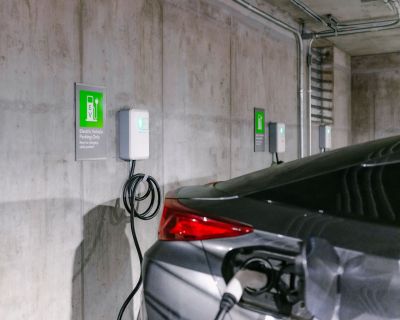
Slow Chargers in Residential Areas, Fast Chargers Concentrated on Highways
The government will focus on installing slow chargers in residential and workplace hubs, and fast chargers at travel hubs such as highway rest areas and gas stations along national roads. First, the mandatory installation ratio of chargers in newly built apartment complexes will be raised from 5% to 10% by 2025, with plans to gradually increase this ratio based on EV adoption trends. Through this, the number of slow chargers at living hubs, which was 184,000 at the end of last year, is targeted to reach 1,085,000 by 2030. Additionally, the number of chargers per highway rest area, currently 3.7, will be increased to 22.
Chargers for commercial and freight EVs will be installed mainly at garages and logistics hubs. Electric buses and taxis will have chargers at garages, commercial electric freight vehicles at garages and logistics hubs, and non-commercial electric freight vehicles at living hubs. Buses and taxis will also be allowed to use gas stations as charging locations in addition to garages.
Furthermore, in places like old apartment complexes with insufficient power capacity, power-distribution type chargers that can autonomously adjust the power needed for EV charging during periods of low electricity usage in the building will be introduced without additional power facility expansion. Mobile chargers will be installed in areas where charger installation is difficult or where charging demand surges.
The government will also improve regulations that restrict charger installation. Exceptions will be allowed in parking lots where green paint on charging parking spaces is difficult, and regulations requiring a certain ratio of fast chargers will be revised to facilitate slow charger installation in old apartments with insufficient power capacity. The current 500 kW limit on underground power supply capacity on highways will be reviewed to allow easier installation of concentrated charging stations (600 kW or more). Additionally, when charging facility electrical equipment is remotely monitored and controlled, the criteria for appointing electrical safety managers will be improved from one manager per 60 sites to one per 120 sites.
Improvement to Allow Payment with a Single Membership Card
Payment methods and information provision will also be enhanced. By the end of this year, the government plans to expand payment information interoperability (roaming) among charging operators so that all chargers can be used with just one membership card. Once roaming agreements are signed, customers without direct contracts with a service provider will be able to use that service. Mobile membership cards and app wallets will be developed within this year to enable easy payment via smartphones.
Additionally, the zero-emission vehicle website will be expanded and revamped to provide integrated management of charger and EV information and real-time monitoring data. Information on charger malfunctions, availability, fees, and locations will also be expanded on navigation systems.
The government will promote strengthening the competitiveness of private charging services. To shift the EV charging market to be private-sector led, about 7,000 public fast chargers operated by the Ministry of Environment will be gradually sold to the private sector. Guidelines will be established to ensure that chargers transferred to private operators maintain a certain level of public service for a specified period.
Additional Subsidies for Purchasing EVs with Superior Battery Safety
The government is also considering providing additional national subsidies for purchasing EVs equipped with fire response functions such as automatic fire reporting or with superior battery safety. Park Yeon-jae, Director of Air Environment Policy at the Ministry of Environment, stated, "The additional subsidies for vehicles with secured safety will be reflected in the '2024 EV Subsidy Execution Guidelines' to be established in the second half of this year. The exact amount of additional incentives still requires a final decision."
To prevent fire accidents, underground parking lots with chargers will be required to have fire-resistant construction. Chargers will be allowed to be installed up to the third basement level, and CCTV installation will be mandatory in underground parking lots with chargers. For rapid fire response, suppression methods tailored to passenger cars, buses, and trucks will be developed and training conducted, and EV fire suppression equipment will be continuously expanded.
Han Hwa-jin, Minister of Environment, said, "This plan will greatly contribute to popularizing EVs and achieving carbon neutrality. We will do our utmost to implement it without delay to resolve consumers’ charging inconveniences and prevent fire accidents."

© The Asia Business Daily(www.asiae.co.kr). All rights reserved.
![Clutching a Stolen Dior Bag, Saying "I Hate Being Poor but Real"... The Grotesque Con of a "Human Knockoff" [Slate]](https://cwcontent.asiae.co.kr/asiaresize/183/2026021902243444107_1771435474.jpg)
















