Recent Trend of Rising Loan Interest Rates Again
Bank Mortgage Variable Rates Exceed 6%
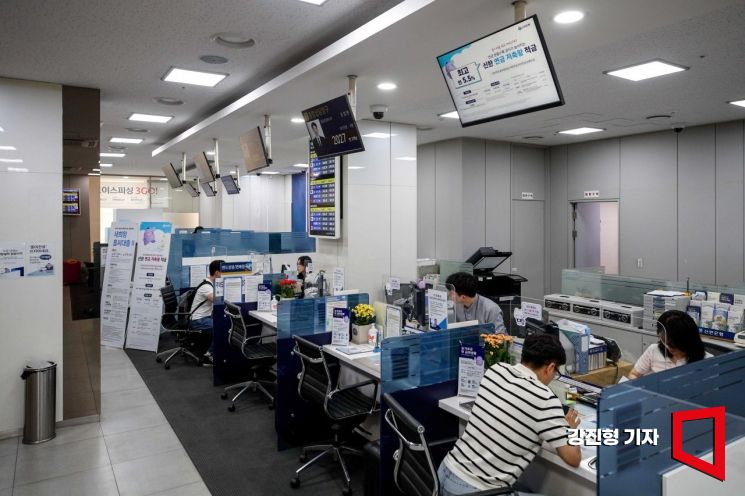 A customer is receiving consultation at a bank loan counseling desk. Photo by Jinhyung Kang aymsdream@
Variable interest rates on mortgage loans at commercial banks have risen above 6%, showing an upward trend. After a decline in the first quarter of this year, interest rates rose again in the second quarter, returning to the 6% range. The noticeable 3% range interest rates that were present until last month have disappeared. According to the five major banks (KB Kookmin, Shinhan, Hana, Woori, NongHyup) on the 29th, the variable mortgage loan interest rates as of the previous day ranged from 4.21% to 6.12%. Fixed interest rates were recorded between 4.00% and 5.81%.
The atmosphere has changed compared to last month when mortgage loans with interest rates in the 3% range were noticeable. According to the Korea Federation of Banks, the proportion of new mortgage loans with 3% interest rates last month was 5.9% at NH NongHyup and 3.5% at Hana Bank. However, within just one month, interest rates have started to creep up again.
The recent rise in interest rates is due to an increase in bank bond yields. One of the main methods banks use to raise loan funds is issuing bank bonds. As the issuance volume of these bank bonds increased, their yields rose, causing loan interest rates to increase accordingly. According to the Korea Financial Investment Association, the 6-month AAA-rated bank bond yield rose from 3.57% on the 2nd of last month to 3.80% on the 28th of this month. During the same period, the 1-year yield increased from 3.64% to 3.86%, and the 5-year yield rose from 3.96% to 4.17%.
A representative from a commercial bank explained, "Starting next month, with the Liquidity Coverage Ratio (LCR) regulations tightening, banks will need to increase their cash asset holdings beyond current levels, so each bank is issuing bank bonds up to the maximum limit." They added, "The Federal Open Market Committee (FOMC) signaling interest rate hikes also influenced the recent rise in rates."
However, fixed interest rates remain lower than variable rates, leading to a noticeable shift toward fixed-rate loans. According to the Bank of Korea, as of April, 80.7% of new mortgage loans were taken out with fixed interest rates, while 19.3% chose variable rates. This is due to financial authorities urging banks to maintain competitiveness in fixed rates over variable rates to minimize the impact of interest rate fluctuations.
Despite the rising interest rates, household loans appear to have bottomed out and are increasing. In this month alone, household loans at the five major banks increased by more than 600 billion KRW. This marks two consecutive months of growth following May. As of the 22nd, the outstanding household loans at the five major banks totaled 678.2162 trillion KRW, up 60.4 billion KRW from the end of May (677.6122 trillion KRW).
© The Asia Business Daily(www.asiae.co.kr). All rights reserved.
![Clutching a Stolen Dior Bag, Saying "I Hate Being Poor but Real"... The Grotesque Con of a "Human Knockoff" [Slate]](https://cwcontent.asiae.co.kr/asiaresize/183/2026021902243444107_1771435474.jpg)
















