- The larger the number of households, the lower the management fees and the higher the tendency for house price appreciation
- 'Gwangmyeong Central I-Park,' a large complex with 1,957 households located in the center of Gwangmyeong New Town
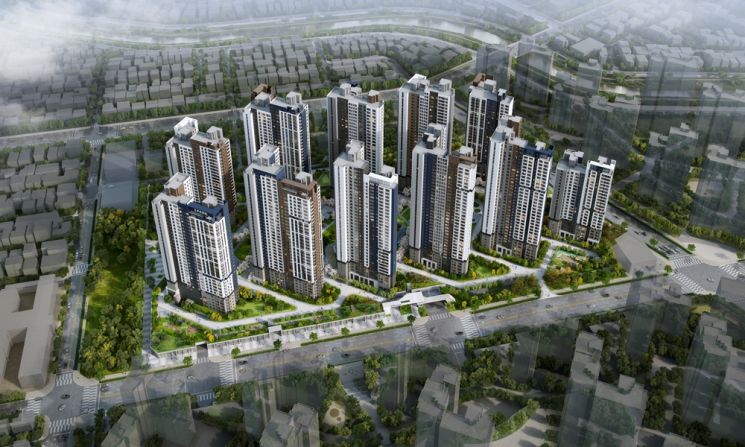
HDC Hyundai Development Company is scheduled to offer the ‘Gwangmyeong Central I-Park’ apartment for sale. Located in the heart of Gwangmyeong New Town, this ‘I-Park’ branded apartment complex will be developed as a large-scale complex with 1,957 households.
Generally, large-scale apartment complexes have the advantage of lower maintenance fees and are favorable for securing price premiums. According to data from the Ministry of Land, Infrastructure and Transport’s ‘Apartment Management Information System,’ the common maintenance fees per square meter for apartments nationwide in March were ▲1,407 KRW/㎡ for 150?299 households ▲1,260 KRW for 300?499 households ▲1,197 KRW for 500?999 households ▲1,170 KRW for 1,000 or more households. The larger the number of households, the lower the maintenance fees.
The size of the complex also affected the average price. According to statistics, the average nationwide apartment sale price per pyeong (3.3㎡) by complex size was △under 300 households 18.47 million KRW △300?499 households 18.57 million KRW △500?699 households 18.62 million KRW △700?999 households 19.05 million KRW △1,000?1,499 households 21 million KRW △1,500 households or more 27 million KRW. The larger the complex, the higher the average sale price, with complexes of 1,500 households or more having the highest average sale price.
Accordingly, the ‘large complex premium’ is also popular in the subscription market. According to Korea Real Estate Agency’s Subscription Home, the place with the highest number of applicants from last year to this year in provincial sales sites (excluding rental-to-sale conversions) was ‘Raemian Forestige,’ which attracted a total of 65,110 applicants and is planned as a large complex with 4,043 households. Also, ‘Unjeong Xi Signature,’ which attracted 41,802 applicants and had the highest number of applicants in the metropolitan area, was a complex of 988 households.
A sales official explained, “Large complexes with more than 1,500 households are basically rare, and they often become landmarks with symbolic significance in the region, so ‘Gwangmyeong Central I-Park’ is also generating high expectations. Large apartment complexes tend to have lower common maintenance fees and higher average sale prices, so residents can expect a ‘tangible’ premium, making them very popular.”
The complex will be developed as a large-scale complex with 11 buildings ranging from 3 basement floors to 36 above-ground floors, totaling 1,957 households with exclusive areas ranging from 39 to 113㎡, of which 425 households will be available for general sale. Composed of 10 types, it offers a wide selection from small to medium and large-sized units, and storage spaces will be provided for each household in all general sale units. It is expected to be highly preferred by the rapidly increasing number of 1-2 person households.
Gwangmyeong New Town, where ‘Gwangmyeong Central I-Park’ is located, is a ‘mini new town-level’ emerging residential area planned for about 25,000 households. Geographically adjacent to Seoul Special City, it is expected to become a huge ‘brand town’ as many large construction companies participate in its development.
‘Gwangmyeong Central I-Park’ is situated in the central area of Gwangmyeong New Town. Since it is located in the original downtown area, there is a variety of completed infrastructure immediately available upon move-in. Within a 500m walking radius of the complex are various convenience facilities such as Gwangmyeong Traditional Market, marts, a movie theater, and Starbucks, making it convenient to use. Right next to the complex, a public complex building integrating culture, administration, and welfare, as well as a fire station, will be established. Additionally, the Cheolsan Station living area can also be shared, boasting a ‘double living zone’ location.
The transportation infrastructure is excellent. Gwangmyeong Sageori Station on Line 7 is about a 5-minute walk away, allowing direct travel westward to Bupyeong-gu Office and Bucheon City Hall, and eastward to the national industrial complex near Gasan Digital Complex or the Gangnam area without transfers. The road network is also excellent, with easy access to the Western Arterial Road, a key road in western Seoul, enabling fast metropolitan travel including to central Seoul.
The ‘one-stop school district’ is another advantage. A daycare center will be located within the complex, and within a 1km radius, there are kindergartens, elementary, middle, and high schools. In particular, Gwangmyeong Elementary School is about a 1-minute walk away, facing the complex across a planned park, providing a ‘green school route’ for residents’ children. The Cheolsan Station academy district is also close, about 1km in a straight line.
The complex is designed as a ‘park-style apartment’ with no cars on the ground. A huge ‘central open space’ runs through the center, featuring a high-end garden composed of four themes. In addition, residents’ exercise facilities, playgrounds for infants and children, and a walking trail circling the complex’s perimeter are planned.
As a large complex, the community facilities are designed on two floors on a large scale. The ground floor includes a family caf?, kids caf?, clubhouse, cultural lecture room, and care center, while the basement floor is divided into two zones: a ‘study zone’ and a ‘sports zone.’
© The Asia Business Daily(www.asiae.co.kr). All rights reserved.
![Clutching a Stolen Dior Bag, Saying "I Hate Being Poor but Real"... The Grotesque Con of a "Human Knockoff" [Slate]](https://cwcontent.asiae.co.kr/asiaresize/183/2026021902243444107_1771435474.jpg)











