Korea Education and Home Evaluation Institute, June Mock Test Scoring Results Notification
Highest Score Korean 136, Math 151... Advantageous for Science Students
The scoring results of the June mock test for the 2024 College Scholastic Ability Test (CSAT) showed that the difficulty level of Korean and English was similar to last year's CSAT, while mathematics was somewhat more difficult.
On the 27th, the Korea Institute for Curriculum and Evaluation announced the scoring results of the June mock test and released the standard score cutoffs and frequency distribution data. The number of test takers for the June mock test was 381,673, of which 306,203 were current students, and 75,470 were graduates and those who passed the qualification exam.
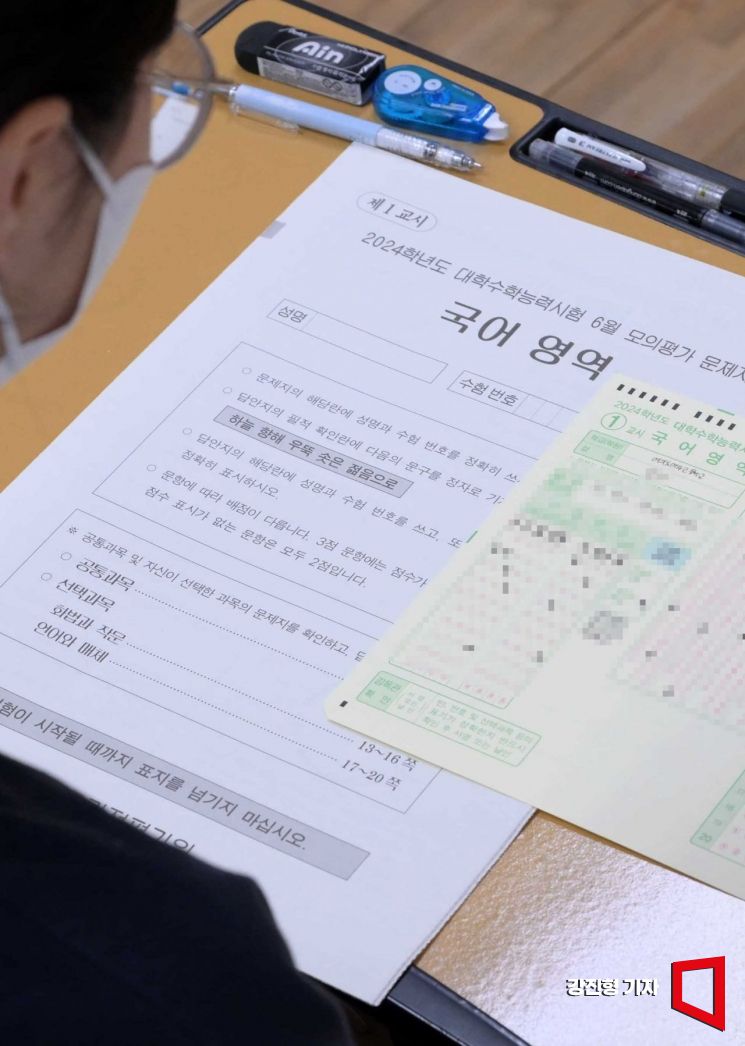 On the morning of June 1st, when the 2024 College Scholastic Ability Test (CSAT) mock exam was conducted, students at Yeouido Girls' High School in Yeongdeungpo-gu, Seoul, were waiting for the exam to start in their classrooms. Photo by Joint Press Corps
In the Korean language section, the ratio of test takers by elective subject was 59.2% for Speech and Writing and 40.8% for Language and Media. Compared to last year's June mock test, the percentage of test takers for Language and Media (35.9%) increased by 4.9 percentage points, while those for Speech and Writing (64.1%) decreased by 4.9 percentage points. This appears to have been influenced by the fact that in last year's CSAT, the standard scores for those who chose Language and Media were calculated higher than those for Speech and Writing at the same raw score.
In the mathematics section, the ratio of test takers by elective subject was 47.8% for Probability and Statistics, 48.5% for Calculus, and 3.7% for Geometry. Compared to last year's June mock test, the percentage of test takers for Calculus (42.8%) increased by 5.7 percentage points, while those for Geometry (5.7%) decreased by 2.0 percentage points, and Probability and Statistics (51.5%) decreased by 3.7 percentage points. This indicates a pronounced trend toward Calculus, which is known to be advantageous in standard score calculation.
In the inquiry section, for the first time, the number of science inquiry test takers surpassed that of social inquiry test takers. The ratio of test takers by inquiry subject was 47.6% for social studies, 48.6% for science, and 3.8% for both. The admissions industry analyzed that many students chose science inquiry due to the tendency of science inquiry test takers to apply to humanities fields, as well as the recent increase in advanced and medical fields, which are concentrated in the so-called natural sciences.
In the social inquiry section, the highest selection rates were for Life and Ethics and Society and Culture, while in the science inquiry section, the selection rates for Biology I and Earth Science I were prominent. In social studies, Economics had the lowest selection rate, and in science, Chemistry II had the lowest. Among test takers, 99.2% chose two subjects in social inquiry, and 99.5% chose two subjects in science inquiry, while 0.8% and 0.5% chose one subject respectively, indicating that most test takers (99.4%) selected the maximum of two subjects.
The highest standard scores for each subject in the June mock test were 136 points for Korean and 151 points for mathematics, with a 15-point difference between subjects, which is a larger gap than last year's CSAT (11 points). Last year's CSAT highest standard scores were 134 points for Korean and 145 points for mathematics. As the score gap between Korean and mathematics widens, the advantage for science track students is expected to deepen. The so-called 'liberal arts invasion' by science students is also likely to become more frequent.
The percentage of students achieving the top grade (Grade 1) in English was 7.62%, similar to last year's CSAT (7.83%) and higher than last year's June mock test (5.5%). It appears that the difficulty was similar to or more challenging than the relatively easy CSAT. However, the percentage of Grade 2 (14.95%) decreased compared to last year's CSAT Grade 2 (18.67%).
Compared to last year's CSAT, social and science inquiry subjects were generally somewhat easier, although there were differences between subjects. The highest standard score among social inquiry elective subjects was 73 points for Life and Ethics, and the lowest was 66 points for Society and Culture, a 7-point difference. In science inquiry, Earth Science II had the highest score at 98 points, and Biology I the lowest at 66 points, showing a significant 22-point difference.
Kim Won-jung, head of the admissions strategy office at Daesung Academy, said, "Considering the recently announced government policies, mathematics, which was somewhat difficult in the mock test, is expected to be easier in the actual CSAT." He added, "Since the common subjects in Korean and mathematics have high weightings, it is wise to prioritize achieving high scores in the common subjects, and not to worry too much about the advantages or disadvantages of elective subjects, but rather to do your best in the subjects you have currently chosen."
© The Asia Business Daily(www.asiae.co.kr). All rights reserved.
![Clutching a Stolen Dior Bag, Saying "I Hate Being Poor but Real"... The Grotesque Con of a "Human Knockoff" [Slate]](https://cwcontent.asiae.co.kr/asiaresize/183/2026021902243444107_1771435474.jpg)















