Ministry of Education to Announce 'Private Education Reduction Measures' on 26th
Expansion of Public Entrance Exam Consulting Centered on Field Teachers
Strengthening National Responsibility for Education, Care, and Early Childhood Public Education
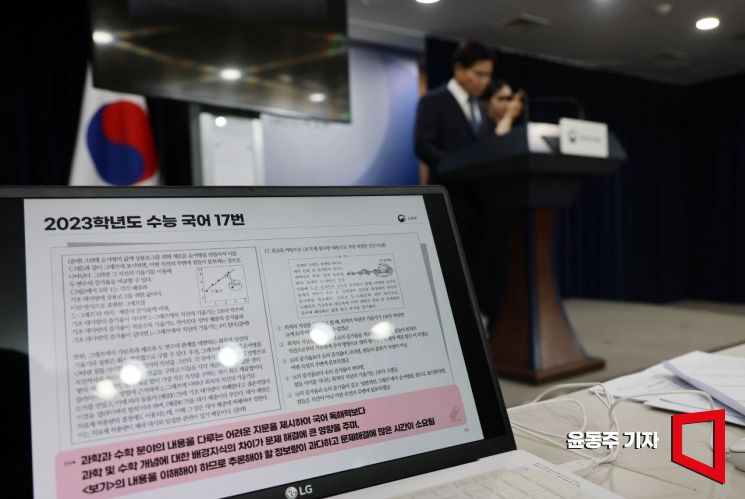 On the 26th, Oh Seung-geol, Director of the Responsible Education Policy Office at the Ministry of Education, is presenting examples of killer questions from the College Scholastic Ability Test at the Government Seoul Office in Jongno-gu, Seoul. Photo by Yoon Dong-joo doso7@
From now on, the College Scholastic Ability Test (CSAT) will eliminate ultra-difficult questions, so-called 'killer questions,' and the CSAT question committee will be composed mainly of on-site teachers.
After-school supplementary subject instruction will also be expanded to ensure that all admission processes can be conducted within the scope of regular public education classes.
On the 26th, the Ministry of Education held a briefing at the Government Seoul Office and announced the 'Measures to Reduce Private Education' containing these details.
The average monthly private education expenditure per student in elementary, middle, and high school in 2022 was 410,000 KRW, marking the highest level since the survey began in 2007. The average monthly private education expenditure per student has been steadily increasing except for the periods 2010-2012 and 2020.
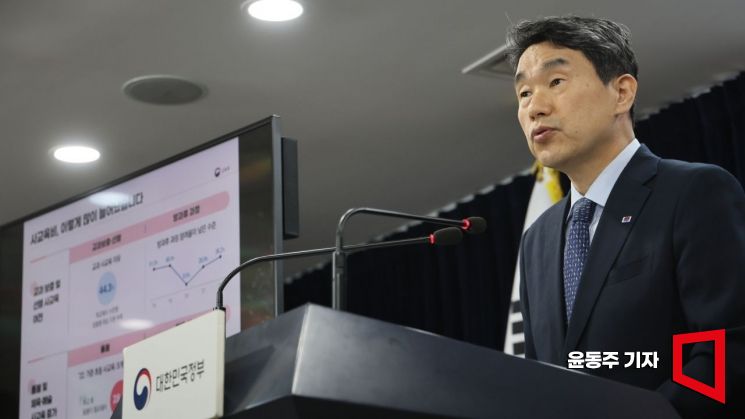 Education Minister Lee Ju-ho is announcing measures to reduce private education expenses on the 26th at the Government Seoul Office in Jongno-gu, Seoul. Photo by Dongju Yoon doso7@
‘Killer Questions’ Removed from CSAT...CSAT Question Committee Centered on ‘On-site Teachers’
First, the Ministry of Education plans to remove so-called 'killer questions' that, while having discriminatory power, favor students who have learned problem-solving techniques and undergone repetitive training through private education, so that students who have diligently studied within the public education curriculum can be fairly evaluated in the CSAT.
The Ministry analyzed the Korean, Mathematics, English, and Science sections of the CSAT over the past three years and the June mock exam this year to firmly exclude questions outside the public education curriculum, and announced a total of 26 examples of killer questions.
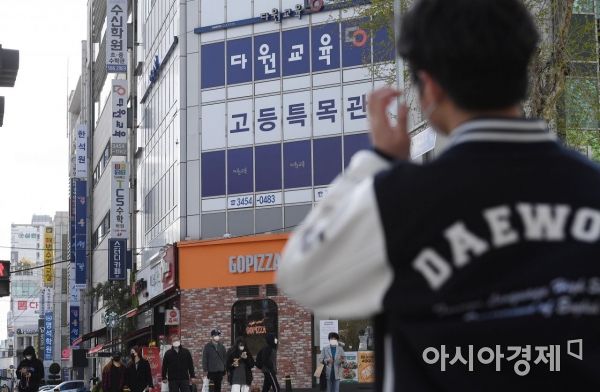
To prevent such killer questions from appearing in the future and to ensure that questions with appropriate difficulty and discriminatory power are presented, a provisional 'Fair CSAT Evaluation Advisory Committee' will be operated, centered on on-site teachers who have a high understanding of the curriculum.
Along with this, an independent 'Fair CSAT Question Review Committee' will be newly established to intensively review questions during the CSAT question development stage. The confidentiality obligations of CSAT question committee members will be strengthened, and starting next year, additional CSAT question information will be disclosed. The plan to compose the question committee mainly of on-site teachers will also be considered.
All Admissions Within the Curriculum...Expansion of Public Consulting and Provision of Customized Education for Each Student
Furthermore, the Ministry of Education plans to carefully inspect and prevent the recurrence of university-specific exams such as essay and oral tests from exceeding the level and scope of the curriculum. Cross-checking will be strengthened to ensure school performance and written evaluations are conducted within the curriculum, and the impact assessment of advanced learning will be firmly implemented.
To prevent the maintenance of autonomous private high schools, foreign language high schools, and international high schools from triggering private education, the Ministry will maintain post-admission student selection and self-directed learning screening and improve admission screening impact assessments. Public consulting and provision of university admission information, such as free university admission counseling centered on on-site teachers, will also be expanded.
Fundamentally, a plan has been established to reduce private education in middle and high school subjects by linking with the 'Public Education Competitiveness Enhancement Plan,' which innovates regular classroom instruction. The EBS system will be revamped so that students can study independently using EBS, paid courses such as the middle school premium will be converted to free courses, and level-based learning content will be greatly expanded.
The Ministry of Education plans to expand tutoring and after-school supplementary subject instruction so that students can receive sufficient supplementary guidance within public education without the need for private education, and will support the activation of various learning support services provided by local governments and the private sector.
Absorbing Private Education Demand through National Responsibility for Education and Care...Strengthening Early Childhood Public Education
To absorb the demand for private care education, the Ministry will expand Neulbom Schools and first-grade EduCare, and significantly expand physical education and arts programs. Facilities such as swimming pools for physical education and arts will be gradually expanded, and local universities, Taekwondo associations, and private organizations in the community will participate to support students with various physical education and arts activities.
The Digital Sprout Camp will be expanded to allow students to experience various new industry fields such as software (SW) and artificial intelligence (AI). For new private education fields such as medical school entrance exam classes, the Ministry will conduct reality checks and provide information to parents. Support for free course tickets such as 'After-school 1+1' will be expanded, and after-school program outsourcing will be inspected and system improvements pursued.
To prepare for private education demand ahead of elementary school entrance, a linked transition semester between kindergarten and elementary school will be operated, and financial support for after-school programs with high demand such as English and arts and physical education will be expanded. Various themed kindergartens such as forest, ecology, and atopy healing will also be designated.
In the mid to long term, the Ministry plans to actively reflect parents' demand for early childhood education in the integrated kindergarten and childcare model and revise the curriculum for ages 3 to 5 in cooperation with the National Education Commission. To systematically respond to early childhood private education, a survey on early childhood private education expenses will be newly established, and the Ministry will closely communicate with each city and provincial education office to normalize the operation of some early childhood English academies and other irregular operations with sufficient grace periods.
Minimizing Parents' Anxiety through Active Communication...Operation of Intensive Reporting Period for Private Education Cartels
To prevent parents from over-relying on private education due to anxiety, opportunities for communication with parents will be greatly increased. The Ministry of Education plans to increase policy participation opportunities such as parent monitoring groups and inform the public of the government's determination to reduce private education and various policy efforts through talk concerts and other nationwide campaigns.
Along with this, the Ministry expressed its intention to listen to public voices and reflect parents' opinions in education policy while promoting follow-up measures. Each city and provincial education office will also be required to establish their own measures to reduce private education, and cooperation with central government agencies, national research institutes, universities, and related organizations will be strengthened to reduce private education.
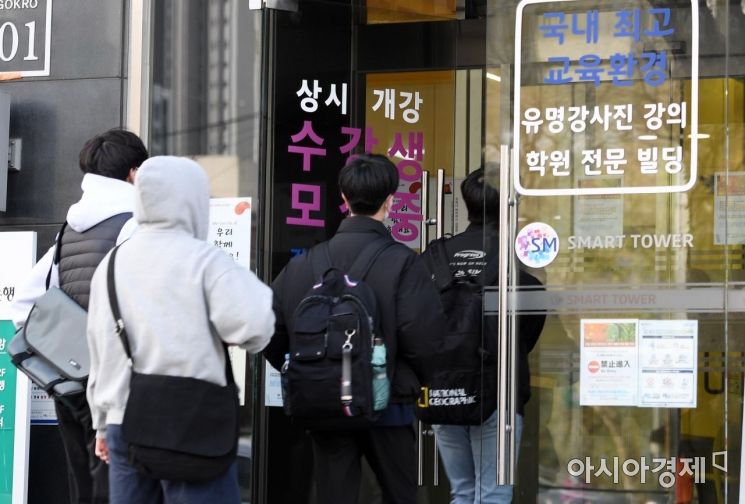
Regarding CSAT killer questions, a Private Education Cartel and Irregularities Reporting Center has been established to receive and handle reports of false or exaggerated advertisements that provoke anxiety among students and parents, and an intensive reporting period has been in operation for two weeks since the 22nd.
Monitoring of unfair advertisements will be strengthened in cooperation with the Korea Internet Advertising Foundation. The Ministry of Education has set a policy to firmly take action in close cooperation with related agencies against cartels and irregularities of some large specialized CSAT private academies reported or monitored.
Lee Ju-ho, Deputy Prime Minister for Social Affairs and Minister of Education, said, "To solve the complex and difficult private education problem, students, parents, education offices, related ministries, and even local governments and the private sector must all put their heads together and join forces," and added, "I ask you to trust the Yoon Suk-yeol administration and join us with your strength and wisdom."
© The Asia Business Daily(www.asiae.co.kr). All rights reserved.
![Clutching a Stolen Dior Bag, Saying "I Hate Being Poor but Real"... The Grotesque Con of a "Human Knockoff" [Slate]](https://cwcontent.asiae.co.kr/asiaresize/183/2026021902243444107_1771435474.jpg)


















