Office worker A, who works in Yeouido, spent about 280,000 won on lunch last month. Compared to the beginning of this year, monthly average spending increased by as much as 30,000 to 40,000 won. This was mainly the result of using inexpensive nearby baekban (set meal) restaurants and snack bars where one can have a simple meal. A said, "Since the prices of nearby restaurants are at least 8,000 to 10,000 won per meal, even lunch expenses have become burdensome, so I am increasing my use of the company cafeteria."
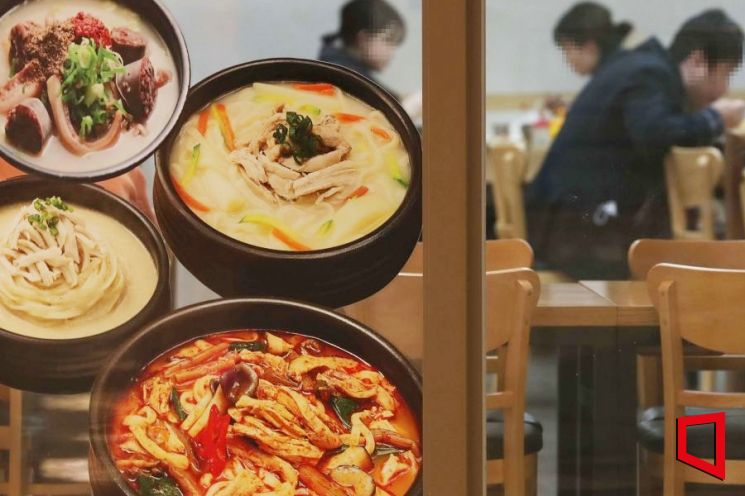
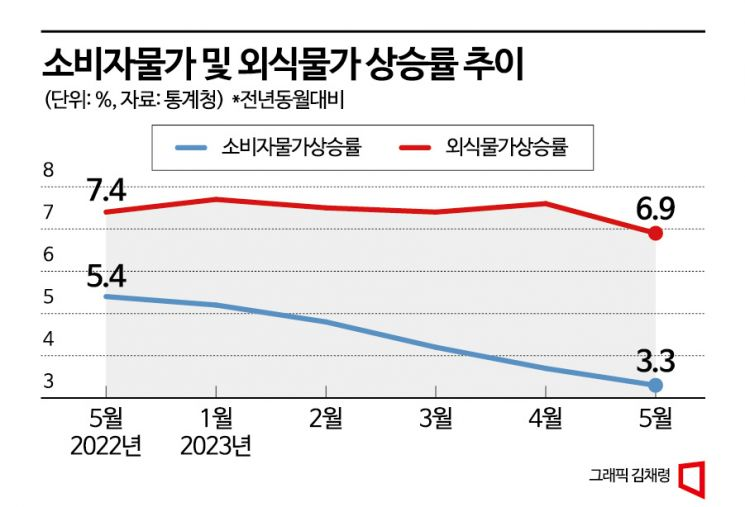
The rise in dining-out prices shows little sign of slowing down. Last month, the consumer price inflation rate compiled by the government recorded 3.3% compared to the same period last year, falling to the 3% range for the first time in 14 months since February 2022 (3.7%). However, dining-out prices rose by 6.9%, maintaining an upward trend for 30 consecutive months since December 2020. According to the Korea Consumer Agency, the average prices of eight popular dining-out items in Seoul last month increased by 8.8% compared to a year ago. Naengmyeon (cold noodles) was priced at 10,923 won, followed by bibimbap (10,192 won), samgyeopsal (pork belly, 200g basis, 19,150 won), and samgyetang (ginseng chicken soup, 16,423 won), all exceeding 10,000 won. Light meals such as jajangmyeon (black bean noodles, 6,915 won) and gimbap (3,200 won) also steadily increased in price.
Given this situation, office workers who eat lunch outside are feeling the burden of lunch expenses firsthand. According to KB Kookmin Card's analysis of card usage by office workers in five major business districts in Seoul and the metropolitan area from January to May this year, the average monthly spending during lunch hours was 239,000 won. This represents a 17.1% (35,000 won) increase compared to 2019 (204,000 won).
The persistent rise in dining-out prices is due to multiple factors, including international food prices and labor cost increases. According to the Ministry of Agriculture, Food and Rural Affairs, food material costs account for the largest share of dining-out business expenses at 41%, followed by labor costs at 34%, rent at 10%, fees at 8%, and taxes at 7%. Although grain prices peaked in the second quarter of last year following the Russia-Ukraine war in February 2022 and then dropped significantly, prices of items such as salt, which is experiencing shortages, sugar, milk, and meat may still rise due to variables like abnormal summer weather and the Russia-Ukraine grain export agreement.
High labor costs and increases in public utility fees are also influencing the rise in dining-out prices. The average labor cost in the dining industry is about 15,000 won, approximately 56% higher than the minimum wage (9,620 won). Next year's minimum wage will be applied uniformly without differentiation by industry, which is likely to increase labor cost burdens for self-employed business owners. Electricity and gas rates, which rose by over 20% for two consecutive months until last month, are also major factors in dining cost increases. Last month, electricity rates rose 25.7% and city gas rates rose 25.9% compared to the same period last year.
The government has recently begun comprehensive efforts to reduce raw material burdens in the food and processing industries, starting with recommending a reduction in ramen prices. It has extended tariff quotas (temporarily lowered tariff rates on a certain quantity of imported goods) on major food items such as sugar and pork. For mackerel, a 0% tariff will be applied on up to 10,000 tons until August, and for sugar and raw sugar materials, a 0% tariff will be applied until the end of this year. Kim Jeong-sik, an emeritus professor of economics at Yonsei University, said, "Increases in public utility fees such as electricity and gas can influence the pressure on service price increases and act as factors stimulating inflation."
© The Asia Business Daily(www.asiae.co.kr). All rights reserved.
![Clutching a Stolen Dior Bag, Saying "I Hate Being Poor but Real"... The Grotesque Con of a "Human Knockoff" [Slate]](https://cwcontent.asiae.co.kr/asiaresize/183/2026021902243444107_1771435474.jpg)

















