'Garbage Mountain' in Chile's Atacama Desert
40,000 Tons of Waste Accumulate Annually Over Decades
A photo capturing the massive 'garbage landfill' visible even from space has been released. It is the Atacama Desert in Chile, infamous as the 'world's mountain of trash.'
Recently, the US satellite imagery company SkyFi posted an image taken near the northern Chilean city of Iquique in the Atacama Desert. The photo shows a brownish patch where soil, sand, dunes, and rocks are mixed together. However, an unusual color that does not fit the desert landscape also stands out. Tiny dark or grayish particles cover the edges of the desert.
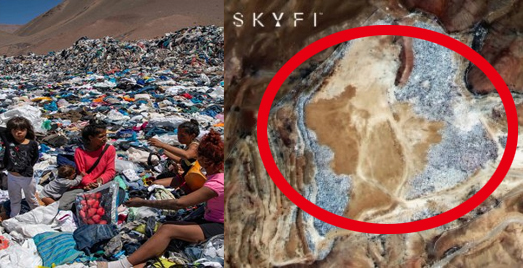 (Left) Residents of the Atacama Desert are examining a pile of discarded clothes. [Image source=AFP Yonhap News]
(Right) Enlarged view of the Atacama Desert in Chile as seen from space [Image source=Skyfi]
Shockingly, these foreign particles in the photo are all waste. SkyFi stated, "The size of the pile of discarded clothes is recognizable even from space," and urged that "the fashion industry needs to change." The area covered by the waste is 6.5 hectares (ha), equivalent to nine soccer fields.
This desert has become a 'mountain of trash' where clothing waste from around the world accumulates. Garments mass-produced in developing Asian countries such as China and Bangladesh flow into wealthy developed countries in the US, Europe, and East Asia, and clothes discarded in these developed countries are dumped back into this desert.
In particular, the port of Iquique, where the Atacama Desert is located, receives about 59,000 tons (t) of used clothing annually. Of this, 20,000 t are sold to secondhand dealers, and the remaining 39,000 t of unsold clothing are all dumped in the desert.
These clothes are not biodegradable and are chemically treated, so they are not allowed in private landfill sites. For this reason, they are dumped as-is in the ownerless desert land.
The clothing waste dumped in the desert has accumulated over decades, now forming a huge mountain. It is estimated that it will take hundreds of years or more for this waste to decompose naturally, and the waste poses a significant risk of polluting air quality and groundwater.
According to a report released by the United Nations (UN) in 2019, global clothing production doubled between 2000 and 2014. The fashion industry accounts for 20% of the world's wastewater production, and producing one pair of jeans requires 7,500 liters of water.
© The Asia Business Daily(www.asiae.co.kr). All rights reserved.
![Clutching a Stolen Dior Bag, Saying "I Hate Being Poor but Real"... The Grotesque Con of a "Human Knockoff" [Slate]](https://cwcontent.asiae.co.kr/asiaresize/183/2026021902243444107_1771435474.jpg)















