Labor Sector Proposes Minimum Wage of '12,210 Won'
Self-Employed and Small Business Communities 'Boiling Over'
The statutory deliberation deadline for the Minimum Wage Commission to discuss next year's minimum wage is just one week away. Meanwhile, dialogue between the business sector and labor sector remains at a standstill.
While the labor sector has proposed an initial demand of 12,210 KRW per hour for next year's minimum wage, the business sector insists on reaching an agreement on sector-specific differentiated application first, resulting in a deadlock.
 The statutory deliberation deadline for the Minimum Wage Commission to discuss next year's minimum wage is just one week away. Meanwhile, the dialogue between the business sector and labor sector remains at a standstill.
 [Photo by Seodongmin, Asia Economy]
On the 22nd, the Minimum Wage Commission under the Ministry of Employment and Labor held its 7th plenary meeting at the Government Complex Sejong in the afternoon. At this meeting, the issue of whether to apply sector-specific differentiation, which sharply divided the positions of workers and employers, was put to a vote and rejected. Accordingly, next year, the minimum wage will be applied uniformly to all workplaces without differentiation by sector.
Meanwhile, prior to the meeting, the worker representatives of the Minimum Wage Commission held a press conference and announced that they had finalized an initial demand of 12,210 KRW per hour. Based on a 40-hour workweek and 209 hours per month, this converts to a monthly salary of 2,551,890 KRW.
The worker representatives argued, "Considering the fundamental purpose of the minimum wage system, the distribution of household members of minimum wage workers, recommendations from international organizations, and opinions from the Minimum Wage Commission's system improvement committee, household living expenses should be the core criterion in determining the minimum wage."
Growing Concerns from Self-Employed and Small Business Owners Ahead of Minimum Wage Finalization
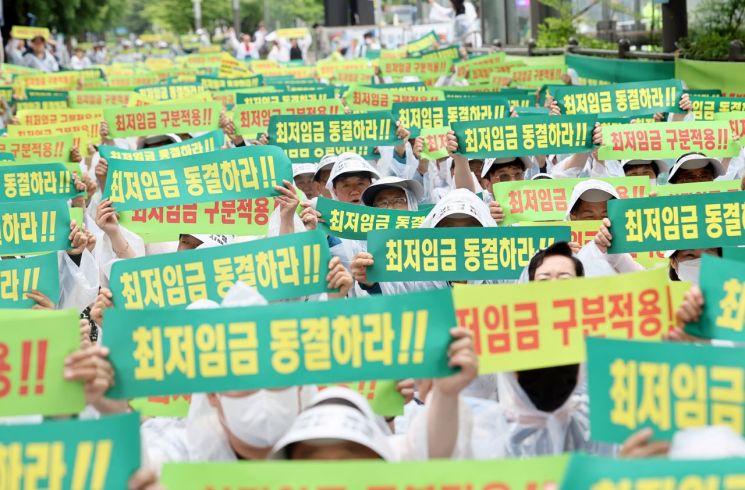 On the afternoon of the 21st, members of the Korea Federation of Micro Enterprise held up related hand placards at a rally urging the freeze of the minimum wage near the National Assembly Station in Seoul.
 [Photo by Yonhap News]
The minimum wage deliberation proceeds by narrowing the gap between the initial demands submitted by the labor and business sectors. Although it is highly unlikely that the minimum wage will be set at the amount initially proposed by the labor sector, self-employed individuals are deeply troubled by the labor sector's proposal.
After the labor sector proposed 12,210 KRW as next year's minimum wage, complaints have been pouring in on communities where self-employed and small business owners gather.
On the Naver cafe "Apeunikka Sajangida" ("Because It Hurts, I'm a Boss"), a community of self-employed and small business owners, various opinions about the labor sector's minimum wage proposal have been posted.
One self-employed person said, "If the minimum hourly wage reaches 12,000 KRW, I will seriously have to do everything alone," while another expressed concern, saying, "If the hourly wage increases by more than 26%, the self-employed will really be in big trouble."
Other voices included comments such as, "Even part-timers could make a living," and "If a couple both work part-time, they would earn over 5 million KRW and become middle class?does this make sense?"
There are also concerns that a sharp increase in the minimum wage will ultimately cause prices to rise even more steeply. One self-employed person said, "Don't they realize that food prices that used to be 10,000 KRW will rise to 12,000 KRW?" Another predicted, "Prices will rise further next year."
Among Workers in Businesses with Fewer Than Five Employees, 3 out of 10 "Do Not Receive Minimum Wage"
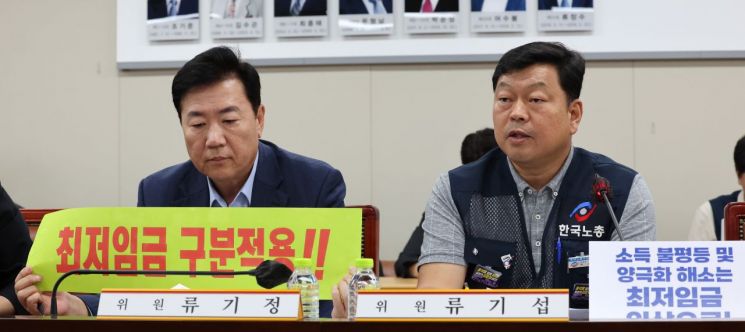 On the afternoon of the 22nd, at the 7th plenary meeting held in the Minimum Wage Commission meeting room at the Government Complex Sejong in Sejong City, Ryu Gi-seop, Secretary General of the Korean Federation of Trade Unions and a worker representative (right), began speaking. Meanwhile, employer representatives, including Ryu Gi-jeong, Executive Director of the Korea Employers Federation (left), held up signs emphasizing the need for differentiated application of the minimum wage.
 [Photo by Yonhap News]
Concerns have also been raised that if the minimum wage increases, businesses with fewer than five employees will face intensified management difficulties. Currently, 3 out of 10 workers in businesses with fewer than five employees do not receive the minimum wage, and the situation is expected to worsen if the minimum wage rises.
According to the "2022 Analysis of Minimum Wage Underpayment Rates and International Comparison of Minimum Wage Levels," released by the Korea Employers Federation in April after analyzing Statistics Korea data, among approximately 3.75 million workers in businesses with fewer than five employees, 29.6% (1,109,000 workers) do not receive the minimum wage. In contrast, the underpayment rate in businesses with 300 or more employees is only 2.3%, indicating that smaller businesses find it more difficult to comply with minimum wage regulations.
Small business owners also unanimously agree that sector- and size-specific differentiated application, considering on-site conditions, is absolutely necessary. At the "Small Business Survival Rights Defense Minimum Wage Freeze Rally" held on the 21st in front of the National Assembly in Yeouido, Seoul, participants strongly urged, "We strongly request the implementation of differentiated minimum wage application."
The labor sector opposes sector-specific differentiated application, arguing that it causes stigmatization effects.
The Minimum Wage Commission plans to hold its 8th plenary meeting on the 26th to continue discussions on next year's minimum wage level.
© The Asia Business Daily(www.asiae.co.kr). All rights reserved.
![Clutching a Stolen Dior Bag, Saying "I Hate Being Poor but Real"... The Grotesque Con of a "Human Knockoff" [Slate]](https://cwcontent.asiae.co.kr/asiaresize/183/2026021902243444107_1771435474.jpg)

















