A Pair of 2m Long Swords "Ceremonial Use"
Blade Inscription Matches 'Yi Chungmugong Jeonseo' Records
Highly Skilled Waist Sword Storage Box Designated as Treasure
Artifacts including a long sword imbued with the noble spirit of Admiral Yi Sun-sin (1545?1598) are designated as national treasures.
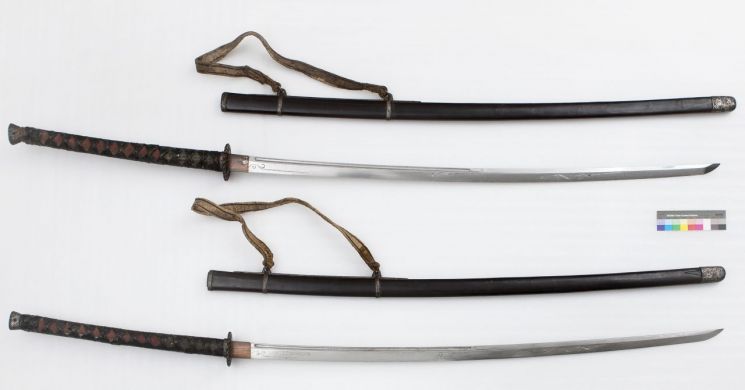
On the 22nd, the Cultural Heritage Administration announced its plan to designate a pair of swords from the nationally designated treasure collection 'Yi Sun-sin Artifacts' as a national treasure under the name 'Yi Sun-sin Jangdo.' Opinions from various sectors will be gathered for a month, and the final decision will be made after review by the Cultural Heritage Committee.
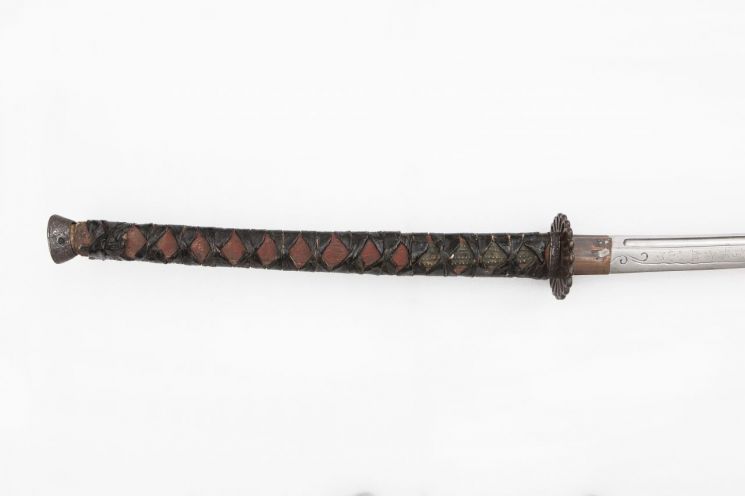
The Yi Sun-sin Jangdo is a pair of swords similar in size and shape that have been managed as treasures since 1963. Each sword measures up to 2 meters in length and comes with its own scabbard. The sword handles are made by wrapping fish skin (eopi) around wood and painting it red. To prevent slipping when held, rectangular metal plates are attached, and black-painted leather straps are crossed in an 'X' shape around the handle.
There are poetic lines written by Yi Sun-sin himself on the blades. On the blade of the sword measuring 196.8 cm in length, the inscription reads 'Samcheok Seocheonsanhadongsaek (三尺誓天山河動色),' which means 'Swearing by the three-foot sword to heaven, the mountains and rivers tremble.' On the other sword, 197.2 cm long, the phrase 'Ilhwi Sotang Hyeolyeom Sanha (一揮掃蕩血染山河)' is inscribed, meaning 'With one sweep, blood stains the mountains and rivers.'
Researcher Choi Narae from the Cultural Heritage Administration’s Intangible Cultural Heritage Division stated, "This matches the records in the 'Yi Chungmugong Jeonseo (1795).'" She added, "Inside the sword handle, there is an inscription reading 'Gaposa-wol-il Jo Taegwireon Lee Museong Jak (甲午四月日造太貴連李茂生作),' indicating it was made in April of the Gap-o year by Taegwireon and Lee Museong." The Gap-o year corresponds to 1594.
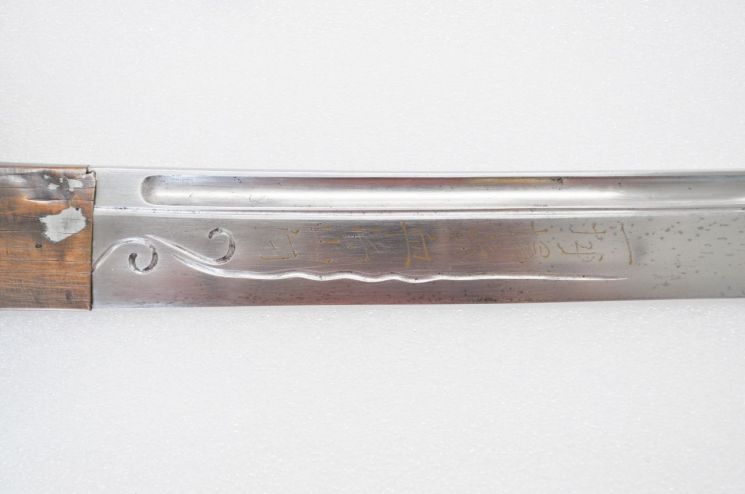
The Yi Sun-sin Jangdo follows traditional styles seen in Joseon Dynasty military swords. However, the method of crossing leather straps in an 'X' shape to firmly grip the handle, the curvature of the blade, and the way the blood groove (fuller) is made are presumed to be influenced by Japanese swords.
The Cultural Heritage Administration regards the Yi Sun-sin Jangdo as a highly valuable artifact symbolizing Admiral Yi’s historical significance. The sharpness of the blade, wave-patterned engraved decorations, silver inlay techniques decorating the handle and scabbard fittings, use of traditional crafts, refined balance, and excellent preservation state were all highly praised. However, considering its length of 2 meters, it is judged unlikely to have been used in actual combat. Lee Sang-hoon, former deputy director of the Army Museum who participated in the on-site investigation, said, "It is presumed to have been used more for ceremonial purposes or as a tool for calming the mind rather than for practical combat." He added, "Historical records rarely mention swords of this size being used in real battles."
Meanwhile, the Cultural Heritage Administration announced plans to add a storage box for a belt (yodae) to the existing 'Yi Sun-sin Artifacts' collection and to rename the cup and saucer called 'Dobaegudae' to 'Peach-shaped cup and saucer.' Accordingly, the Yi Sun-sin Artifacts collection will consist of a jade ornament called Okro that decorates the gat (traditional hat), the belt and its storage box, and the peach-shaped cup and saucer. The newly added belt box is designed to cover like a lid without a separate locking mechanism.
Researcher Choi explained, "It was made using traditional Joseon craftsmanship techniques and a high level of skill. It is much larger than similar artifacts and is well preserved." She added, "It also holds great academic and documentary value in helping to understand the culture of official uniforms and belt storage at the time."
© The Asia Business Daily(www.asiae.co.kr). All rights reserved.
![Clutching a Stolen Dior Bag, Saying "I Hate Being Poor but Real"... The Grotesque Con of a "Human Knockoff" [Slate]](https://cwcontent.asiae.co.kr/asiaresize/183/2026021902243444107_1771435474.jpg)

















