Minimum Wage Committee Vote... 15 Oppose, 11 Support
Labor Sector's Initial Minimum Wage Demand: 12,210 Won
Management's Backlash... "Ignoring Reality, Telling Us to Close"

The minimum wage will continue to be applied uniformly without distinction by industry next year.
On the 22nd, the Minimum Wage Commission announced that at the 7th plenary meeting held at the Government Sejong Complex, a vote on whether to apply the minimum wage by industry next year was rejected with 15 votes against and 11 in favor. The vote was attended by 8 worker representatives, 9 employer representatives, and 9 public interest representatives. Kim Jun-young, a worker representative (Secretary General of the Korean Metal Workers' Union), who was arrested on charges of wielding a weapon during a 'watchtower sit-in' protest, was absent.
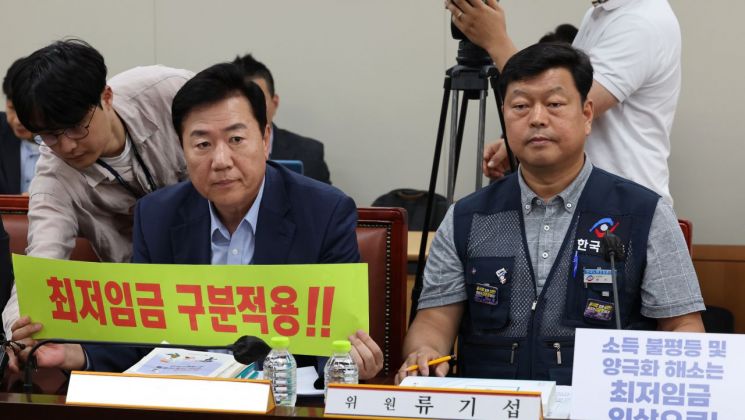 On the afternoon of the 22nd, at the 7th plenary meeting held in the Minimum Wage Commission meeting room at the Government Complex Sejong in Sejong City, Ryu Ki-jung, Executive Director of the Korea Employers Federation and a user committee member (left), emphasized the necessity of differentiated application of the minimum wage while holding up a placard. On the right is Ryu Ki-seop, Secretary General of the Korean Confederation of Trade Unions and a worker committee member.
 [Photo by Yonhap News]
The business sector has argued that differentiated application of the minimum wage should be introduced, setting lower minimum wages for three industries: chain convenience stores, taxi transportation, and accommodation and food services (with some exceptions). They particularly claimed that these three industries have significantly lower payment capacity, as revealed by government research projects and official Minimum Wage Commission review materials.
On the other hand, the labor sector opposed the differentiated application by industry, arguing that it contradicts the purpose and intent of the minimum wage system. Although Article 4 of the Minimum Wage Act provides a basis for differentiated application by industry, the labor sector claims that this system is effectively obsolete.
The only time the minimum wage was applied differently by industry was in the first year of the system's introduction in 1988. At that time, the Minimum Wage Commission applied an hourly wage of 487.5 won to 16 high-wage industries such as beverages, furniture, and printing and publishing, and 462.5 won to 12 low-wage industries such as food products, textiles and clothing, and electronic devices, considering the wage gap.
Since the labor and business sectors are evenly matched, it is interpreted that the public interest representatives, mostly scholars, cast many of the opposing votes.
The business sector strongly opposed the result. The Korea Employers Federation (KEF) expressed "serious concern and regret" in a statement released immediately after the rejection, saying, "Despite presenting the proposal after careful consideration of reasonable standards and side effects of uniform implementation, we feel a sense of emptiness and helplessness that the decision was made again to apply a single minimum wage." They added, "Since the differentiated application was rejected, next year's minimum wage must be determined based on industries that cannot afford the current minimum wage level."
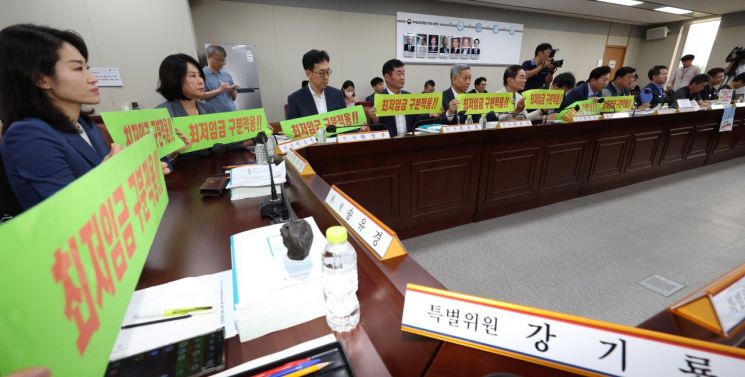 On the afternoon of the 22nd, at the 7th plenary meeting held in the Minimum Wage Commission meeting room at the Government Complex Sejong in Sejong City, employer representatives emphasized the need for differentiated application of the minimum wage by holding up placards.
 [Image source=Yonhap News]
Meanwhile, the labor sector proposed an initial demand for next year's minimum wage at 12,210 won per hour. Converted to a monthly salary (applying 209 working hours per month), this amounts to 2,551,890 won. This is 26.9% higher than this year's minimum wage (9,620 won per hour, 2,010,580 won per month). Worker representatives cited the following reasons for the increase: ▲ revitalization of domestic consumption through minimum wage increase ▲ realization of minimum wage increase reflecting workers' household living expenses ▲ resolution of worsening wage inequality ▲ decrease in real wages of minimum wage workers due to expanded wage inclusion.
The appropriate living cost for next year, converted based on consumer price index forecasts, is 14,465 won. The average ratio of labor income to current income for worker households is 84.4%, and 84.4% of 14,465 won is the 12,210 won proposed by the labor sector that day.
The minimum wage deliberation proceeds by narrowing the gap between the initial demands submitted by the labor and business sectors. The employer representatives did not present an initial demand that day. Their position was that deciding on the differentiated application of the minimum wage by industry should come first, and the meeting ended amid opposition from employer representatives immediately after the vote. Regarding the initial demand proposed by the labor sector, Ryu Ki-jung, Executive Director of KEF, criticized, "Ignoring the desperate reality of small and medium-sized enterprises and small business owners, demanding a 26.9% increase is equivalent to telling everyone to close their doors."
© The Asia Business Daily(www.asiae.co.kr). All rights reserved.
![Clutching a Stolen Dior Bag, Saying "I Hate Being Poor but Real"... The Grotesque Con of a "Human Knockoff" [Slate]](https://cwcontent.asiae.co.kr/asiaresize/183/2026021902243444107_1771435474.jpg)

















