Visiting Daejeon Nears Lab Future Technology Research Center
Drone Capable of Autonomous Flight Without GPS Signal to Launch Next Year
Demonstration of Near-Complete Model... Indoor Obstacle Avoidance Flight
A drone takes off and begins autonomous flight without human control. However, this place is an indoor space enclosed on all sides. Although it is a spacious area of about 590㎡ with a ceiling height of 6 meters, GPS signals necessary for the drone's autonomous flight are not available indoors. The drone uses vision sensors and Lidar to navigate. When given the command to go straight ahead, it hesitates in front of obstacles scattered around but soon avoids them and continues flying. This scene is only possible because of technology that quickly analyzes the indoor environment through sensors acting as eyes, determines the path, and derives the optimal route.
This place is NearsLab’s Future Technology Research Center located in Daedeok-gu, Daejeon. The indoor autonomous flight drone currently undergoing testing is a technology not yet commercialized in Korea. Including this technology, the Future Technology Research Center develops technologies that will literally be responsible for the company’s future. NearsLab, which has been active worldwide in the field of wind power safety inspection with its autonomous flight drone solutions, has now set this place as its forward base to challenge the defense sector.
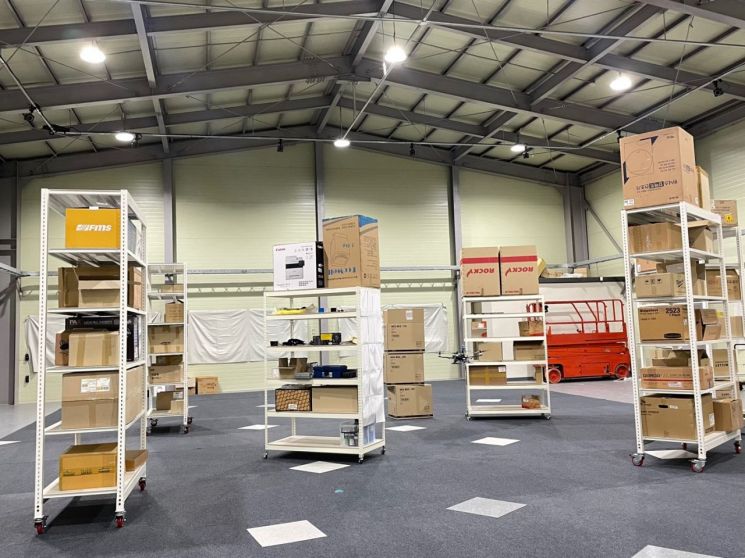 An indoor autonomous flight drone demonstration is being conducted at Nears Lab Future Technology Research Institute located in Daedeok-gu, Daejeon.
On the 22nd, Youngseok Jeong, Chief Technology Officer (CTO) of NearsLab, said, "A small drone body for indoor autonomous flight will be completed this year, and a product with the solution applied will be released next year." Founded in 2015 by CEO Jaehyuk Choi and CTO Jeong, NearsLab applies artificial intelligence (AI) autonomous flight drones to facility safety inspections. The drones autonomously inspect large infrastructures such as wind turbines, dams, and bridges. Naturally, until now, drones have mainly been flown outdoors. The decision to develop indoor autonomous flight solutions was made because this technology was judged to be applicable in the defense sector. CTO Jeong said, "Indoor autonomous flight drones will be developed to a level applicable in the defense sector next year," adding, "We expect demand in urban warfare, building or tunnel searches, and similar scenarios." Militarily, it can be used for reconnaissance and surveillance in battlefields where GPS signals are disrupted, underground, tunnels, and indoor operations.
For drones to fly indoors, they must autonomously fly without GPS signals and be small and lightweight. Drones under 2 kg are required. Cameras and sensors must also be miniaturized. There were no existing drone products that met these conditions. This is why the Future Technology Research Center is directly developing the drone bodies. Since establishing the research center in 2021 and starting related research, many trials and errors have been experienced. It was not easy to build a test environment reflecting various indoor spaces where drones would fly. There were many malfunctions during testing, with misrecognition of obstacles being a representative example. Continuous research, development, and testing were conducted until stable autonomous flight became possible. Even when obstacle positions were changed and tests were repeated that day, the drone independently found the optimal path again. According to CTO Jeong, the technology has been developed to the stage where it can recognize moving obstacles.

NearsLab has completed technology development and plans to seek various opportunities in line with the government’s recent support projects that enable rapid application of innovative technologies from startups and private companies to the defense sector. This year, by being selected as a partner company of the Daejeon Defense Venture Center, NearsLab has also secured a foundation to be more active in the defense field.
Besides the defense sector, NearsLab expects that the related technology can be utilized in various industrial fields such as logistics centers and factories. CTO Jeong said, "For example, in a logistics warehouse, there will be no need for people to climb up high on forklifts to check inventory," adding, "It will have versatile uses in facility inspections and public safety."
© The Asia Business Daily(www.asiae.co.kr). All rights reserved.
![Clutching a Stolen Dior Bag, Saying "I Hate Being Poor but Real"... The Grotesque Con of a "Human Knockoff" [Slate]](https://cwcontent.asiae.co.kr/asiaresize/183/2026021902243444107_1771435474.jpg)
















