Illegal Cultivation of Opium Poppies for Drugs Detected in Yeongwol and Daegu
How to Distinguish Drug-Use Opium Poppies by Presence of Fine Hairs
Amid recent cases of illegal cultivation of opium poppies for drug use being uncovered one after another, this time, opium poppies were found in a garden at a rest area in Yeongwol.
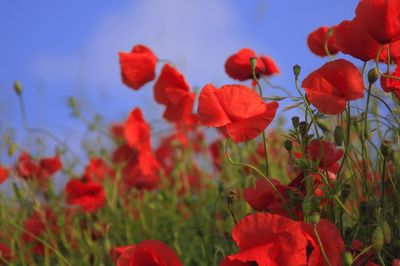
According to a report by G1 Broadcasting on the 20th, an illegal cultivation site of opium poppies, which are raw materials for drugs such as opium and heroin, was discovered in a garden next to a rest area building in Yeongwol, Gangwon Province.
A total of 170 opium poppy plants were found this time, and the garden owner claimed, "I got a few plants from an elderly woman in the neighborhood," saying they thought it was just a flower.
When the police said, "Grandmothers usually wrap (poppy) leaves in food and eat them," the owner responded that they did not know.
The police requested the National Forensic Service to analyze the components of the seized poppies and will decide whether to file charges based on the results.
Earlier, on the 7th, about 100 opium poppy plants were found in a garden at an elderly care facility in Daegu.
The police seized all the poppies and sent them to the National Forensic Service for analysis, confirming on the 16th that they were indeed narcotics.
Accordingly, the Daegu Seobu Police Station announced that it plans to investigate the director and related personnel of the elderly care facility on charges of violating the Narcotics Control Act.
How to distinguish between drug-use and ornamental poppies?
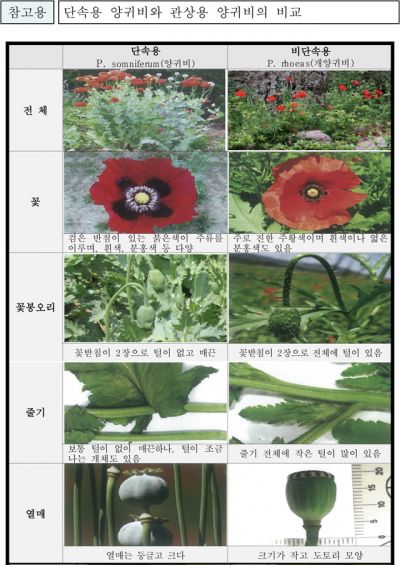 Comparison of Opium Poppies for Crackdown and Ornamental Opium Poppies [Photo by National Police Agency]
The biggest difference between drug-use opium poppies and ornamental poppies is the presence or absence of fine hairs.
According to the National Police Agency data, the stems of drug-use poppies are usually smooth without hairs, whereas ornamental poppies have many small hairs all over the stem.
The flowers of drug-use poppies are mainly red with black spots, while ornamental poppies' flowers are mostly deep orange.
Also, the fruits of drug-use poppies are round and large, but the fruits of ornamental poppies are small and acorn-shaped.
Meanwhile, according to the Narcotics Control Act, anyone who cultivates plants that are raw materials for drugs or possesses raw materials, seeds, or seedlings containing their components can be punished with up to five years in prison or a fine of up to 50 million won.
In particular, even cultivating a single drug-use poppy plant is subject to punishment, so special caution is required.
© The Asia Business Daily(www.asiae.co.kr). All rights reserved.
![Clutching a Stolen Dior Bag, Saying "I Hate Being Poor but Real"... The Grotesque Con of a "Human Knockoff" [Slate]](https://cwcontent.asiae.co.kr/asiaresize/183/2026021902243444107_1771435474.jpg)

















