Ministry of Education Announces 'Measures to Enhance Public Education Competitiveness'
Operates Focused Reporting Period for Private Education Interest Cartel
Regarding President Yoon Seok-yeol's recent strong remarks about the College Scholastic Ability Test (CSAT), Lee Ju-ho, Deputy Prime Minister for Social Affairs and Minister of Education, stated that "removing killer questions does not mean a 'watered-down CSAT'."
On the 21st, while announcing the 'Measures to Enhance the Competitiveness of Public Education' at the government Seoul office, Deputy Prime Minister Lee emphasized multiple times that the CSAT is designed to sufficiently secure differentiation and is not an 'easy CSAT.'
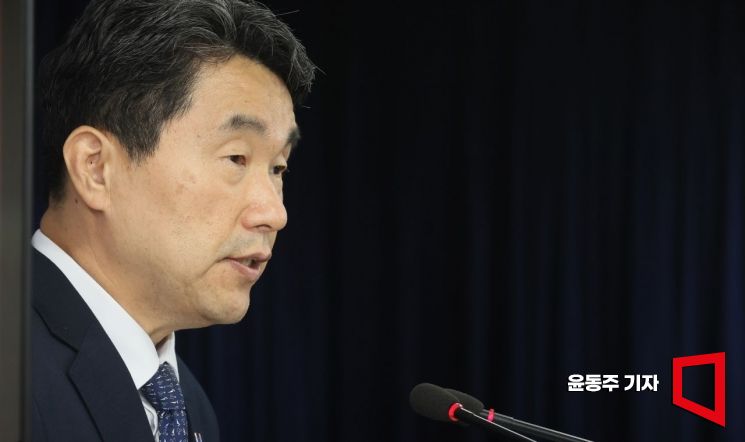 Education Minister Lee Ju-ho is briefing on measures to enhance the competitiveness of public education at the Government Seoul Office in Jongno-gu, Seoul, on the 21st. Photo by Dongju Yoon doso7@
On that day, Deputy Prime Minister Lee said, "We share the recognition that killer questions, which are not covered within public education, cause anxiety among students and parents and push them toward private education, which is problematic. However, the direction of boldly removing such killer questions is by no means the so-called 'watered-down CSAT' as some worry. I want to say that there is a way to sufficiently secure differentiation. Parents can rest assured."
Earlier, President Yoon criticized, "If the CSAT requires excessive background knowledge or questions on topics not covered in the public education curriculum, isn't that essentially telling students to rely on private education? Are the education authorities and private education industry on the same side?" In response, Deputy Prime Minister Lee announced that killer questions would be excluded from this year's CSAT.
Regarding the criticism that one reason students attend private academies is because they cannot obtain entrance exam information from public education, he said, "Some measures are included in the private education countermeasures to be announced early next week," adding, "We will explain in detail then."
He continued, "Starting tomorrow, we will operate a two-week intensive reporting period for private academy irregularities such as private education interest cartels and false or exaggerated advertisements."
Deputy Prime Minister Lee emphasized, "By absorbing the demand for private education into public education and excluding content not covered in the public education curriculum from the CSAT, we will create a fair CSAT that prevents children from being pushed to private academies and relieves parents from the burden of private education."
Additionally, regarding the decision not to introduce the common subject achievement evaluation system (absolute grading) despite the full implementation of the high school credit system, he explained that it was a decision made considering the burden on the field. He said, "There was a very close debate until the end, but since the opinion that the burden on the field is significant was strong, we decided to postpone it."
In the context of controversy over the highest-ever private education expenses, concerning the decision to maintain autonomous private high schools and foreign language high schools, he explained, "Since these are existing systems and supplementary measures such as the establishment of regional talent selection have been prepared, there will be no additional factors inducing private education," adding, "Maintaining these is very important for educational diversity and autonomy."
© The Asia Business Daily(www.asiae.co.kr). All rights reserved.
![Clutching a Stolen Dior Bag, Saying "I Hate Being Poor but Real"... The Grotesque Con of a "Human Knockoff" [Slate]](https://cwcontent.asiae.co.kr/asiaresize/183/2026021902243444107_1771435474.jpg)















