Song Gap-seok "Claims to Cut Seats Expecting Shallow Public Opinion"
Kim Byung-min "Reducing by 30 is the Ruling Party's Common Position"
Jo Hae-jin "Proportional Representation Should Be Reduced"
Lee Jae-myung, leader of the Democratic Party of Korea, declared the 'waiver of parliamentary immunity,' followed by Kim Ki-hyun, leader of the People Power Party, countering with a proposal to 'reduce the number of National Assembly members by 30.' Both statements are made in the context of 'relinquishing the privileges of lawmakers,' but their feasibility is questionable. In particular, the reduction in the number of lawmakers is closely linked to the ongoing discussions on electoral system reform, requiring bipartisan agreement. However, the opposition party opposes this, making bipartisan consensus unlikely.
Song Gap-seok, Supreme Council member of the Democratic Party of Korea, expressed opposition on the 21st during SBS's 'Kim Tae-hyun's Political Show,' saying, "We believe that a responsible ruling party leader's stance is to say, 'We will restore and create politics that gives hope,' but (Leader Kim) relies on shallow public opinion to cut and reduce the number of lawmakers."
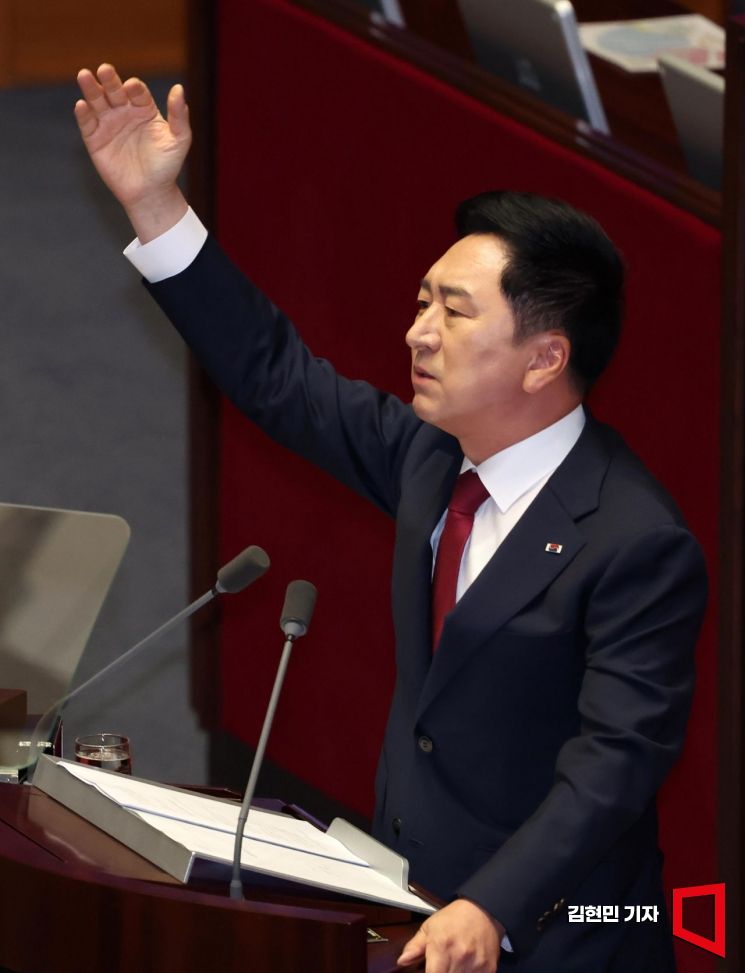 Kim Ki-hyun, leader of the People Power Party, is delivering a negotiation group representative speech at the National Assembly on the 20th. Photo by Kim Hyun-min kimhyun81@
He also pointed out that electoral reform is already underway through the Special Committee on Political Reform. Song said, "In our National Assembly, 300 lawmakers have had various discussions through the plenary committee for the first time in decades, and through the National Deliberation Committee, public opinion was gathered on issues such as reducing the number of lawmakers or reducing or abolishing proportional representation. Within just two weeks, 500 citizens who participated in the deliberation submitted quite progressive opinions. Therefore, (Leader Kim's proposal) is a very irresponsible suggestion."
Leader Kim, in a speech to the negotiating bodies in the National Assembly the previous day, said, "Leader Lee promised the public to waive parliamentary immunity but broke that promise as easily as flipping his palm," and proposed a joint pledge on three major political reforms to the opposition party, including waiving parliamentary immunity, reducing the number of lawmakers by 10%, and introducing a no work, no pay system. This was a counterproposal to the opposition, adding the reduction of lawmakers and the no work, no pay system to Lee's 'waiver of parliamentary immunity.' It is part of the 'competition to relinquish lawmakers' vested privileges.'
Kim's statement on 'reducing the number of lawmakers' is not the first. In April, during a Supreme Council meeting when plenary committee discussions on electoral reform were in full swing, he officially advocated for 'reducing the number of lawmakers.' After the meeting, he told reporters, "I discussed (reducing the number of lawmakers) with lawmakers who proposed it to the plenary committee and gathered opinions from many lawmakers around me," adding, "I firmly believe that reducing the number of lawmakers is the right stance." However, at that time, it was not adopted as the party's official position.
However, this time, there is a response within the ruling party that it could become the party's official stance. Kim Byung-min, Supreme Council member of the People Power Party, said on MBC radio, "(It is) the general position of the People Power Party," and Jang Ye-chan, youth Supreme Council member of the People Power Party, said on BBS radio, "If this is officially raised as an agenda at the party meeting, it is likely to be adopted as the party's stance by a majority, excluding some minority opinions." Jo Hae-jin, People Power Party lawmaker and subcommittee chair of the National Assembly's Special Committee on Political Reform, also conveyed the atmosphere on KBS radio, saying, "When lawmakers have conversations in small groups, many share sympathy, so if the floor leader convenes a party meeting for discussion, it seems highly likely to be adopted as the party's stance."
The ruling party is leaning toward reducing the number of lawmakers by cutting 'proportional representation' seats rather than 'constituency' seats. Lawmaker Jo said, "If the current semi-proportional representation system is maintained or expanded, it may require increasing proportional seats. If, based on past trial and error, it is concluded that the mixed-member proportional system is no longer necessary, there is a plan to reduce proportional seats," adding, "Personally, I think proportional seats should be reduced or abolished to reduce the total number of seats."
Supreme Council member Kim also pointed out the problems of the current proportional representation system, saying, "Regardless of party, the fact that proportional representatives, after about three years, are busy looking for constituencies to run in next time, is a problem that both ruling and opposition parties commonly raise, which causes public disapproval."
© The Asia Business Daily(www.asiae.co.kr). All rights reserved.
![Clutching a Stolen Dior Bag, Saying "I Hate Being Poor but Real"... The Grotesque Con of a "Human Knockoff" [Slate]](https://cwcontent.asiae.co.kr/asiaresize/183/2026021902243444107_1771435474.jpg)
















