Electronic Monitoring Possible Before Sentencing
Military Pension Act Amendment Proposed
Broadcasting Act Not Included in Plenary Session Agenda
On the afternoon of the 21st, the ruling and opposition parties will hold a plenary session of the National Assembly to submit the 'Stalking Crime Punishment Act Amendment,' which allows perpetrators to be punished even if the victim does not want punishment for stalking crimes. Controversial bills such as the 'Broadcasting Three Acts Amendment' are not expected to be submitted.
The proposed amendment to the Stalking Crime Punishment Act includes the abolition of the 'non-prosecution upon victim's request' provision for stalking crimes. It also specifies that providing, distributing, or posting the other party's personal information or location information to a third party, or impersonating the other party using identity information, shall be included as stalking acts.
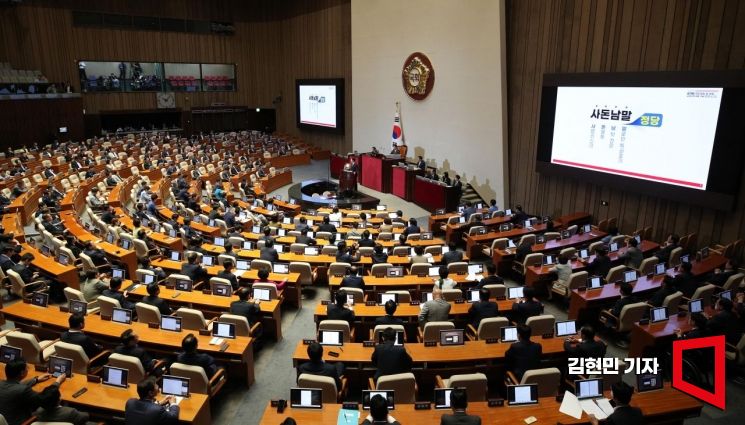 Kim Ki-hyun, leader of the People Power Party, is delivering a negotiation group representative speech at the National Assembly on the 20th. Photo by Kim Hyun-min kimhyun81@
Along with this, the National Assembly also approved the 'Electronic Device Attachment Act Amendment,' allowing the attachment of electronic devices to stalking offenders as a provisional measure even before a stalking crime verdict is issued.
During the plenary session, the 'Special Act on the Punishment of Sexual Crimes (Sexual Crime Punishment Act) Amendment' is also scheduled to be processed. The amendment stipulates that video recordings of testimonies from victims under 19 years old can only be used as evidence if the accused and defendant are guaranteed the opportunity for cross-examination.
This measure follows the Constitutional Court's decision in December last year that the provision in the Sexual Crime Punishment Act allowing video recordings of testimonies from victims under 19 years old to be used as evidence in court based solely on the recognition of a trusted person present during the investigation was unconstitutional.
Additionally, the National Assembly plans to submit the 'Military Pension Act Amendment,' which provides that if the salary of elected officials with military backgrounds is less than their retirement pension amount, the difference will be paid as a pension. The amendment aims to improve conditions for retired military personnel entering local basic councils with lower salaries.
Furthermore, through the 'Amendment for Suicide Prevention and the Promotion of a Culture of Respect for Life,' 'youth' will be explicitly included in suicide prevention measures across the life cycle, requiring the establishment of suicide prevention planning. It also mandates national institutions, public institutions, and schools under the Elementary and Secondary Education Act to conduct suicide prevention education.
Meanwhile, the 'Broadcasting Three Acts Amendment,' which was submitted to the National Assembly plenary session on April 27 under opposition leadership and aims to change the governance structure of public broadcasters such as KBS, MBC, and EBS, is not expected to be on the agenda that day. Lee So-young, the floor spokesperson for the Democratic Party of Korea, stated in the morning, "The Broadcasting Act will not be included in today's plenary session agenda."
© The Asia Business Daily(www.asiae.co.kr). All rights reserved.
![Clutching a Stolen Dior Bag, Saying "I Hate Being Poor but Real"... The Grotesque Con of a "Human Knockoff" [Slate]](https://cwcontent.asiae.co.kr/asiaresize/183/2026021902243444107_1771435474.jpg)
















