Gacha Toy Craze
Popular Among Women in Their 20s and 30s
Capsule toys, once considered the exclusive domain of children, are gaining popularity among Japanese people in their 20s and 30s. As the main consumer base shifts to adults in their 20s and 30s, the industry is reportedly adopting strategies to increase both the price and quality of products, releasing premium items priced at over 2,000 yen (about 20,000 won) per play.
On the 21st, Nihon Keizai Shimbun (Nikkei) reported on the craze for capsule toys, known as "Gacha," among Japanese people in their 20s and 30s. Gacha refers to vending machines where you insert a coin and turn a handle to receive a toy randomly enclosed in a transparent capsule. Originally started in the U.S. as "capsule toys," the first machine in Japan appeared in 1965, selling toys for 10 yen (about 91 won) per play. The name derives from the sound made when turning the handle, "gacha gacha" (ガチャガチャ, clack-clack).
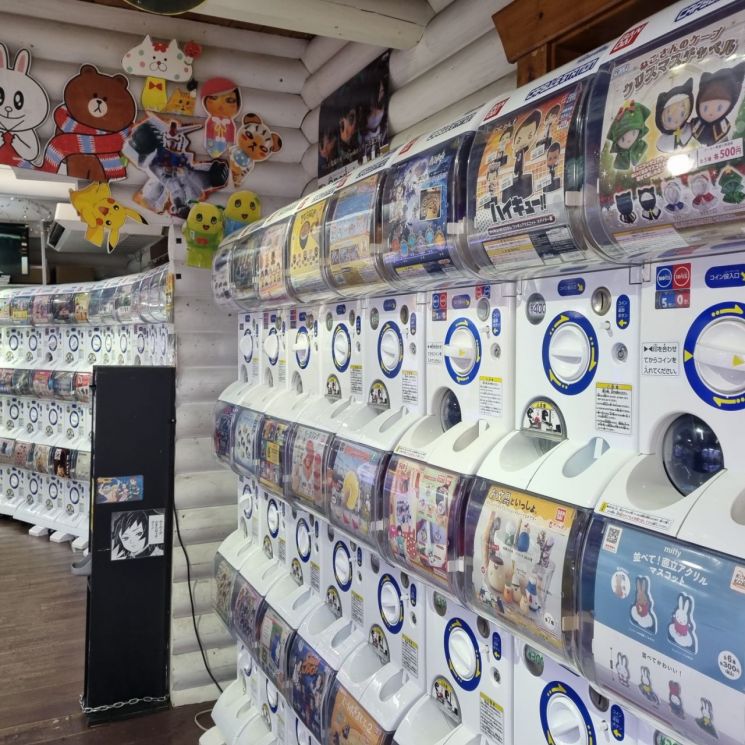
In bustling urban areas of Japan, specialty stores housing hundreds of Gacha machines are emerging one after another. Since Gacha specialty stores do not require staff to assist customers, they were recognized as a "contactless industry" that was not severely impacted during the COVID-19 pandemic. In Tokyo’s Ikebukuro district, a specialty store with over 1,200 Gacha machines has opened. Recently, it has become trendy on social media (SNS) to carry the toys obtained from Gacha in transparent pouches, which has further accelerated the craze.
According to the Japan Capsule Toy Association, the Gacha market size reached 72 billion yen (about 655.5 billion won) as of last year. Yusuke Tsuzuki, the association’s representative director, stated, "We are currently experiencing the fifth boom of Gacha. In the past, many people purchased Gacha impulsively, but now, with the emergence of specialty stores, consumer behavior has shifted to purchasing with specific purposes."
As the number of customers in their 20s and 30s increases, the placement of Gacha machines has also changed from the past. Previously, machines were placed within easy reach of children, such as next to stationery stores or toy counters, but recently, machines are increasingly stacked three or more levels high to match adult eye level.
Companies are also actively targeting the changed customer base. A representative from Luluaque’s Capsule Toy Division, a toy company operating Gacha specialty stores, said, "Our business targets adult women in their 20s and 30s. As adults become the main customers, there is a demand for higher quality, which is driving prices up." In fact, the average price of products handled by Luluaque was 302 yen (about 2,752 won) in 2021, but due to rising raw material costs and other factors, it increased by about 15% to 347 yen (about 3,162 won) this year.
Major toy company Bandai has also entered the competition for high-quality and high-priced products. Previously, Bandai’s Gacha machines only handled products priced below 500 yen (about 4,550 won), but since 2021, they have released machines capable of vending items priced at 2,500 yen (about 22,704 won). Since March, focusing on high-priced products, they have introduced a biological encyclopedia series priced at 2,000 yen (about 18,227 won) per play.
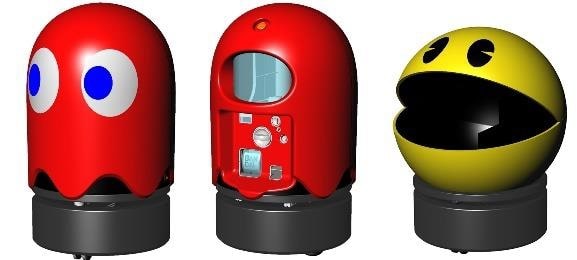
Recently, a new type of vending machine was also launched. Bandai’s Gacha machine "Gashadroid," announced this month, recreates the world of Pac-Man and is equipped with wheels, allowing the machine to move autonomously.
Experts analyze that the reason for Gacha’s popularity is that it satisfies the tastes of people in their 20s and 30s who frequently use social media. Kazuhiko Ono, representative director of the Japan Gacha Association, said, "There are many unique products that can only be purchased through Gacha, such as bus stop buttons. Customers who might not have bought these products through conventional sales methods enjoy the experience of turning the handle and purchasing. Unlike crane games such as claw machines, one can obtain the product immediately after inserting money, which is a distinctive feature."
Hideo Kumano, senior economist at Dai-ichi Life Research Institute, added, "It has played a role in fulfilling the latent desires of young people who share the joy of consumption through social media. Since various innovative products are released every month, it generates a lot of buzz and provides the joy of unexpectedly obtaining unique items."
© The Asia Business Daily(www.asiae.co.kr). All rights reserved.
![Clutching a Stolen Dior Bag, Saying "I Hate Being Poor but Real"... The Grotesque Con of a "Human Knockoff" [Slate]](https://cwcontent.asiae.co.kr/asiaresize/183/2026021902243444107_1771435474.jpg)
















