Low-Credit Company Financing Sources CLO Market Shrinks
Capital Raising Costs Surge... Default Concerns Spread
Investment sentiment toward low-credit companies in the United States is freezing up, causing borrowing costs for these companies to rise. Due to the Federal Reserve's (Fed) interest rate hikes and the economic slowdown, funding rates have increased, raising concerns about the heightened bankruptcy risk for companies with low credit ratings.
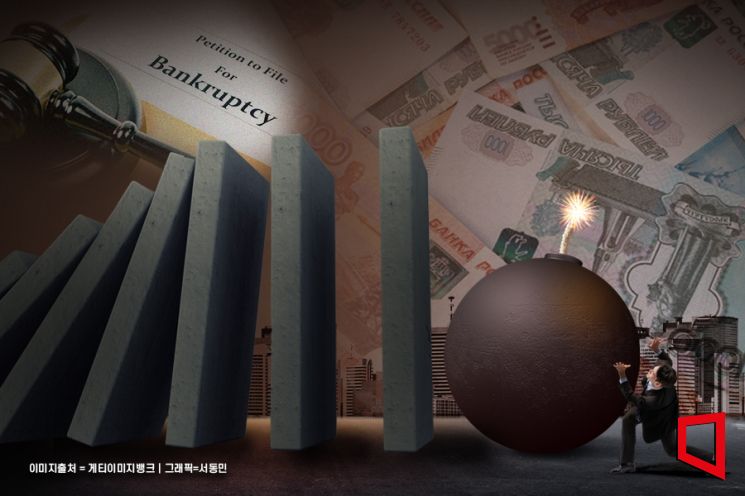
According to major foreign media on the 20th (local time), U.S. low-credit companies are facing difficulties in raising funds as the $1.4 trillion (approximately 1,800 trillion KRW) 'junk loan' market has recently contracted.
In particular, the market for Collateralized Loan Obligations (CLOs), which bundle bank loan receivables from low-credit companies and reissue them as collateral, is rapidly shrinking. According to market research firm PitchBook LCD, the volume of new CLO issuances from the beginning of this year to June 12 was in the $50 billion range, down from around $60 billion a year ago. Compared to 2021, when CLO issuances surged to about $70 billion, the decline is even more significant.
Not only new CLO investments but also reinvestments are decreasing. According to Bank of America (BofA), the proportion of CLOs reaching the end of their reinvestment period is expected to rise from 20% at the end of last year to 40% by the end of this year. This indicates that it is becoming increasingly difficult for low-credit companies to raise funds.
PG&E, California's largest electric utility company, recently had its loan extension put on hold. Dental service provider Heartland Dental and digital media company Internet Brands saw borrowing costs increase during loan maturity extension processes. In particular, Heartland's loan interest rate jumped by as much as 1.25 percentage points. The number of companies that can only secure loans by strengthening investor protection measures is also increasing.
The Fed's aggressive tightening and worsening macroeconomic conditions such as the economic slowdown have led to a tightening of corporate funding markets. Concerns about junk loan defaults are gradually becoming a reality. According to Goldman Sachs, there have been 18 defaults totaling $21 billion (approximately 27 trillion KRW) in the $1.4 trillion U.S. junk loan market this year. This amount exceeds the total amount of bad loans that occurred over the past two years (2021?2022). The junk loan default rate also surged from 4% in April last year to 6% in April this year.
Rob Jaible, Global Head of Liquidity Credit Strategy at Blackstone, said, "Companies need to attract the interest of new lenders, so capital raising costs may also be affected." BoAf strategist Prateek Gupta explained, "Traditionally, large banks, which are major investors in CLOs, began withdrawing from this market after stress tests last year," adding, "Banks have become more conservative in their investment portfolios."
As more companies are pushed into liquidity crises due to high interest rates, concerns about domino defaults are also growing, especially among low-credit companies. Steve Caprio, Head of Credit Strategy for Europe and the U.S. at Deutsche Bank, stated, "We are preparing for entry into a default cycle."
© The Asia Business Daily(www.asiae.co.kr). All rights reserved.
![Clutching a Stolen Dior Bag, Saying "I Hate Being Poor but Real"... The Grotesque Con of a "Human Knockoff" [Slate]](https://cwcontent.asiae.co.kr/asiaresize/183/2026021902243444107_1771435474.jpg)















