Ministry of Environment Certification, UNESCO Designation Expansion Plan
East Coast Also Promoting UNESCO Global Geopark
All areas of Uiseong-gun, Gyeongbuk, have been certified as a National Geopark.
Gyeongbuk Province announced on the 21st that, following the review and resolution of the Geopark Committee, the entire area of Uiseong-gun was certified as the fourth National Geopark in Gyeongbuk and the 15th National Geopark certified by the Ministry of Environment nationwide.
Geoparks are one of the three major UNESCO natural protection programs alongside World Heritage and Biosphere Reserves.
They are systems for protecting geological heritage, divided into 'Global Geoparks' designated by UNESCO and 'National Geoparks' certified by the Ministry of Environment.
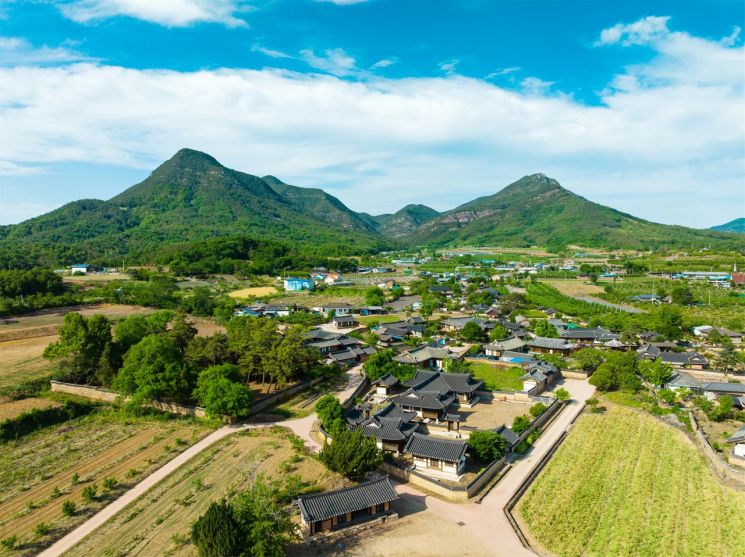
The newly certified Uiseong National Geopark corresponds to the Gyeongsang Basin, the largest Cretaceous sedimentary basin in Korea. It covers an area of 1,174.68 km² and includes 12 geologically significant sites with high academic value, such as Geumseongsan Mountain, Jeori Dinosaur Footprints, and Uiseong Stromatolites.
Additionally, Mungyeong City, rich in internationally and nationally valuable geological, historical, and cultural heritage such as trilobite fossil sites and Mungyeong Saejae, has been evaluated as having sufficient conditions to be a National Geopark and was selected as a 'National Geopark Candidate Site.'
After being selected as a candidate site, the final decision is made through a request for National Geopark certification within two years and the review and resolution of the Geopark Committee.
Furthermore, the 'Gyeongbuk East Coast National Geopark,' covering an area of 2,261 km² including the coastal area of the Gyeongbuk East Coast and part of the Nakdongjeongmaek Range, is evaluated as the optimal site to identify geological characteristics from the Paleozoic to the Neogene period and is challenging for UNESCO Global Geopark designation.
Gyeongbuk Province plans to submit a letter of intent for the 'Gyeongbuk East Coast UNESCO Global Geopark designation' to the UNESCO Korean Committee by the end of this month, proceed with full preparations, and then submit the application for Global Geopark designation to UNESCO by November this year.

Afterward, by April next year, UNESCO will conduct a document review, followed by a five-day on-site evaluation between May and August. A preliminary result regarding the designation will be announced in September through the UNESCO Geopark Committee review.
The final designation approval will be decided by the Executive Board resolution at the UNESCO Spring General Assembly held in Paris, France, in May 2025.
Cheongsong, designated as a UNESCO Global Geopark in 2017, underwent its re-designation evaluation, which was postponed by about two years due to COVID-19, last September.
As a result, on the 9th of this month, it received re-designation approval from UNESCO, maintaining its status as a UNESCO Global Geopark until the end of 2024.
Choi Young-sook, Director of the Environment and Forestry Resources Bureau of Gyeongbuk Province, said, “We will continue to support the expansion of National Geopark certifications and Global Geopark designations within Gyeongbuk Province.” She added, “By utilizing the geopark system, we will widely promote the excellence of Gyeongbuk’s natural landscapes and heritage and contribute to a new leap forward for Gyeongbuk after COVID-19.”
© The Asia Business Daily(www.asiae.co.kr). All rights reserved.
![Clutching a Stolen Dior Bag, Saying "I Hate Being Poor but Real"... The Grotesque Con of a "Human Knockoff" [Slate]](https://cwcontent.asiae.co.kr/asiaresize/183/2026021902243444107_1771435474.jpg)
















