The European Union (EU) has decided to impose restrictions to prevent companies within the region that possess sensitive technologies such as advanced semiconductors from making excessive investments in third countries. The EU also plans to strengthen export controls on product groups that could potentially be used for military purposes and actively respond to issues of key regional companies being acquired by third countries.
On the 20th (local time), the European Commission announced that it had adopted the "European Economic Security Strategy," which centers on these points, during its weekly College of Commissioners meeting.
The EU plans to initiate discussions and legislative work to promote policies starting with the adoption of this communication. Specific discussions are expected to take place at the EU summit scheduled for the end of this month. However, the communication itself does not have legal binding force.
Among the 14-page communication released that day, the most notable part suggested regulations on "overseas investments" by companies holding sensitive technologies. The Commission stated that it will closely cooperate with member states to investigate potential security risks arising from (EU companies') overseas investments and plans to establish a consultative body composed of experts from each country for this purpose. Examples of sensitive technologies include quantum technology, advanced semiconductors, and artificial intelligence (AI).
It further stated that based on the investigation results, possible measures to address security risks related to overseas investments will be reviewed by the end of the year. This is interpreted as an intention to curb investment activities such as regional companies possessing related technologies or products building factories in third countries to reduce labor costs.
Export controls to prevent the overseas leakage of "dual-use" product groups that could potentially be diverted for military use were also announced. The Commission emphasized, "Strengthened cooperation (among member states) is required to prevent the leakage of sensitive emerging technologies, including dual-use products." To this end, it said it would review new proposals to fully implement existing export control regulations related to dual-use items and ensure their effectiveness.
Additionally, the EU plans to strengthen foreign direct investment screening to prevent foreign companies from indiscriminately acquiring critical infrastructure or companies within the EU.
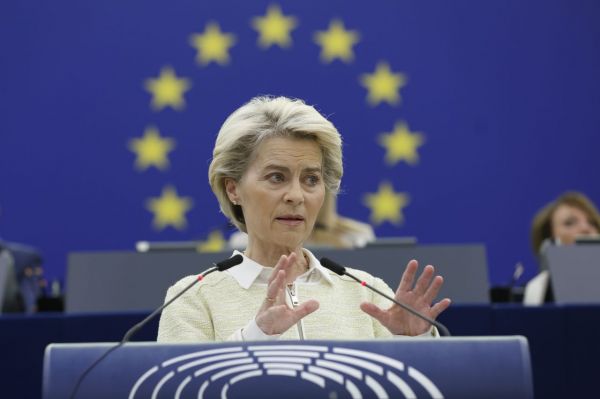
This is the first time the EU has officially pushed for the establishment of a comprehensive economic security strategy. It appears that these measures are effectively aimed at China. Earlier, Ursula von der Leyen, President of the European Commission, had announced in March before her visit to China that she would employ a de-risking strategy targeting China and prepare a new economic security strategy. However, there are still considerable differences among member states regarding the EU's approach to China, so it is expected to take some time before detailed legislation is prepared and implemented.
© The Asia Business Daily(www.asiae.co.kr). All rights reserved.
![Clutching a Stolen Dior Bag, Saying "I Hate Being Poor but Real"... The Grotesque Con of a "Human Knockoff" [Slate]](https://cwcontent.asiae.co.kr/asiaresize/183/2026021902243444107_1771435474.jpg)















