"Improving Conservative Corporate Culture"
Increasing Non-Core Interactions to Foster Talent Adaptable to Change
Recently, a trend of 'employee side jobs' has been spreading among Japanese companies. Moving away from the previous atmosphere of prohibiting employees' side job activities, a new environment is emerging where companies themselves are actively encouraging side jobs. It is being analyzed as a strategy to break away from uniform and conservative corporate cultures and to nurture talent capable of responding to various changes by expanding sales activities and outlets beyond their main jobs.

According to NHK on the 19th, Lion, a Japanese household goods manufacturer, has fully allowed employees to have side jobs for the past three years. Previously, those who wanted to have a side job had to obtain company permission, but now any employee can engage in side jobs simply by reporting it. Since the introduction of this reporting system, the number of employees with side jobs has steadily increased, and currently, about 180 employees at the company are engaged in side jobs. The age range is also diverse, from their 20s to their 60s.
Lion actively supports employees interested in side jobs. They provide guidance on talent matching projects with local small and medium-sized enterprises promoted by the Japanese Cabinet Office for those wishing to have side jobs, and also cooperate with roundtable discussions held by the in-house labor union with employees who have side job experience.
Yoko Koike, Executive Officer of Human Resources at Lion, explained the reason for allowing side jobs: "There was a strong sense of crisis about becoming a uniform organization." She pointed out, "In large companies, employees often continue working with the same values. As a result, individuals become implicitly bound by unspoken rules and become uniform. If each employee cannot perceive changes in society, they cannot keep up with the pace." Koike added, "I believe the disadvantages of not knowing the outside world are greater than the risk of talent outflow caused by permitting side jobs."
In fact, in a new business project conducted at Lion headquarters this month, an employee with a side job played an important role. A fourth-year employee in the new business development department, responsible for planning, utilized their experience in web design side jobs to take on app design and planning.
The employee said, "Until now, I was just a member of the company, but through side jobs, I gained confidence in my abilities," and added, "Now, the company is a partner moving toward the same goal." NHK evaluated this as "a new talent development strategy aimed at increasing contact with the outside world to create diverse talent capable of responding to change."
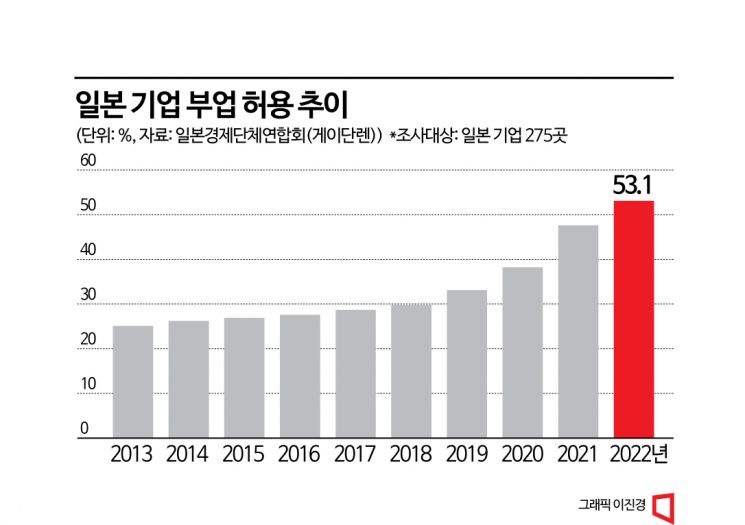
According to NHK, the number of Japanese companies allowing side jobs has doubled over the past decade. Since the Japanese government introduced provisions permitting side jobs and concurrent employment in 2017, this movement has gained momentum. Currently, more than 50% of domestic companies allow side jobs, and including those planning to allow them, the figure reaches 70%.
Of course, companies are also working hard to establish internal rules that allow the coexistence of main jobs and side jobs, concerned about labor issues that may arise from side jobs. In Lion's case, employees cannot have side jobs for the first two years after joining, and if they do have side jobs afterward, their working hours are limited to 20 hours per week.
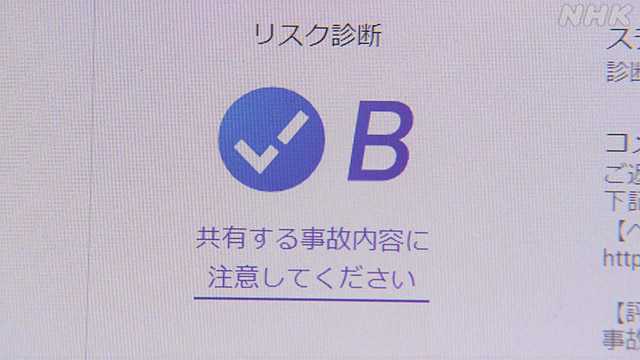 As a result of requesting a risk assessment from the 'Side Job Risk Diagnosis Service,' the risk level was rated as B. It is advised to be cautious as there have been cases where it affected the main job. (Photo by NHK)
There are even companies that provide a ‘Side Job Risk Diagnosis Service.’ When a side job applicant inputs information about the company they want to work for or the job details, the system diagnoses the risks that may affect their main job based on a database of past court cases. If the risk is judged to be high, advice is given based on actual cases, and consultations are conducted.
Kaoru Fujii, HR Editor-in-Chief at Recruit, a Japanese human resources company, said, “It is difficult for employees to have side jobs under a work style based on overtime. It is necessary to clearly design the main job’s tasks to optimize the required time and skills,” and added, “It is important for companies and individuals to move forward together rather than leaving career development solely to individuals.”
NHK added, “Until now, Japan has been a society where one employee entrusted their career to one company, and the company took care of them until retirement,” and “Through corporate movements surrounding side jobs, we can see a shift from a close relationship of mutual dependence between companies and employees to a way of keeping some distance.”
© The Asia Business Daily(www.asiae.co.kr). All rights reserved.
![Clutching a Stolen Dior Bag, Saying "I Hate Being Poor but Real"... The Grotesque Con of a "Human Knockoff" [Slate]](https://cwcontent.asiae.co.kr/asiaresize/183/2026021902243444107_1771435474.jpg)


















