Although the number of jobs in the labor market is increasing, it has been revealed that the number of young people not engaging in job-seeking activities has also grown. The most common reason given for not seeking employment was that there are no jobs that meet the desired wage level and working conditions.
According to the analysis of microdata from the Statistics Korea National Statistical Portal (KOSIS) on the 18th, the population of people in their 20s (aged 20?29) was 6,155,000 as of last month. This is a decrease of 196,000 compared to the same month last year.
Following the trends of low birth rates and aging, the population of young people in their 20s has been declining since July 2021, when it last increased by 8,000, continuing the trend of year-on-year decreases.
Accordingly, the number of employed people in their 20s last month was 3,833,000, down 63,000 from the same month last year, marking a decline for seven consecutive months since November last year. The number of unemployed also decreased by 67,000 compared to last year, totaling 241,000.
In the labor market, however, the number of "vacant jobs" is rapidly increasing. The employment rate for those aged 15?64 last month was 69.9%, up 0.7 percentage points compared to the same month last year. The employment rate for those aged 15 and over also rose by 0.7 percentage points to 63.5%, reaching an all-time high.
Nevertheless, the number of young people not seeking jobs or preparing for employment has actually increased.
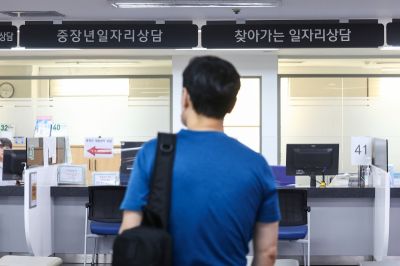
Among the youth (aged 15?29) last month, the number of economically inactive people classified as "resting" without any particular reason for not working or seeking employment increased by 40,000 compared to the same month last year. In April, this number had increased by 34,000, so the rate of increase has grown.
Among them, the "resting" population in their 20s increased by 36,000 to 357,000. Amid a declining overall population, the 20s age group is the only one, aside from those aged 60 and over, where the "resting" population has increased.
According to the Statistics Korea survey, the population is broadly divided into economically active and economically inactive groups. Those who are neither employed nor unemployed are classified as economically inactive. People who neither seek jobs nor work without any particular circumstances belong to the economically inactive population.
Looking at the activity status classification of the economically inactive population in their 20s last month, "resting" was the second largest category after attending regular educational institutions (997,000 people). This number exceeds those preparing for employment (331,000) or attending academies/institutions for employment (113,000).
Among the economically inactive population in their 20s who had the intention to work last month, the most common reason for not seeking employment recently was "because there are likely no jobs that meet the desired wage level or working conditions," with 173,000 people giving this answer.
Following this were answers such as "lack of education, skills, or experience" (169,000 people) and "because there are likely no jobs matching their major or career" (105,000 people). In contrast, relatively fewer people answered "because they had looked before but found no jobs" (23,000) or "because there are likely no jobs nearby" (10,000).
An official from Statistics Korea explained, "Young people who have failed to find employment tend to rest rather than return to job seeking." This is analyzed to be because the quality jobs young people desire do not match the level of human resources demanded in the labor market.
© The Asia Business Daily(www.asiae.co.kr). All rights reserved.

















