Starting with the drama 'Wave Makers'
In Taiwan's political sphere, an analysis suggests that a Netflix drama served as the starting point for the spread of the 'Me Too' movement.
According to foreign media including the British BBC on the 14th (local time), more than 90 Me Too allegations have been reported in Taiwan over the past two weeks. Initially centered around the political sector, the Me Too allegations have gradually spread to the medical, academic, and sports fields, creating an atmosphere where the Me Too movement is expanding throughout Taiwanese society.
Liu Wen, a social critic and PhD at Taiwan's Sinica Academia, told the BBC in an interview, "There have been individual cases related to sexual harassment before, but not on this scale," adding, "This is the first time fundamental problems across various sectors of society have been revealed simultaneously."
'Wave Makers' as the Catalyst for the Me Too Movement
 A scene from the Netflix Taiwan drama "Wave Makers." The party spokesperson (left) learns that the aide (right) was sexually harassed and shows support for him.
 [Photo by Netflix]
The Me Too movement in Taiwan was triggered by the Taiwanese Netflix political drama 'Wave Makers,' released at the end of April. The drama depicts the story of a young female aide in a candidate's campaign ahead of an election.
In the drama, the female aide confides in the party's female spokesperson about being sexually harassed by a male colleague within the party. The spokesperson responds, "We must correct this even if it means risking damage to the party," and delivers the memorable line, "Let's not leave this as it is. Otherwise, we will wither and die."
The media described this scene as "a clear signal for the Me Too movement currently sweeping Taiwan."
In fact, this line has become a slogan for Taiwan's Me Too movement.
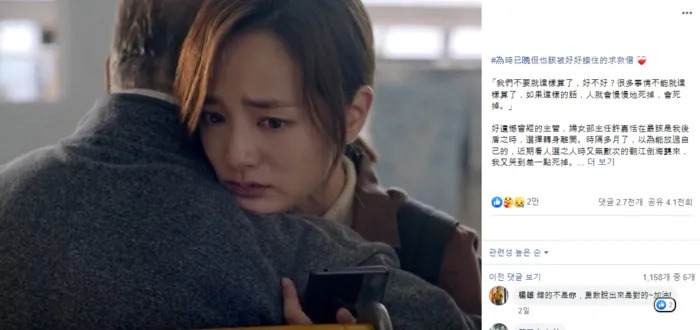 A Facebook post by a former member of the Democratic Progressive Party, which became the starting point of the #MeToo movement in Taiwan.
 [Photo by Facebook]
On the 31st of last month, a former member of the ruling Democratic Progressive Party (DPP), identified as A, revealed on Facebook that last year they reported sexual harassment within the party to the head of the DPP Women's Department (Gender Equality Department), but suffered unfair treatment and secondary victimization from the department head, who was a women's rights activist. Their post began with the drama line "Let's not leave this as it is" and ended with a screenshot from 'Wave Makers.'
This sparked a series of Me Too allegations in the political arena. Another party member working in the DPP Youth Department exposed that after reporting sexual harassment by a colleague to the youth department head, they faced unfair treatment and ostracism, eventually leading to their resignation.
Fu Kun-chi, a member of the opposition Kuomintang, was also accused of sexually harassing a female reporter in 2014.
The BBC reported, "Taiwanese people have taken pride in their culture of gender equality." Taiwan has long embraced Western-style gender equality ideals, distinguishing it from China, where premodern remnants such as foot-binding and son preference still persist.
While China has no female high-ranking political leaders, Taiwan has had a female president leading the country for nearly a decade. Additionally, women make up 43% of Taiwan's parliament, significantly higher than the global average of 29% reported by the Inter-Parliamentary Union.
Although Taiwan is progressive in terms of gender equality, the media pointed out that conservative cultural elements remain, such as victims of sexual violence hesitating to report due to fear of prejudice. Taiwanese society views the drama 'Wave Makers' as having cracked this gap.
DPP's Favorability Hits Lowest Point... President Tsai Ing-wen Issues 'Apology'
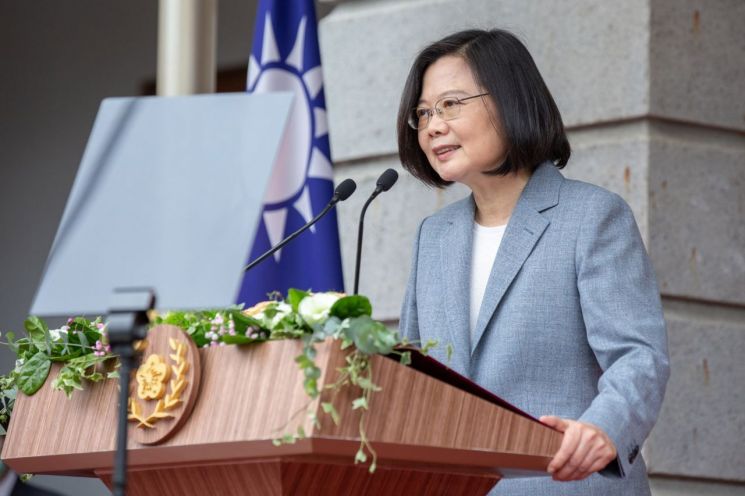
Coincidentally, Taiwan is heading toward a presidential election in January next year, just as depicted in the drama. Attention is focused on how this wave of the Me Too movement will act as a variable in the upcoming election.
For now, the DPP has taken a major hit. The party has long regarded women's suffrage, marriage equality laws, and the protection of gender equality and women's rights as core values. According to the Taiwan Issue Research Center, the DPP's favorability peaked in mid-May before the Me Too movement and plummeted to its lowest point earlier this month.
Yu Ying-lung, chairman of the Taiwan People's Foundation, told the media, "If the DPP fails to properly handle this situation, it could lose a large number of votes from young people, women, highly educated individuals, and the middle class."
President Tsai Ing-wen also expressed an apology on her Facebook as both president and DPP leader, stating, "Those who have been sexually harassed are victims and should be treated with protection, not prejudice," emphasizing, "Our entire society must educate itself again."
© The Asia Business Daily(www.asiae.co.kr). All rights reserved.
![Clutching a Stolen Dior Bag, Saying "I Hate Being Poor but Real"... The Grotesque Con of a "Human Knockoff" [Slate]](https://cwcontent.asiae.co.kr/asiaresize/183/2026021902243444107_1771435474.jpg)

















