The nationwide housing price decline narrowed for the fifth consecutive month due to market recovery expectations and the depletion of some preferred complex urgent sale properties.
On the 15th, the Korea Real Estate Board announced that according to the nationwide housing price trend survey in May this year, the comprehensive housing (apartments, multi-family houses, detached houses, etc.) sales price fell by 0.22%, reducing the decline compared to the previous month (-0.47%). Since January's -1.49% change rate, which was a smaller decline than the previous month (-1.98%), the downward trend has been slowing for five consecutive months.
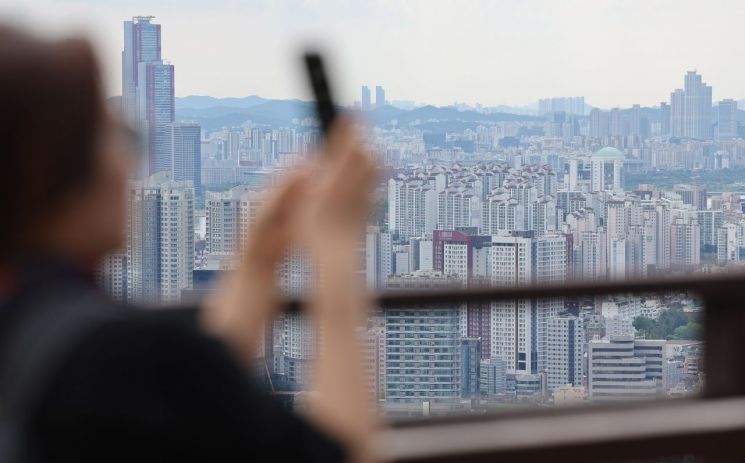
By region, the decline narrowed in Seoul (-0.34%→-0.11%), the metropolitan area (-0.49%→-0.18%), and provinces (-0.45%→-0.26%).
In Seoul, all 25 autonomous districts reduced their decline. Among them, Yongsan-gu (-0.11%→0.03%), Nowon-gu (-0.19%→0.06%), Seocho-gu (-0.02%→0.33%), Gangnam-gu (-0.06%→0.32%), Songpa-gu (-0.26%→0.45%), and Gangdong-gu (-0.11%→0.07%) turned to price increases, and Dongjak-gu (-0.04%→0.00%) recorded stability. The district with the largest decline was Gangseo-gu (-0.48%).
The Real Estate Board explained, "In Seoul, overall housing prices fell due to decreased preference for multi-family and multi-unit houses, but in some areas, listing prices rose, narrowing the decline."
Gyeonggi (-0.24%) continued its downward trend mainly in older buildings in Ilsanseo-gu, Goyang-si (-1.23%), Yangju-si (-1.16%), and Uijeongbu-si (-1.10%). On the other hand, Hanam-si (0.58%), Gwangmyeong-si (0.49%), and Hwaseong-si (0.47%) turned to price increases.
Incheon (-0.12%) saw price declines in Michuhol-gu (-0.53%), Bupyeong-gu (-0.26%), and Dong-gu (-0.13%). In areas with favorable residential conditions, urgent sale properties were depleted, leading to a 0.20% increase in Yeonsu-gu. Gyeyang-gu (0.07%) also rose due to development within the new town.
Among the five major metropolitan cities in the provinces, Daegu (-0.56%) and Busan (-0.45%) showed notable declines. Sejong (0.94%) rose for the second consecutive month.
Last month, the nationwide comprehensive housing jeonse (long-term lease) price fell by 0.31%, narrowing the decline compared to the previous month (-0.63%). Seoul, the metropolitan area, and provinces fell by 0.21%, 0.25%, and 0.37%, respectively. The Real Estate Board stated, "Amid ongoing contraction in the jeonse market due to concerns such as deposit non-return stemming from jeonse fraud incidents, Seoul saw declines mainly in outer areas and older buildings."
By district, Dobong-gu (-0.66%) saw significant jeonse price drops mainly in older buildings in Ssangmun, Chang, and Dobong-dong, and Gwangjin-gu (-0.61%) experienced large declines in Gwangjang and Jayang-dong, affected by new supply. South of the Han River, Seocho-gu (-0.58%) and Geumcheon-gu (-0.43%) declined, while Gangnam-gu (0.55%) and Songpa-gu (0.33%) rose, showing mixed trends.
Jeonse prices in Gyeonggi and Incheon fell by 0.26% and 0.34%, respectively. In the provinces, areas affected by supply continued to decline, with Daegu (-0.90%) and Ulsan (-0.69%) among those falling.
In May, the nationwide monthly rent price fell by 0.14%. In the metropolitan area (-0.16%), regional fluctuations were mixed due to the depletion of urgent sale properties and rental demand in some areas. Seoul (-0.14%→-0.06%) narrowed its decline, while provinces (-0.12%→-0.13%) saw an expansion in decline.
© The Asia Business Daily(www.asiae.co.kr). All rights reserved.

















