Handuksoo "If It Meets Korean Safety Standards, Contaminated Water Is Drinkable"
Japanese Government Logic Inadequate... Contaminated Water Discharge Controversy Continues Worldwide
As contaminated water from Japan's Fukushima Daiichi Nuclear Power Plant is expected to be discharged starting this summer, Prime Minister Han Duck-soo sparked controversy by stating that if the water meets drinking standards, it could be consumed.
On the 12th, during a National Assembly question session, when Democratic Party lawmaker Kim Sung-joo asked, "If the safety of Fukushima contaminated water is verified, would you drink it?" Prime Minister Han responded, "If the contaminated water is completely scientifically treated and meets our safety standards, it can be consumed."
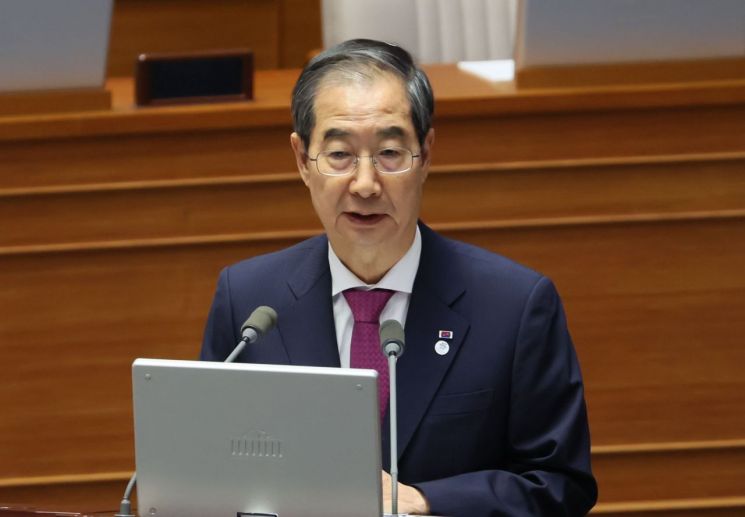 Prime Minister Han Duck-soo is responding to a question from Democratic Party lawmaker Yoon Ho-jung during the government questioning session at the National Assembly plenary meeting held on the afternoon of the 12th. Photo by Yonhap News
This statement appears to emphasize the scientific safety regarding the discharge of Fukushima contaminated water. Prime Minister Han said, "Spreading false information not based on science will make it difficult for our fisheries workers," adding, "If such content harms the stakeholders, it would not be wrong for us to criticize it as agitation."
Han is not the first to advocate the possibility of 'drinking Fukushima contaminated water' to emphasize its scientific safety. Starting with Wade Allison, a radiation and nuclear physics authority and emeritus professor at the University of Oxford in the UK, Professor Park Il-young of the College of Pharmacy at Chungbuk National University has also expressed willingness to drink it.
Professor Allison stated at a press briefing hosted by the Korea Atomic Energy Research Institute and the Korean Nuclear Society on the 15th that he would drink 1 liter of contaminated water treated by the Advanced Liquid Processing System (ALPS). He also reiterated at a meeting titled "Radiation Fear Rumors and Fukushima," hosted by the People Power Party's "Protect Our Sea Verification Task Force (TF)" at the National Assembly on the 19th of last month, "I am willing to do the same, and I can drink about ten times that amount."
Professor Park argued that the possibility of internal radiation exposure from consuming water containing tritium is low, stating, "If treated Fukushima contaminated water is brought, I would dilute it to the discharge concentration and drink it." In a post on the Biological Research Information Center (BRIC) bulletin board, he said, "Do not distort scientific matters with subjective feelings," and added, "If tritium is diluted in the North Pacific seawater to the concentration that returns to our coastal waters, it is safe to drink for a lifetime."
Professor Park explained, "If the Japanese government treats the water with ALPS and it flows into our coastal waters, there will be only a very slight increase compared to the current seawater radiation level of about 12 Bq per liter," and "when drinking 1 liter of water diluted to the discharge concentration of 1,500 Bq per liter, the effective dose of tritium inside is about one-quarter of that from eating one banana."
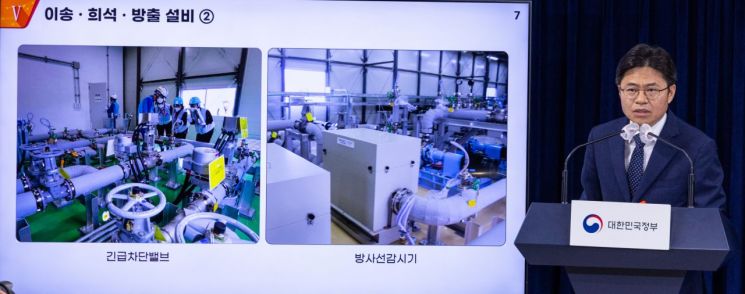 Yoo Guk-hee, Chairman of the Nuclear Safety and Security Commission and head of the expert inspection team on Fukushima nuclear wastewater, explained the results of key activities conducted by the inspection team in Fukushima and other locations in Japan regarding the Advanced Liquid Processing System (ALPS) on the morning of the 31st of last month at the Government Seoul Office in Jongno-gu, Seoul. Photo by Yonhap News Agency
Although claims continue that ALPS-treated contaminated water is safe, suspicions surrounding the water remain. Critics point out that Japan's logic is insufficient as it pushes forward with the discharge despite opposition from various countries while claiming the water is safe.
On the 3rd, Pio Tikoduadua, Fiji's Minister of Internal Affairs, publicly criticized the discharge of contaminated water at the 20th Asia Security Conference (Shangri-La Dialogue) held in Singapore. According to Japan's Asahi Shimbun, he said, "If the contaminated water from Japan's Fukushima Daiichi Nuclear Power Plant is safe, why not keep it in Japan?" and added, "If discharged into the sea, it will eventually flow southward. We are very concerned."
Hong Kong raised its voice, calling Japan's decision to proceed with the discharge despite significant international concerns irresponsible.
Che Ching-wan, Hong Kong's Secretary for the Environment, wrote in a pro-China media outlet, Ta Kung Pao, on the 8th, regarding recent cases where fish caught near the Fukushima nuclear plant contained radioactive substances far exceeding standards, stating that the discharge of contaminated water poses a serious risk to food safety and that if the saline discharge begins, Hong Kong will immediately suspend imports of some Japanese seafood products.
© The Asia Business Daily(www.asiae.co.kr). All rights reserved.
![Clutching a Stolen Dior Bag, Saying "I Hate Being Poor but Real"... The Grotesque Con of a "Human Knockoff" [Slate]](https://cwcontent.asiae.co.kr/asiaresize/183/2026021902243444107_1771435474.jpg)
















