Ministry of Unification "Actively Considering Amendments While Monitoring Constitutional Court Deliberations"
On Government Legislation Inquiry, "Nothing Decided Yet"
Some Say "Need to Revise Internal Legal Interpretation Guidelines First"
The Ministry of Unification has expressed its intention to amend the law banning leaflets sent to North Korea, derogatorily called the 'Kim Yo-jong Command Law,' but there are expectations that concrete actions will be difficult before next year's general election. This is because the Democratic Party of Korea, which forcibly passed the bill in the National Assembly, still holds the majority.
An official from the Ministry of Unification told reporters on the 13th, "Please understand the minister's remarks on the amendment of the law banning leaflets to North Korea as they are," adding that there is no set decision yet on whether to wait for the National Assembly to propose a bill or to prepare government legislation. Minister of Unification Kwon Young-se stated during the government questioning session in the National Assembly the day before, "I intend to actively consider amending the law banning leaflets to North Korea while reviewing the Constitutional Court's hearing content." This was in response to Rep. Kim Seung-soo of the People Power Party pointing out that it was an absurdly bad law rushed through during the Moon Jae-in administration, which could even suppress humanitarian activities.
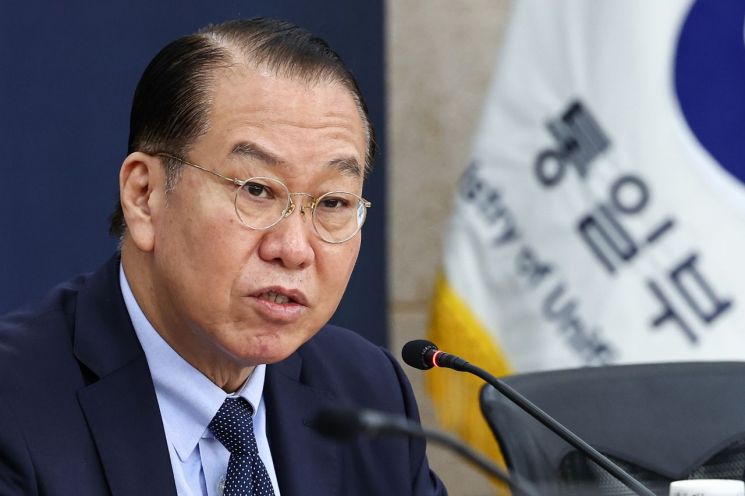
Minister Kwon has consistently expressed concerns about the law banning leaflets to North Korea, including submitting an opinion to the Constitutional Court in November last year stating that the law is unconstitutional. During the government questioning session the day before, Minister Kwon reiterated his intention to amend the law, saying, "There are problems in terms of suppressing the freedom of expression of the people of the Republic of Korea and blocking the right to know of North Korean residents, and the punishment provisions themselves also have constitutional issues."
Earlier, in April, the Supreme Court overturned the lower court's ruling that dismissed the appeal by the Free North Korea Movement Alliance against the Ministry of Unification's cancellation of its nonprofit corporation establishment permit, and sent the case back to the Seoul High Court. At that time, the court pointed out that there are positive aspects to leaflets sent to North Korea and that simple distribution does not fall under 'cases that harm the lives of citizens.' This was an indirect critique of the law's issues.
Previously, 27 organizations including the Lawyers for Human Rights and Unification of Korea (Hanbyun), the Direct Aid Movement for North Korean Compatriots, Keunsaem, and Mulmangcho filed a constitutional complaint in December 2020, arguing that the law banning leaflets to North Korea was hasty and excessive legislation. Hanbyun and others submitted opinion letters urging prompt judgment three times?in March 2021, April 2021, and January this year?but the Constitutional Court has yet to reach a conclusion.
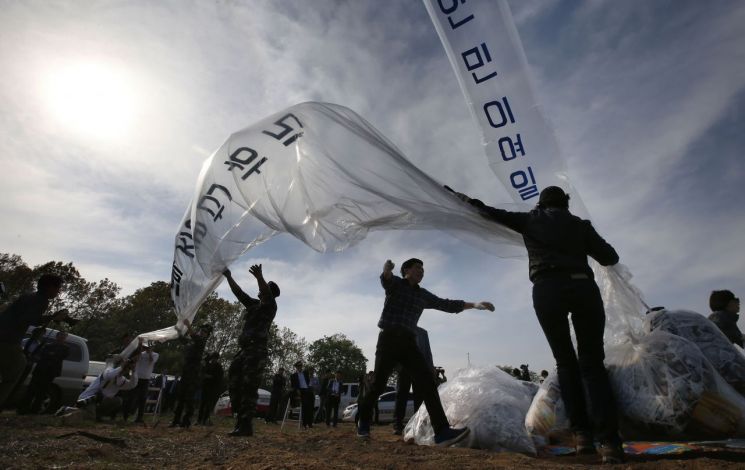
Regardless of the Constitutional Court's decision, it is expected that amending the law will be difficult before next year's general election. A government official said, "The ruling party is effectively pushing for the amendment of the law banning leaflets to North Korea as a party stance, and the Ministry of Unification fully recognizes the need for legal revision," but added, "Given the overwhelming number of seats held by the Democratic Party, even if an amendment is proposed, it is judged difficult to pass the National Assembly, so the timing is being considered."
Some suggest that the Ministry of Unification should first revise the 'interpretation guidelines' that it can modify on its own. Under the current law, areas where loudspeakers and visual media aimed at North Korea are prohibited are defined as 'the vicinity of the Military Demarcation Line,' but during the Moon Jae-in administration, guidelines were established interpreting the prohibited area for leaflet distribution broadly as 'south of the Military Demarcation Line.' In January this year, nine human rights organizations including the Korea Transitional Justice Working Group (TJWG), the U.S. Committee for Human Rights in North Korea (HRNK), Bridge UK, and Han Voice Canada sent a letter to President Yoon Suk-yeol requesting revision of the interpretation guidelines.
© The Asia Business Daily(www.asiae.co.kr). All rights reserved.
![Clutching a Stolen Dior Bag, Saying "I Hate Being Poor but Real"... The Grotesque Con of a "Human Knockoff" [Slate]](https://cwcontent.asiae.co.kr/asiaresize/183/2026021902243444107_1771435474.jpg)
















