Review Aligned with October Revision of Real Estate Transaction Reporting Act
Possible to Designate Permit Zones Based on Specific Uses in the Future
As key areas in Seoul have been consecutively redesignated as land transaction permission zones, it is anticipated that office and commercial real estate may be excluded from these regulations. In response to growing opposition across various regions citing 'infringement of property rights,' the Seoul Metropolitan Government plans to comprehensively review the land transaction permission zones in line with the implementation of the Ministry of Land, Infrastructure and Transport's amendment to the Real Estate Transaction Reporting Act in October.
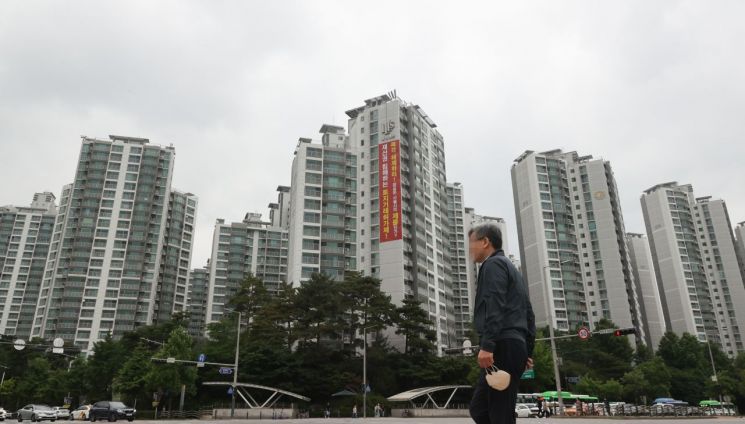 An apartment in Jamsil-dong, Songpa-gu, Seoul, with a banner urging the abolition of the land transaction permit system [Image source=Yonhap News]
On the 10th, a Seoul city official stated, "Once it becomes possible to designate land transaction permission zones by specific use, we will consider excluding commercial and office real estate that are not for residential purposes."
Recently, Seoul extended the designation period of land transaction permission zones by one year in four neighborhoods: Jamsil-dong in Songpa-gu near the International Exchange Complex District, and Daechi, Cheongdam, and Samseong-dong in Gangnam-gu. As a result, these four neighborhoods have been designated as land transaction permission zones for four years, from June 2020 to June next year.
In April, the designation of land transaction permission zones was also extended in major reconstruction and redevelopment areas including Apgujeong-dong in Gangnam-gu, Mok-dong in Yangcheon-gu, Yeouido-dong in Yeongdeungpo-gu, and Seongsu-dong in Seongdong-gu.
The land transaction permission zone system requires obtaining permission from the mayor or district office chief when trading land above a certain area. Transactions are only allowed for actual residence purposes, making gap investments involving lease deposits impossible. Residents have demanded the lifting of these zones citing infringement of property rights, but their requests were thwarted by the recent redesignations.
The Seoul Metropolitan Government maintains that this is an "unavoidable measure to prevent overheating in the real estate market."
However, following the amendment to the Real Estate Transaction Reporting Act in April, which allows designation by specific use and land category starting October 19, the city added a caveat that a comprehensive review of the land transaction permission zones will be pursued.
Consequently, expectations are rising that commercial and office real estate may be excluded from the land transaction permission zones. Real estate of these uses is primarily traded through leasing, but under current law, within land transaction permission zones, only official residences, dormitories, and neighborhood living facilities of types 1 and 2 (commercial buildings) can be leased. Moreover, one of the main objectives of these zones is 'housing stability for actual demanders,' so raising barriers to commercial and office real estate transactions has sparked significant opposition.
Calls for deregulation of commercial and office real estate have been consistently raised. Recently, Yook Kyung-jun, a member of the People Power Party, met with Seoul Mayor Oh Se-hoon and argued, "Commercial buildings should be excluded from the land transaction permission zones," stating, "The designation of permission zones has rapidly suppressed transactions of commercial and office real estate such as shops."
© The Asia Business Daily(www.asiae.co.kr). All rights reserved.
![Clutching a Stolen Dior Bag, Saying "I Hate Being Poor but Real"... The Grotesque Con of a "Human Knockoff" [Slate]](https://cwcontent.asiae.co.kr/asiaresize/183/2026021902243444107_1771435474.jpg)















