December 12-21 at Taehwalu Wall Colony Area
Ecological Explanation · Instant Photos · Making Circular Badges
A ‘Koelreuteria paniculata’ flower observation site will be operated around the Taehwagang River area in Ulsan.
On the 9th, Ulsan City announced that, in cooperation with the Taehwagang Ecotourism Council, it will operate the ‘Koelreuteria paniculata Flower Observation Site’ at the south wall of Taehwaryu from the 12th to the 21st.
Here, a natural environment interpreter will be stationed to explain the ecological value and significance of the natural colony of Koelreuteria paniculata at Taehwaryu, and visitors can also observe the fruits called yeolmaeggwali and the black seeds inside them.
Additionally, visitors can take instant photos with the Koelreuteria paniculata flowers as a background to capture memories, and circular badges using photos of the Taehwaryu Koelreuteria paniculata flowers will be made.
The Koelreuteria paniculata growing naturally under Taehwaryu consists of a total of 18 trees and has been designated as a protected tree (2009-4) by Jung-gu Office in November 2009 and is being managed accordingly.
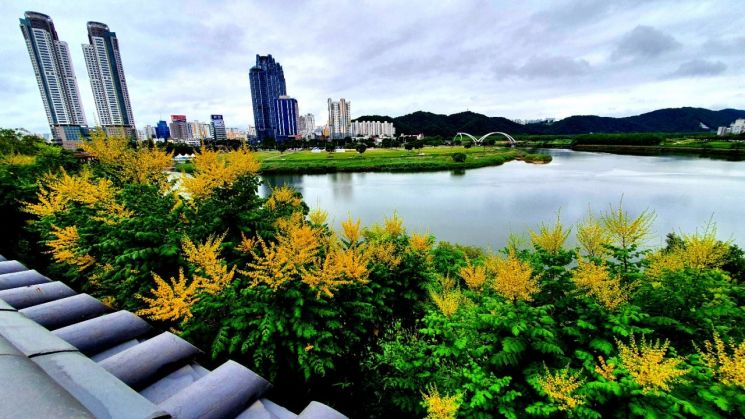
Koelreuteria paniculata belongs to the Sapindaceae family and is native to China. It is a rare tree that grows in Korea, China, and Japan. It is resistant to seawater and wind, mainly growing on seaside cliffs, and thrives even in harsh environments such as rocky or cliff-like dry areas. It is widely planted as a park tree and street tree.
Major natural habitats in Korea include Anmyeondo, Taean-gun, Chungnam; Balsan-ri, Nam-gu, Pohang; and Daemun-ri, Gunoe-myeon, Wando-gun, Jeonnam, most of which are designated and protected as natural monuments.
In early summer, yellow flowers bloom, and from a distance, they look like golden droplets of rain hitting the ground, which is why it is called the ‘Golden Rain Tree’ in English.
It is a ‘melliferous plant’ that attracts bees due to its abundant nectar, and its fruits ripen in October and are sometimes used to make prayer beads, hence it is also called ‘Yeomjuna-mu’ (prayer bead tree).
An official from Ulsan City said, “The Koelreuteria paniculata flowers growing naturally at Taehwaryu, a scenic spot within the Ministry of Environment-designated Taehwagang Ecotourism Area, further enhance the ecological tourism value of the Taehwagang River.”
© The Asia Business Daily(www.asiae.co.kr). All rights reserved.
![Clutching a Stolen Dior Bag, Saying "I Hate Being Poor but Real"... The Grotesque Con of a "Human Knockoff" [Slate]](https://cwcontent.asiae.co.kr/asiaresize/183/2026021902243444107_1771435474.jpg)















